
Myths that Can Be Bought Are Never Ones to Live: Moods, Myths, and Emotions

I was visiting friends in the town of Woodstock, NY. I could feel the town not only in my memory but in my bones. It was that visceral. I’d been visiting there for years. And it wasn’t about the music festival. The visceral feeling I had was very different from drugs, sex, and rock ‘n’ roll. In1969, I was in Sierra Leone, West Africa, in the Peace Corps and didn’t attend the festival.


I did go to a festival a year or two later, to see Joe Cocker. I also went to Woodstock to stay in a Tibetan Buddhist Monastery for a few days. I went there to climb a mountain nearby, to visit a native American site, and a Zen Monastery. And then friends began moving to the area.


And now I notice that whenever I visit, or wherever I walk in the town, I am engulfed in a mood, and expectation. Except for when I see my friends, everywhere I look, everything I see—the mountain just out of town, the central square, the tourist shops, bookstores, art galleries are covered by some deep-seated sense of a reality originating somewhere beyond sight; it’s more of a walking myth than a touchable reality.


And it’s clear that nothing I touch can live up to that myth. That’s one nature of a mood, and myth. They don’t fit into normal boxes. A mood sets the tone for emotion and actions. According to psychologist and pioneer in the study of emotion and facial expression, Dr. Paul Ekman, moods “lower the threshold for arousing” emotions. They set us up, ready us. Think about a time you were in an irritable mood, for example, and how ready you were to get annoyed, or angry. We pick from the world whatever will call forth the anger, or depression, sadness, frustration, inadequacy, etc. and we become less willing and able to stop the emotion.


If we’re in a “good mood,” or we feel open, then euphoria, joy, insight all might come more readily. Emotions are more short-lived. Moods can go on for much longer, for hours, maybe on and off for years.


Ekman asks, what brings forth a mood? One source can be physiological changes. For example, lack of sleep or food can make our children, or us, cranky. Sometimes, lack of sleep can also do the opposite. We get out of bed in the morning, and our cat or dog sees us, rolls over onto its back, shows us it’s belly, and puts its paws behind its ears. And we start laughing crazily.


But Ekman also speaks of dense emotional experiences, ones of high intensity, and often repeated, as causing a mood. For example, someone insults us, repeatedly, and a mood forms around the person and the place we experience them. And if we don’t get the chance to fully respond to the communication or provocation, to honestly express our emotion or to fully experience what we needed, there’s more of a chance a mood might develop. And we no longer see the person and place as an immediate, alive presence. Our freedom of mind, of action can be narrowed or lost. I remember as a nine-year-old having to harden myself in preparation for rebuffing the efforts of another student to insult or make me look foolish and hide my fear. It didn’t take long before the sight of the schoolroom began to evoke a mood of threat.


And this fits the myth of Woodstock. My visits to monasteries were short. I never stayed for a long enough session to fully grasp the meaning of the place, its teachings and practices. The experience was just a hint, a mere taste. A bell was rung but never allowed to ring in me. And now I enter a store and have an expectation of finding a book that will reach deeply into my heart or provide me with what the monastery promised. A mood can narrow our mind or remind us of expanded visions we haven’t yet seen. Stores sell myths; but myths that can be bought are never ones to be lived.


One day during our recent visit, my wife and friends went off shopping for flowers and I was alone. I went down to a stream in a wooded area, sat on a chair someone left on the rocks probably for just this purpose, and meditated. I started by counting my breaths; but once focused, I let go of the counting and just listened. Cars and trucks were passing by on a road nearby. There was this constant, steady, almost humming sound, which, as my mind quieted, was recognized as the stream speaking. And so many birds. So many I hadn’t heard until then and didn’t name until later– crows, robins, nuthatches, the harsh, loud voice of a pileated woodpecker. The quieter I was, the more I heard. And the less– no more myths or moods. No more getting lost in thoughts and memories….


*To read the whole post, please go to The Good Men Project.


When All that Remains of Me is A Deep and Gentle Laugh

It was about 9:00 am. I opened my eyes and got lost in colors and sounds, some of those sounds soon becoming voices. The voices were possibly from outside the house or inside, outside my head or inside a dream. They were just sounds, with a hint of something familiar. And I was just there, listening; listening to everything, and not wanting to do anything but lie there in the easy tired warmth that can come at the end of night.


I remember one time sitting with one of my cats. She gets so happy she almost talks, her words a language of cries, snorts, and kneading of the blanket. It’s a language I of course didn’t totally understand, but I get the drift. She also loves to rub noses, which always evokes a deep smile in me. I feel so full in her presence that all that remains of me is a deep and gentle laugh.


In both instances, I’m right there. But let’s say I want to tell someone about it. I get an urge to write this blog, for example, to talk about my funny cat or my taking refuge in the deep comfort of a warm morning, and I lose it. To write about her, I need to step out of my deep loving laugh as a snorting cat and look at me thinking about, and distinct from, her. But I guess writing can be another way to feel full or immersed, another sort of magic.


I was reading Zen master teacher Dainin Katagiri’s book, You Have to Say Something: Manifesting Zen Insight. He talked about there being a subtle feeling that exists before we decorate, expand, separate from or bury it with words. Before we move to approach, avoid, or stay still; before like, dislike, or feeling neutral arises. There’s a subtle state, he says, that we usually zoom right past. In that state, there’s “a oneness of our feeling with the object of our feeling.” A oneness with no sense of someone looking at it, no impulse to speak about it. His words shook me up and felt so alive and fresh. But as soon as I wrote them down

that life of meaning disappeared.


Back in February, I wrote a blog about re-discovering a leonine version of a Teddy Bear that I was given back when I was 5 or 6 and now lives on the back of the couch in the den of our home. That lion has seen so much of my life.


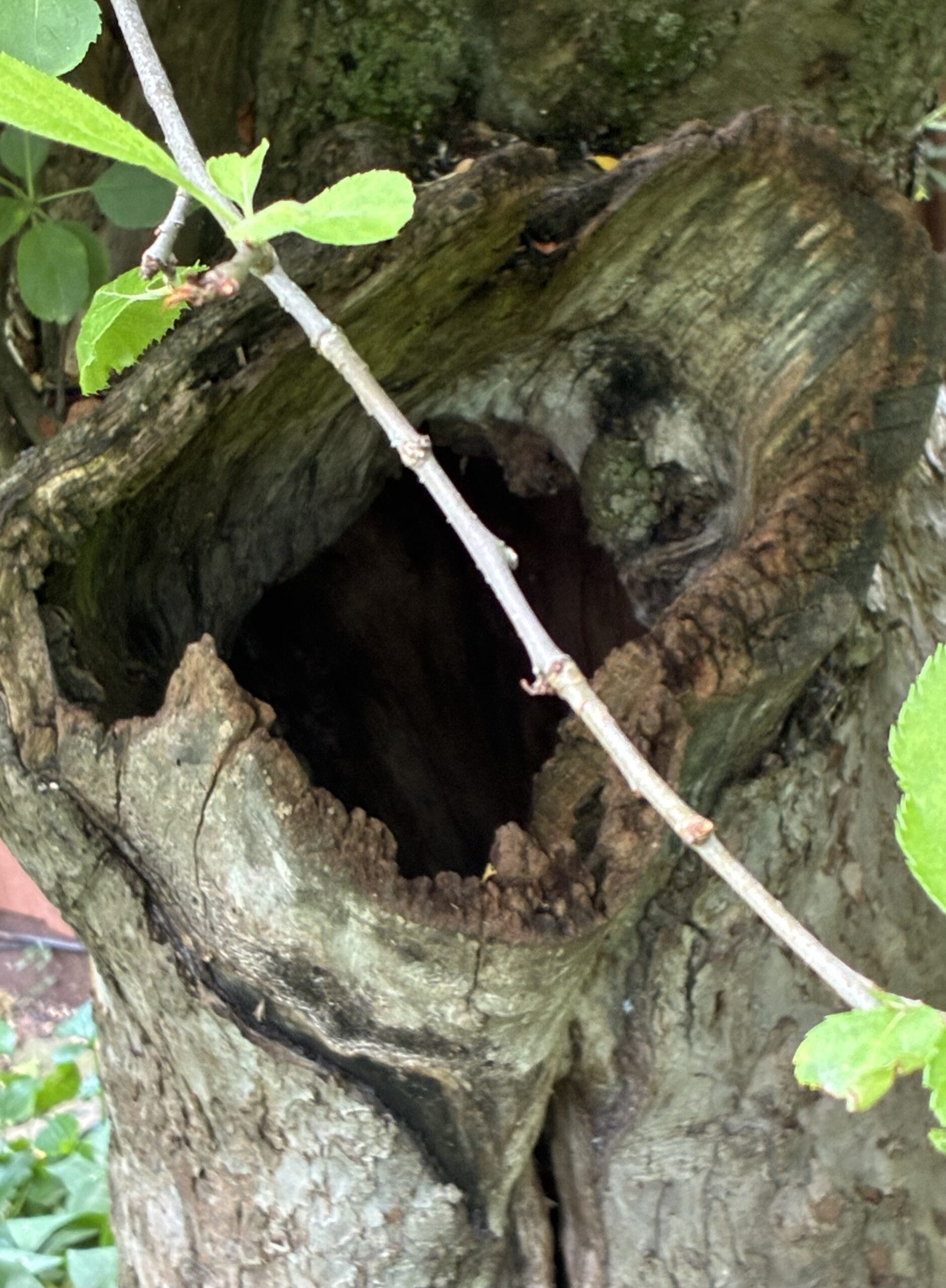
I look out my window at an apple tree that has been living outside our front door since we first built that door in 1972. That tree is so old, and so many limbs have fallen off, that what remains is a shell of what it once was, hollow, seemingly held up only by history and memories. And that tree goes back to other trees, a maple that had once lived in front of my ancestral home in Queens, NYC, back to when I was gifted with the lion. It goes back to pre-school, to a drawing of a tree that was used to formally teach me the word. It goes back to when I first spoke any word, probably MamaMama maybe being the root of all words. It goes back to ancient Sumeria and the roots of written language. It goes back to prehistoric caves like Lascaux in southern France and maybe the first symbolization. It goes back to the first humans or first hominids or first creatures to draw a breath. Or back maybe to the wind.


The tree isn’t me. Yet, without me and my wife and cats, who would know it, enjoy it, tell stories about it?  When I see it, a universe of me can appear….


*To read the whole article, please go to The Good Men Project:

If We Can’t Be Silent, How Then Can We Hear Deeply? Expecting God to Send a Text

How often do we look up to the sky, or sit at our desk or in our bed, and we ask a question, or want to, of a God or the universe?


We want the universe to be like AI, or social media. Or we want God to speak at the other end of a text but never get Her, Him, It, or Them. Or we want a voice in a cloud to speak to us, in English or whatever language we prefer. Or maybe we engage in one of those conversations with ourselves that so occupy our time, and we divide ourselves in two, into a questioner and a responder, but all we get in response is a repeat of something old and familiar. The universe then feels silent to us, even empty. Oh, or something happens to us, and we think the universe is sending us the event as a message.


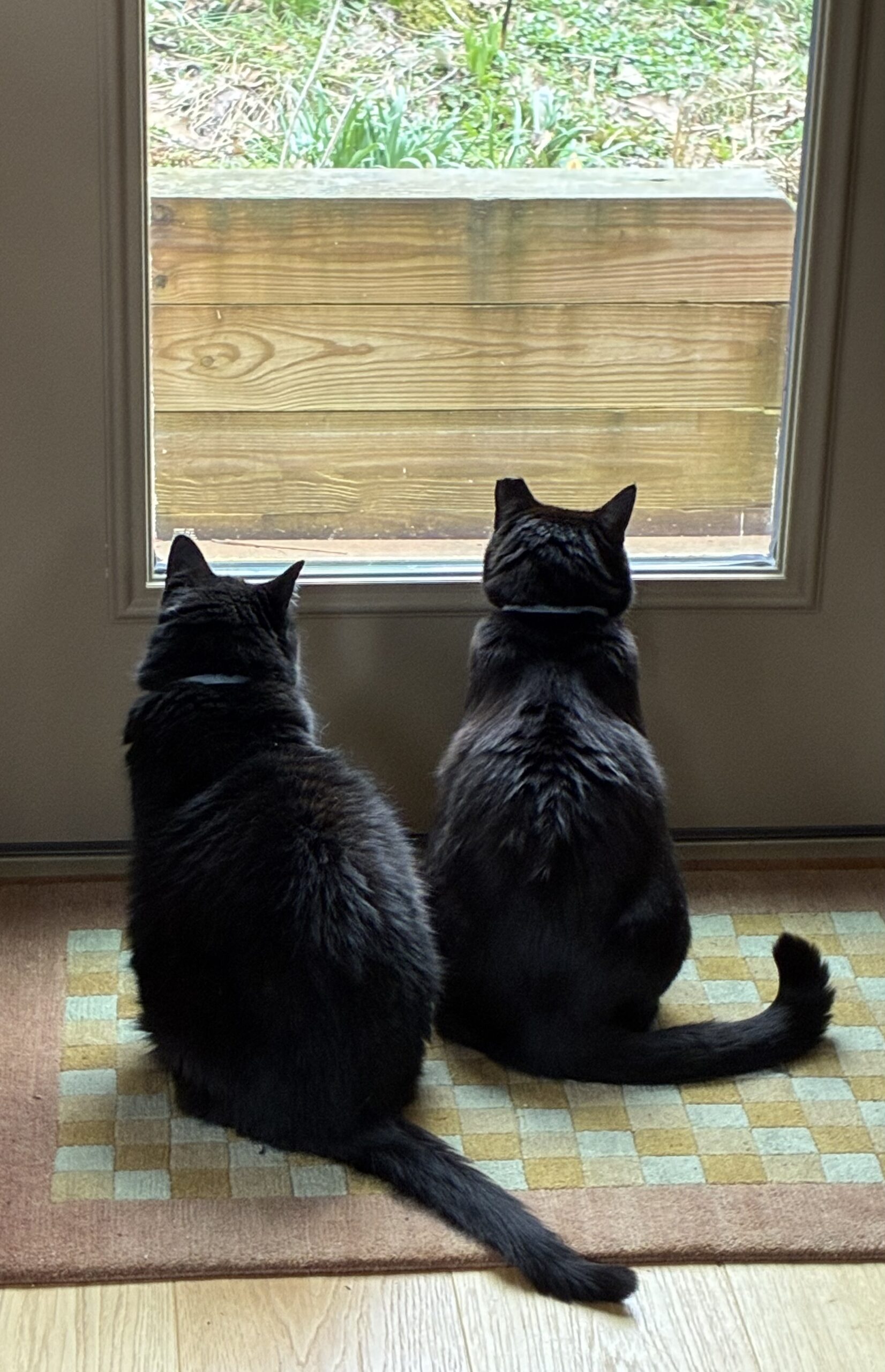
As I was thinking about this, one of my cats, then another, went to the glass outer door in my den and intently stared out the window. One, our girl, looked slowly from side to side, as if following something, while the other stared straight ahead. I don’t know if it was her eyes that were tracking something, or her hearing, but whatever it was, it was invisible to me. They were both seeing with more than their eyes. There was no distraction for them from looking, just attention.


Maybe the problem is in where we look, or how we ask. In Exodus 3:1-6 God says to Moses, from a burning bush, “Moses, Moses! Here I am.” Or in the 1950s classic religious movie, The Ten Commandments, Charlton Heston stands over the Red Sea, parts his arms, and speaks “Behold His mighty hands.” And God answers by parting the sea. Maybe we’d like such a clear and dramatic response, but it’s a bit much to ask. I’ve never personally seen seas parted by command or heard God’s voice in a bush.


Maybe we expect the answer to come in a certain way, and the expectation blinds us to the answer. We might look, for example, outside ourselves, or to some authority or a defined being not ourselves. Or to the thoughts and images in our minds, not the feelings and sensations in our bodies.


Maybe we’re hearing the speech of the Burning Bush wrong. Maybe, as some scholars say, we could hear God’s “Here I am,” as “Look Here;” see all this, see this right here.


Describing Buddhist practice in his book, You Have to Say Something: Manifesting Zen Insight, Dainin Katagiri, a central figure in the early transmission of Buddhism to the US, says that to truly see a teacher, or see anybody, you cannot maintain an expectation of a certain response. If you have a preconceived idea of a meeting, there’s no meeting.


We often create such noise in ourselves. We know this. We know people who can’t stand silence and constantly play the tv or listen to their earbuds or search social media and suffer from FOMO. The world right now is bad enough, so terribly frightening. So, silence, if we can hear it, can be so healing. We need to give ourselves a break, a pause, a bit of kindness. If we can’t be silent, how can we listen deeply?


Maybe we’d hear more if we asked ourselves a question and then just listened, listened not just to words, but to the entirety of the moment when we heard the question in ourselves? We ask and then feel the asking. Maybe then we’d hear our own mind more clearly….


*To read the whole article, please go to The Good Men Project.
 

Studying the Space-Time Continuum: Maybe Time Can Reveal the Timeless, Our Limits Can Reveal the Limitless

Traveling can do so much for us. So many people have written about how much they learned from other cultures, and themselves, by leaving behind the known, the culture they grew up with, and immersing themselves in another place. I love listening to Travel with Rick Steves on NPR, or reading travel books by Pico Iyer. When I was in College, I took 4 months to hitch-hike through Europe. It was one of the most formative times in my life. Same with being in the Peace Corps in Sierra Leone, hitch-hiking across the US, traveling with my wife for a month in Greece. But since COVID, I haven’t traveled very much.


And it’s not just that we learn from where we arrive. We can learn from the mere fact of moving from place to place with awareness.


We frequently get caught up in one place or way of doing things. We look out the window of our home, maybe into a garden, street, or city. Maybe we enjoy it, maybe not. But we create a momentary identity space. And then we might lose touch with how the yard or garden spreads to the hills beyond it, or to the street and the city, or neighboring nations.


I walk almost every day and pick a route, places to go and see, but really, I could go almost anywhere. I’m limited only by my concept of what the walk should be. Our ideas about what we’ll meet on the road can limit how and what we greet.


There’s space, miles, and there’s time. We might want to go someplace. Go to a doctor, visit a friend. And we want to be there now. We want to “cheat” space by speeding through time, by driving faster, or diverting ourselves with music and podcasts as we move, so we don’t feel “are we there yet?” Driving can be a good time for music and such. But time and space, as Einstein and others have shown, cannot be separated.


Buddhism and other spiritual and philosophical approaches share a similar perspective yet turn it in an engaging direction. They remind us change is constant and everything impermanent. Dogen Zenji, a Japanese Zen teacher, poet, and philosopher said we, all things, are time. “Time itself is being.” “The time we call spring blossoms directly as an existence called flowers.” In this moment, I am dependent upon and enmeshed with all beings in all time.


Driving, or that time in the airport or those minutes in a subway, can be a great opportunity to learn from others. By being mindful of our feelings, we learn an important lesson about ourselves and how we experience time. Of course, what we learn traveling we can learn anytime we pause to study ourselves. But traveling makes time and change so obvious.


Dogen said, “Do not think that time merely flies away…If time merely flies away, you would be separate from time.” Imagine driving a long distance. Just a few weeks ago, my wife and I drove 8 hours to visit my brother and sister-in-law. And I noticed the obvious⎼ when we’re driving, we’re always moving. Then we stop, get out to pump gas or go to the bathroom. And internally, we’re still on the road; or still focused on a destination other than where we are. So, when we stop, it takes effort to feel that moment in that space. We’re not fully alive to where we are.


We often mentally limit ourselves to what’s within our skin or conceptual border, so everything else is considered outside us. Our culture trains us in such limitation. It also trains us to think of time as moving in a linear fashion abstracted from us and the rest of existence. This exaggerates the borders or spaces between us, and between here and there. Yet the universe is open. We have to re-train ourselves, so even the limits are ways to touch the limitless….


*To read the whole piece, please click on this link to The Good Men Project.


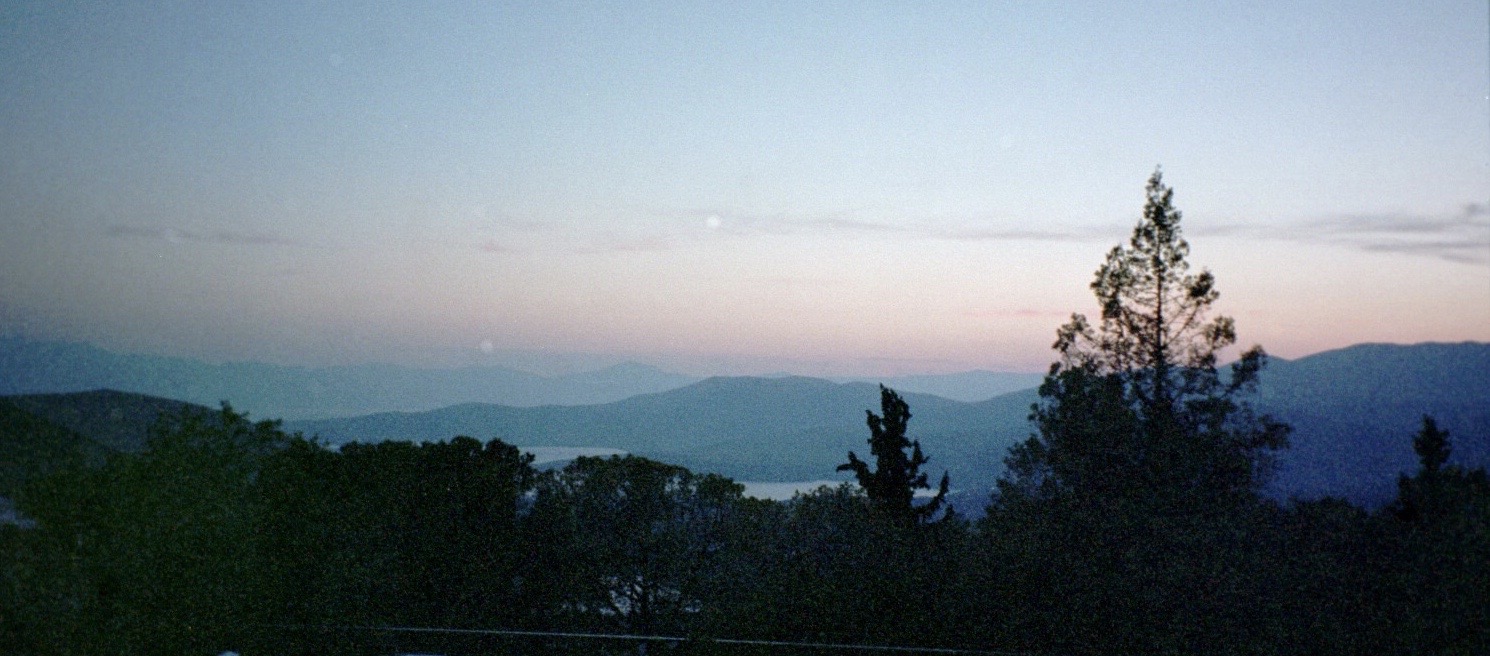
**The photo is from Delphi. Greece.

Window Watching and Sky Gazing: Attention that Heals

It’s been hard for so many people to get a good sleep at night lately, or to feel at ease during the day. I still wake up 3 or more times a night, mostly for issues common to aging, although there’s nervousness about all the threats in our world today lurking in the background. But how we respond to any event, and the quality of attention we give each moment, shapes the quality of our life overall.


A few weeks ago, I wrote about waking up in the middle of the night and noticing the beauty of moonlight outside my very rural home. Or of distant city lights etching tree limbs against the gray sky⎼ or turning parked cars into mysterious, almost animal shapes. And I’d like to report that when sleep is interrupted and I do this looking-out-the-window practice, intently looking for the beauty that is there, my nights have been more engaging. I’ve become a connoisseur of darkness, a night watcher studying what is seen.


I look forward to the moment of looking. And even the pain and other issues that wake me have become more interesting⎼ or less annoying. Even my dreams have taken up this practice. Last night, my dream-self said that instead of window washing, I was window watching.


And I’ve become a night listener. Like a bird watcher searching for a rare bird or one we love, we can listen for any rare sound to focus on for study. There are few loud sounds at night near my home. Yet, no matter where we live, we can listen to the sounds of the neighborhood, the city, or the forest, for example, as if there was a concert going on outside the window. Or we can listen for trees bending, people talking, cars honking, or leaves spinning in the wind. We watch and listen for the beauty, for patterns, for interconnections.


We can do this not only at night, but all through the day. Sleeping and dreaming help us integrate one day’s thoughts and happenings into a fresh, new morning. The past creates the ground of the present.


Of course, at night, sometimes there is no moon or distant city lights, and our windows become holes into nothing. I like that less, but can study how even emptiness, and my not liking, feels. We often imagine nothingness as a distant event, or thing. But what are we seeing when we notice a hole in our knowing now?


We can also watch the sky during the day. Many of us continually look down, narrowing our attention and reinforcing self-concern. Looking up and out into the distance can spread our awareness, open us up, let us take in more.


One of my favorite books is the classic Zen Flesh, Zen Bones: A Collection of Zen and Pre-Zen Writings, compiled by Paul Reps and Nyogen Senzaki. The first story in the collection is about a university professor visiting a Zen Master named Nan-in. The professor could be anyone full of their own opinions, and sure that what they think is true is the one and only truth.


The professor asks Nan-in about Zen. In response, the Master invites the professor in for tea. After they sit and the tea is ready, Nan-in pours the visitor’s cup full and keeps on pouring. The professor gets nervous while watching and exclaims, “It’s overfull. No more will go in.”


You, too, are overfull⎼ of opinions, not tea, says Nan-in. “How can I show you Zen unless you first empty your cup?”


It’s not just when or where we look, but how. …


*To read the whole article, please go to The Good Men Project.

The Language of Moods: Tuning Our Ears to Hear the Heart of the World in Our Heart

When I was 19 and deeply involved in trying to figure out who I was, I heard a lecture by the philosopher of eastern religions, Alan Watts and read several of his books. He helped change how I felt about life.


When I thought ahead to the future, it seemed so big. A vast number of days, and a huge weight to carry. So many questions: how do I decide on a career? What should I do with all this time I have? How can I do some good? Thanks to Watts and others, especially to a few inspiring teachers, instead of a life of tasks and burdens mixed with occasional pleasures, I began to see depth and beauty; began to realize how my own response, attitude, and openness shaped the reality I experienced.


Three books by Watts stand out for me. The first: The Book: On the Taboo Against Knowing Who You Are. The second: The Wisdom of Insecurity: A Message for An Age of Anxiety. The subtitle of the latter book, published in 1951, is certainly an appropriate label for today.


In another book, The Way of Zen, Watts not only explains his view of Zen history and practice but introduces the reader to four different moods often found in and characteristic of Zen and Japanese arts. It was a new thought for me that a philosophy could be expressed in a few distinct moods. These moods are, in Japanese, sabi, wabi, aware (a-wa-re), and yugen.


Understanding these moods can reveal unexpected ways to live life more directly and skillfully. The Way of Zen describes how the arts can be a way of practice and gives examples of poetry brewed in the four moods. Especially in these troubling times, when I read these poems, my mind and heart settles and comes alive. I discern better how to respond with strength even to the toughest situations and feel appreciation and gratitude for so much I have been given. These moods also reveal different ways and stages of meditation practice.


When we look at the breadth of the future, we can get lost. To make a decision, it helps to feel the truth of what is in and around us. There isn’t an infinity of moments ahead of us, only one.


As much as I understand it, Sabi, according to Watts, is when we get quiet and feel detached from our usual concerns⎼ worries, social media, plans, and expectations. Silence is not the absence of sound or thought, but being present, not judgmental or grasping, to sound and thought. We focus, for example, on one breath at a time, one place, one thing. We can see anything or “all things as happening ‘by themselves’ in marvelous spontaneity.” The poet, translator, Lucien Stryck called sabi, “…the feeling of isolation at the midpoint of an emotion when it is both welcome and unwelcome, the source of ease and unease…” It is the recognition of beauty in asymmetry, imperfection, and the yearning to go beyond a superficial understanding.


Wabi, I think, is similar to sabi. It is a sense of simplicity and purity. Watts said the mood can arise when we feel sad or depressed and we notice the uselessness of much of our concerns. We catch a glimpse of the ordinary in its “incredible suchness.” The sincerity. Stryck said it is the feeling of something previously ignored now seen as precious. This very moment is all we have. The ordinary is no longer ordinary. The philosopher and environmentalist Henry David Thoreau spoke of being “self-sufficient with an insufficiency of things.”


It’s the simple that will save us. It has been said that we can’t take our money or possessions with us into death. We can’t take anything, except what’s in us at that moment. How can we accept this moment is gone before we even recognize it’s here? …


*To read the whole article, please go to The Good Men Project.

Sometimes, It Seems I’m Split in Two: Taking Us Where We’ve Always Wanted to Go but Never Knew We Needed to Go There

Sometimes, it seems I’m split in two. Did you ever feel that? Don’t we all at times feel divided against ourselves?


I hear a catbird complain and a cicada call out, continuously. A background concert the universe plays for me right now. Other birds join in. A car races down the road. A raven responds raucously. And I write about that. I write a blog about the comfort of nature, love, meditation, art, overcoming fear, feeling at home.


Then I hear the news, about DJT, the Supreme Court, Jan 6, new legislation in Congress, climate emergencies, people being flooded or burned from their homes. All accentuated, fueled by a warming planet that so much industry and GOP politicians want to hide from us. I feel anxious. I feel a desire to meet people and bring us together, to act, to speak. To change it all and resurrect justice. And I write about that.


And the two sides of me can feel so different, in opposition even. I feel wonderful after writing the first blog. There’s so much appreciation, gratitude, joy there. So much anxiety, worry, anger in the second. Concern. Care. I am so glad I wrote not only the first but the second blog. I feel I had to write it. There is power, strength in saying it. But it hurts.


There is care in both. Compassion. I touched on this in my last blog. They are both fueled, I realize, from the same yearning.


There are not two sides, but many. Maybe an infinite set. And maybe we always wish to be one being in agreement with ourselves, but we’re not so easy to pin down. Maybe it’s not that I’m split in two, meditative on the one hand, angry on the other. Maybe it’s just that since the universe itself is so indescribably complex, interconnected and ever-changing, it presents us with so many different faces that our face must change, too⎼ a new face with each meeting.


Sometimes, we’re just damn lucky. We see a person smile. The wind bends two trees together, so we hear them speak. Or it rains, and instead of a flood, it ends the drought, and the air feels lovely, cooling. Or we read a passage in a book, and it takes us right where we’ve always wanted to go but never knew we needed to go there. Nothing in or around us stands in our way or fights with us. We see it all up close and personal and the person we see or passage we read goes right to our heart and beats for us.


Other times, it’s more difficult to see how we and the universe fit together. But who said life would or should be easy?


In the first blog, ‘I’ disappear. It’s not just that my being at peace and yours are not separate. Looking at the tree in my front yard, hearing the catbird, the cicada⎼ that is home. It is where I live. And in the second type of blog, ‘I’ jump to the forefront clothed in fear, hurt, and pain.


Pain so easily closes us into ourselves or consists of us closed into our self. But what if we noticed some space between the beats of pain? Or we felt how much space there was around us, in whatever location or whatever room we were in? Or instead of taking in less, we took in everything? Then the pain becomes just one beat out of many, one place in a vast universe….


**To read the whole article, please go to The Good Men Project.
The Party of Hungry Ghosts: What Reveals the Origins of Our Thirst So We Find the Water that Fulfills Us

The political situation we are in today reminds me of a frightening dream I had as a teenager. I was outside, at night, on a mist-filled city street and felt something calling to me. I didn’t know what it was, but I followed it anyway to an old storefront, the kind with a door set between two showcase windows, which were empty of everything but darkness. The door was partly open, so I stepped inside.


The dark and emptiness continued inside the front room. But the call grew stronger as I walked. I followed it to an even darker back room where I could feel but could not see. And the room was not empty. The call was ringing in my mind, emerging from one corner filled with what I thought were people standing eerily still. I approached one, then another, tentatively reaching out to identify them. They were not breathing, not alive. I started searching more frantically, to find the source, the being, the life that was calling out for me.


And then I felt it, there, before me. A powerful, child-sized mannequin with a voice. But it had no head.


Teenagers can easily feel a type of solipsism, a fear that they are alone, isolated, or afraid that what they feel, no one else feels. That they are, in a way, the only human, or only human like them. Their need calls out for them, but they fear no one will be there when they respond, so they don’t. Adults can, of course, feel something similar. It is too easy to lose touch with the rest of the world.


Zen teacher Katsuki Sekida, in his classic book Zen Training: Methods and Philosophy, said we suffer when we don’t understand the reflecting action of consciousness. Although the world is always whole, never divided, we don’t always experience it that way. We first sense the world, then have thoughts about or reflect on what we sense, then reflect on reflections.


This goes on moment after moment. We reflect on what has already gone and can mistake the reflection for the reality. Consequently, we are always rushing to catch up. The reflection can be powerful; but it is so much smaller than the total reality that gave birth to it.


Out of such thoughts self-consciousness is born. Self-consciousness can mean “aware of oneself” or distant from oneself and uneasy about it. We separate the object of awareness from the act of being-aware and create this distinct being, with specific characteristics and history who has thoughts. We fashion an ego and then try to pin it down, give it life, and maintain it, but we can’t. Because it’s an apparition. It’s more like a suit of clothes we put on than the body that wears them.


One of the key battles of human history is to feel the life of the world, the life that resides in all of us. To feel that the world is alive, not dead ⎼ not a machine, not just dead matter. So much of the world breathes and feels. We struggle as a species to even feel the reality of others and thus to come alive to the reality of ourselves….


*To read the whole article, please go to The Good Men Project.


How Beautiful Is A Good Belly Laugh: We Expect a Hannibal Lecter but Instead Find Mr. Rogers

Can you imagine or remember a moment when simply looking, listening, or tasting was all you needed in life? When time disappeared and nothing else was desired, nothing was thought missing? Or when something was just so beautiful and unexpected, all you could do was smile or laugh?


In No-Gate Gateway: The Original Wu-Men Kuan, a translation of the classic collection of Koans or public records of conversations between master and student that led to enlightenment, the poet and translator David Hinton wrote “once mind is emptied of all content… the act of perception becomes a spiritual act.” It becomes selfless, simply a mirror reflecting what is there before it. Slow, respectful. Letting each thing be utterly itself. No violence is possible. No anger or let down. Closer to an act of love than anything else. Just loving by sensing.


Hinton says this perceptual clarity is a way of awakening, of seeing the world and oneself in the same instant. It is a way for one being to meet another.


Wouldn’t that be something?


We experience such moments in so many ways but lose them somehow in all the bustle of our lives. We stare transfixed at a work of art or nature or hear a song that stops all thought, or we read a poem that takes us to a new world. The beauty clears us of ourselves.


When I was younger, I hitch-hiked from New York to California and stopped at the Grand Canyon. I remember standing at the edge of it, just staring, immobile, barely breathing. From behind me I vaguely remember voices of other tourists arriving but didn’t want to turn away from the canyon. A woman I didn’t know approached closely and suddenly saw what it was all about, suddenly saw what was there ⎼and maybe what wasn’t. Whatever idea she had of the Grand Canyon was inadequate or wrong. All she said, and she repeated it over and over again, was “Oh my God. Oh my God.”


Mary Oliver, in a poem titled “Mysteries, Yes”, said:

Let me keep company always with those who say

            ‘Look!’ and laugh in astonishment,

            And bow their heads.


Or, in the poem “When Death Comes,” she tells us,

I don’t want to end up simply having visited this world.


We often expect that life will be like a shove from behind, or merely a bump. Unexpected, yet not, we are surprised and turn around with clenched fists. We build in our mind a Hannibal Lecter but instead find Mr. Rogers. Or instead of a threat or an enemy we find someone as surprised as we are. Someone who openly welcomes us with kindness. We realize the contact was an accident. And we laugh. All the tension dissolves in an instant, and butterflies fly from our mouth instead of curses. We feel delicate and open instead of iced and closed….


*To read the whole piece, please go to The Good Men Project.
Stories that Free Us from Limiting Thoughts: Turning the Best of What Might Be into the Reality of What Is

The psychologist Milton Erickson was a transformative figure in therapy, using stories as ways to motivate, change, or de-hypnotize us from hurtful and limiting patterns of behavior. When I was teaching, I used his and other stories to make a point and engage students when their attention drifted, or when they needed something real but approachable to appear in the classroom.


One example of a story I always loved was how Erickson taught an athlete to win an Olympic gold medal. This version was told by Sidney Rosen in his book My Voice will Go with You: The Teaching Tales of Milton H. Erickson.


A high school athlete named in the book as Donald Lawrence had been practicing to set a national high school record for throwing a shot put. But after a year, he could only put the shot 58 feet, way short of the record.


His father brought him in to see Erickson, who at their first meeting helped Donald go into a trance and feel his muscles one by one. On the next visit, after repeating the trance for muscle awareness, Erickson asked Donald if he knew a mile used to be four minutes long. The record had stood for many years until Roger Bannister broke the record. Erickson asked, “Do you know how?”


Bannister had realized you could win a ski jump by a tenth of a second or a race. Since a four-minute mile was 240 seconds, all he had to do to set a new record was run a mile in 239.9 seconds, or 239.5. One tenth or one half a second faster.


“You have already thrown the shot fifty-eight feet…Do you know the difference between fifty-eight feet and fifty-eight feet and one-sixteenth of an inch?” Donald said no. Erickson slowly enlarged the possibility of what Donald could do in his mind until 2 weeks later Donald set the high-school record. He went on to set more records until four years later he brought home the Olympic gold.


Erickson, says Rosen, used obvious truths to plant suggestions for personal growth. He told Donald, “You’re four years older now. It would be all right if you take the gold medal.” The first was true; the second could be true. By juxtaposing them, Erickson made the unrealized realizable, the unknown known. He demonstrated the control Donald had when he moved step by step and eliminated the anxiety that can erupt from the past. Donald was left with each moment being the first and only moment to focus on. And then he, or the real person ‘Donald’ represents, won the gold.


Likewise, each of us can be freed from many of our fears and limitations….


To read the whole article, please go to The Good Men Project.