

How often do we look up to the sky, or sit at our desk or in our bed, and we ask a question, or want to, of a God or the universe?
We want the universe to be like AI, or social media. Or we want God to speak at the other end of a text but never get Her, Him, It, or Them. Or we want a voice in a cloud to speak to us, in English or whatever language we prefer. Or maybe we engage in one of those conversations with ourselves that so occupy our time, and we divide ourselves in two, into a questioner and a responder, but all we get in response is a repeat of something old and familiar. The universe then feels silent to us, even empty. Oh, or something happens to us, and we think the universe is sending us the event as a message.
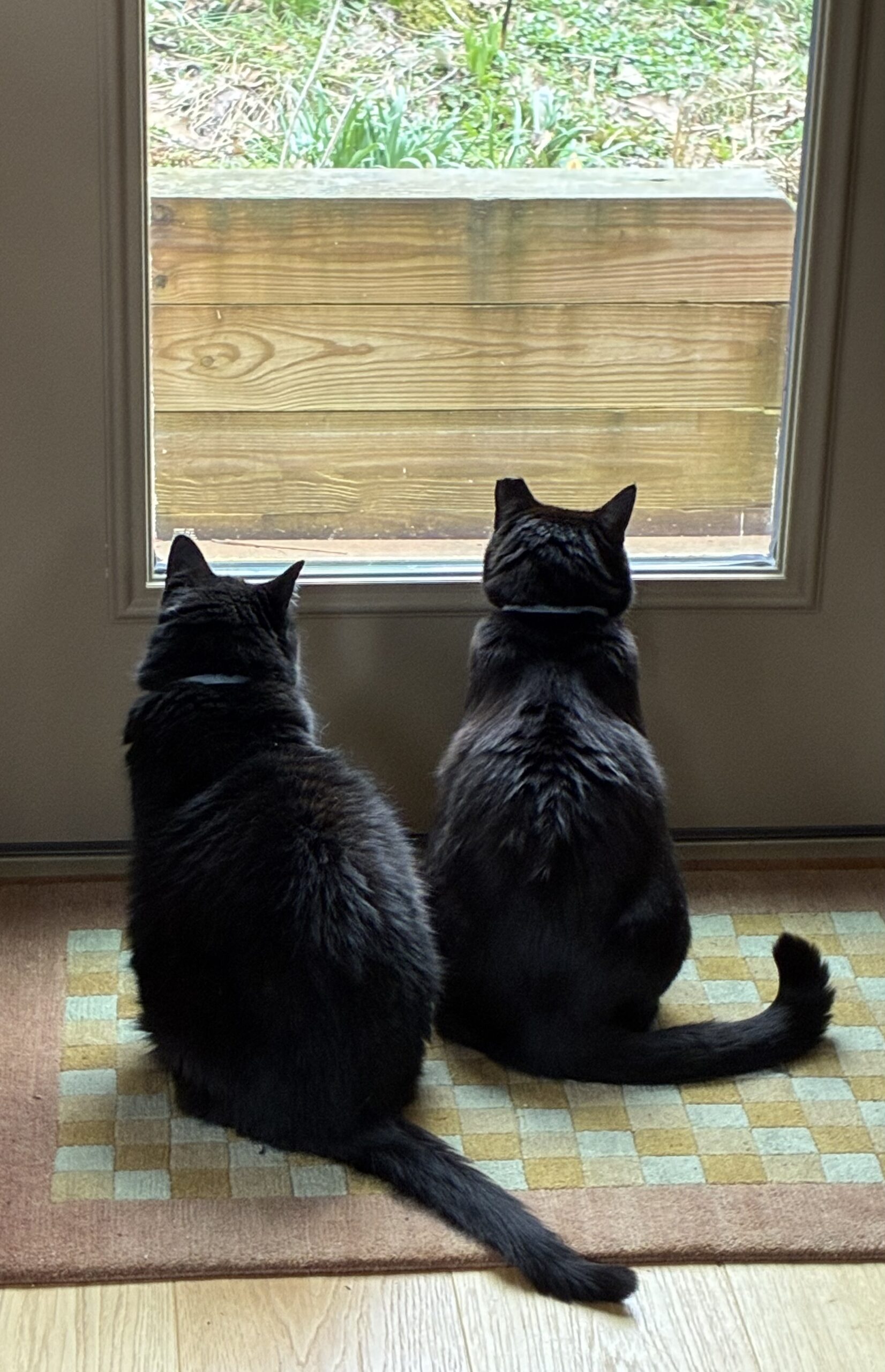
As I was thinking about this, one of my cats, then another, went to the glass outer door in my den and intently stared out the window. One, our girl, looked slowly from side to side, as if following something, while the other stared straight ahead. I don’t know if it was her eyes that were tracking something, or her hearing, but whatever it was, it was invisible to me. They were both seeing with more than their eyes. There was no distraction for them from looking, just attention.
Maybe the problem is in where we look, or how we ask. In Exodus 3:1-6 God says to Moses, from a burning bush, “Moses, Moses! Here I am.” Or in the 1950s classic religious movie, The Ten Commandments, Charlton Heston stands over the Red Sea, parts his arms, and speaks “Behold His mighty hands.” And God answers by parting the sea. Maybe we’d like such a clear and dramatic response, but it’s a bit much to ask. I’ve never personally seen seas parted by command or heard God’s voice in a bush.
Maybe we expect the answer to come in a certain way, and the expectation blinds us to the answer. We might look, for example, outside ourselves, or to some authority or a defined being not ourselves. Or to the thoughts and images in our minds, not the feelings and sensations in our bodies.
Maybe we’re hearing the speech of the Burning Bush wrong. Maybe, as some scholars say, we could hear God’s “Here I am,” as “Look Here;” see all this, see this right here.
Describing Buddhist practice in his book, You Have to Say Something: Manifesting Zen Insight, Dainin Katagiri, a central figure in the early transmission of Buddhism to the US, says that to truly see a teacher, or see anybody, you cannot maintain an expectation of a certain response. If you have a preconceived idea of a meeting, there’s no meeting.
We often create such noise in ourselves. We know this. We know people who can’t stand silence and constantly play the tv or listen to their earbuds or search social media and suffer from FOMO. The world right now is bad enough, so terribly frightening. So, silence, if we can hear it, can be so healing. We need to give ourselves a break, a pause, a bit of kindness. If we can’t be silent, how can we listen deeply?
Maybe we’d hear more if we asked ourselves a question and then just listened, listened not just to words, but to the entirety of the moment when we heard the question in ourselves? We ask and then feel the asking. Maybe then we’d hear our own mind more clearly….
*To read the whole article, please go to The Good Men Project.

