Creating a Model of How to Live in Friendship with Life Itself: Celebrating An Educator and Education that Freed and Sang to Us

In this time where teachers are being overburdened and education itself is under attack, where propaganda and lies are being elevated and facts, science, and diverse examples of literature are being suppressed, it’s more important than ever to speak of schools where something very different occurs. Where not only critical thinking but compassion and the wisdom and freedom of young people is fostered.


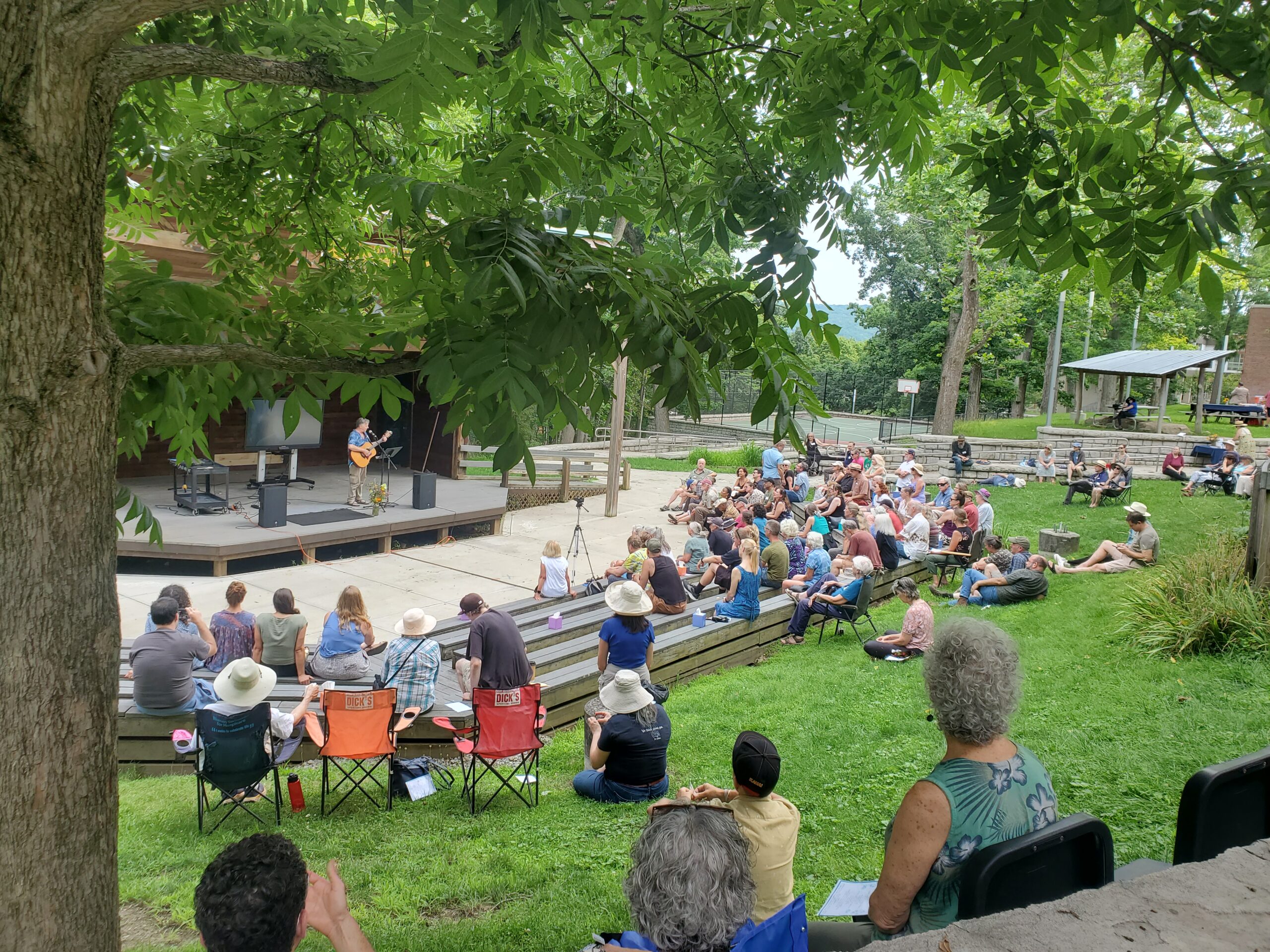
Yesterday, I attended the celebration of life of Dr. Dave Lehman, who died recently. He, with his wife, Judy Lehman founded the Lehman Alternative Community School (LACS), a public secondary school where I was lucky enough to teach for 27 years. Dr. Dave was the principal from 1974-2004. I attended the event as a grieving colleague not as a reporter or chronicler. I didn’t get permission from all the wonderful organizers and speakers, so I can’t mention their names or quote exactly what they said. All I can attempt is to somehow discover and reveal, to you and myself, my feelings about Dr. Dave and the school.


The speakers evoked in me so many memories. I was reminded how Dr. Dave sang to us, or more characteristically, led us in song and joy. In fact, all during the afternoon, whenever I looked around me, I was surprised by memories. Time itself took on new meaning. A former colleague shared with me their own experience of this. We might recognize how then influenced now. But what about the “reverse?” How is now influencing then?


Here we were, people spanning over 50 years of history at LACS. For me, right over there was a student from my first year of teaching and another from when I retired. There was one who went with me to Toronto to study theatre and one who went whale watching near Boston. There was one who helped create a replica of a Paleolithic art cave or read John Paul Sartre. They were 15, 16, 17 then, are 50 now. 50! They have their own children now in the school. How does who they are now illuminate who they were then? Or who I was? Or am?


I was reminded how successfully the school served as a place where everyone concerned, young people and adults, students and teachers, administrators, counselors, and janitors, secretaries and nurses, were allowed and supported in taking responsibility for educating and being themselves. We were learning how to be compassionately aware of our role in creating a community in which we and others could thrive together.


I was reminded that Dr. Dave often spoke about relationships and community as being the heart of a school and education itself, so our school was structured accordingly. Some examples: Each student and staff member had a family that met twice a week to plan and support their education. There was a weekly all-school meeting (ASM) where democracy was taught by actually making decisions about the school. There were committees to help plan the ASMs, clean and beautify the school, give support to diverse groups, take ecological action, and mentor new students. Students had choices in what courses they took and input into what was taught. The course material often grew out of student questions and concerns. Students themselves voted to require, as part of their education, 60 hours of community service.


I got to the school after having left teaching for a while and drifting from one job or area of interest to another. Then a friend told me about an opening at LACS, and I went to an interview. It turned out all the diverse experiences that I had had, all the courses I had taken and subjects that I loved were exactly what the school needed. Before teaching at LACS, I didn’t understand the underlying themes in my story. I did not know the feeling of being both centered and capable of helping others on a daily basis. But then I did.


During the event I kept thinking: how does anyone start such a school? How did Dr. Dave do it? Where did the vision and dedication come from? The persistence? Confidence? He didn’t do it alone, of course. I mentioned his wife, Judy, who ran the office and was like a mother to so many of us. Once started, he recruited an amazing core of educators, ready to give their hearts and enormous amounts of time to the job and with little financial renumeration. Most were so committed to helping young people that, for many years, they gave up part of their salaries in order to increase the number of staff and variety of courses.


And through the first 20 years or so, the school was frequently questioned, doubted, and even attacked by administrators and sometimes residents of the area, for being too different, not fitting into their ideas of what a secondary school should be or what young people were supposed to be. But not often by students and parents. For many years, there was a long waiting list to get into the school; potential students had to choose to attend. Dr. Dave was a great protector. He so capably worked to protect the school and all of us while our education continued.


And he taught us about change. That it was life itself. As one speaker pointed out at the event, he didn’t let us ever get too attached to seeing or doing things one way. For example, he tried to change the 45-minute class structure to 90 minutes, to allow for longer teaching periods and increased involvement in learning. However, after a yearlong trial period, the students voted down the change. And Dr. Dave, instead of getting upset, honored the wisdom and choice of students. Now, some 90-minute classes remain but most are 45.


And maybe most of all, Dr. Dave cared about us and for us. He taught us a language of caring. One example: after I had a difficult surgery, he came to my house to help with my recovery. We talked philosophy, and he helped me think about something other than pain, something uplifting. He did such things for all the staff, as well as students. When doors of such deep honesty and heart are opened, they don’t close so easily. A model for how to better live in friendship with life itself is created.


That’s what this school did for so many of us. Uplifted us. This is what education is about. This is what leaders could and I think should be. I was lucky enough to have known him, to have worked with him. And to have worked and shared with so many people, so many young people and older ones. Such an amazing group of colleagues; such an amazing assortment of students. What a gift.


*Photo by Rebecca Costello.

Opening Doors in Time and Mind: The Bookstore Resistance

It was such a comforting moment. I was reading a book where the main character, a bookseller, was watching a customer reading the classic novel, The Count of Monte Cristo. The man was old and seated in a cushioned chair, at a table, sipping coffee. Books were scattered everywhere, not just on the wood shelves. There was mismatched artwork on the somewhat peeling walls. Lights hung from the ceiling creating areas of clarity amidst the soft darkness. Snow increasingly falling outside as the world turned dark. Yet inside, it was warm. A fire was going in the woodstove. Such a comforting moment.


The Book of Doors by Gareth Brown is part urban fantasy, part mystery and adventure, part romance⎼ and partly an examination of the psychological effects of pain and grief. Shortly after the book begins, the main character inherits a magical book that allows them to travel from any unlocked door to any other they can clearly imagine. There are all sorts of magic books in the story⎼ a book of shadows, for example, enabling the holder to disappear and become a mere shadow passing through any space. There’s a book of Illusions, one of luck, destruction, etc.


We never know what a book might reveal. They’re all around us or used to be. Like doors. Like places in the mind, or in our homes, schools, or workplace; memories, ignored bits of reality. Places we can step through to taste or digest; or to dwell fully and beautifully. Some with a hidden power.


When I was 18 or 19, I walked through an open door into the old Barnes & Noble Bookstore in the Village, on 8th Street & 6th Avenue, in downtown New York City. Back then, it was a smaller, more intimate store, not like the chain stores of today. I was just wandering the aisles, hoping to find a treasure, when I noticed a man and woman, maybe in their 70s, in the philosophy section in the back of the store. They were discussing the French activist and philosopher, J. P. Sartre and his concept of authenticity. They were both dressed in old but expensive clothing. The woman looked sort of regal, the man very professorial. They intrigued me but I respected their privacy and felt too embarrassed to get close enough to listen in on their conversation. So, I moved on.


I ran into them 2 more times. One time was at a lecture on Thoreau in an upper middle-class neighborhood on the West Side of Manhattan. Someone at the lecture told me they had escaped from the Nazis in Austria. I don’t know the truth of this, but supposedly she was from a noble family, and he was a professor, but I don’t remember in what field. And later, back downtown on 6th Avenue, I was surprised to see the woman alone on the street, begging for money, and aggressively berating those who pretended not to see her.


Another doorway, in a recent dream. I entered what at first appeared to be the home I grew up in, where my parents lived for almost 30 years after I moved out. But in the dream my parents had sold that house. The dream home was slightly different, and in bad shape. The bathroom was not working. I had to sleep on the couch in the living room, not my old bedroom.


And my parents were very old. Someone said my mom was near death. My dad was in only slightly better shape. All at once, several people I didn’t know, mostly younger, in their twenties or thirties, came out from the back of the house, talking loudly amongst themselves and crowding the living room. Outside, through a window, I saw someone park, get off a motorcycle, and walk away. One of the younger people claimed the bike had been stolen and now returned. My dad, who had never in his life been on a motorcycle let alone driven one, put on a leather jacket and helmet, climbed on the bike, and tore off. Maybe he had stepped through a doorway to a younger self, as he looked so much younger, with his back straighter than it had been in years…


*To read the whole article, please go to The Good Men Project.


Learning How to Face Right Now: The Deceptions We Inflict on Ourselves and the Possible Liberation

It can seem that some lessons need to be learned over and over again until they finally live in us. These lessons are often the most basic, maybe even the most obvious.


But sometimes, instead of an old lesson needing to be re-learned, we’re noticing a new perspective on an old situation, or seeing a new dimension in something we thought we should’ve known all along.


For example, we have an expectation, fear, or regret, a project and we get lost in it; we ruminate on a detail and forget why we started the project to begin with. We lose ourselves in thought and don’t recognize that we’re living being lost in thought; we’re living an idea and no longer feel our life. We do something and feel we did it incorrectly and think we’re now and forever a mistake. And then we live angry at ourselves. Or we get angry at someone; and somewhere inside us we imagine this anger at another will save us from our own shortcomings⎼ but there’s no such escape. We’re just living scapegoating, living resentment.


Oh, and here’s one that’s common: we’re exercising and thinking mostly of getting it done. Or, similarly, we’re in a car driving to meet friends in order to relax together. But we drive fast; we get all tense trying to get to a future where we can let ourselves relax, instead of driving at a more leisurely pace where we’re at ease right now. How many times do we have to learn such lessons?


These insights are inspired by the 13th century Japanese Zen Master Dogen Zenji’s Being-Time, not that I have more than a basic understanding of his teachings. We often try to withdraw from or escape a situation, emotion, or expected future. We certainly can “time travel;” it’s one of humans’ greatest gifts. It allows us to plan ahead, empathically feel what another person feels, imagine a work of art or what the consequences of an action might be. It makes critical thinking possible. But when we lose perspective, time-travel can become a great peril we inflict on ourselves.


We can never step outside our lives, outside the universe, outside time. The imagined mental travel is itself a moment of life. A thought is time. A cry is time. A book is time. The first flower after winter, the first snowdrop, is the time that is spring. We are being time.


We too easily forget everything around us, everything we’ve experienced, every being around us is our life now. This, right here, right now. There’s no exit from it, not until we die, if then.


The French philosopher, J. P. Sartre, who was a member of the French resistance during WWII, gives us an interesting angle on these insights. Sartre wrote a play during the WWII occupation of France by the Nazis. The play was called No Exit. From one perspective, the play can be seen as an exposition of the hell created by a hellish war and the way the Fascist occupiers treated their fellow human beings. The Nazis deceived themselves, lied about their aims and the reality of others, refusing responsibility, refusing to feel the enormity of pain and destruction they inflicted. The play was first performed in 1944, during the occupation with Nazis in the audience ignorant of this layer of meaning in the play.


The three main characters in No Exit share a room together in hell for eternity. There are no torturers other than themselves, no flames other than the fire of lies and deceptions they lit in themselves….


*To read the whole article, please go to The Good Men Project.

Models of Who We Might Be: Finding the Quiet that Reveals Truths and Informs Our Voice

We are all influenced by others, constantly, and more often than we like to admit. It doesn’t matter if we’re young or old or the time or place. When we’re with certain friends, we act and respond one way. When we’re in school or work or with parents, we present ourselves differently. As the philosopher Aristotle said, we’re political or social beings, even the shyest and most independent of us.


Yet, even surrounded by others we can feel alone, isolated inside our heads as if our joys and pains were what separated us from others, not united us. We might breathe in and out as if each breath secluded us from the world instead of weaving us together. Our minds can feel filled with static when we haven’t learned how to adjust the channels to a receptive station.


The French philosopher and author J. P. Sartre had a character in his play No Exit say that hell is other people. What if this hell was caused by an obstructed or inauthentic view of our self? What if we had a model to follow who could show us how to live and think in authentic ways that are now hidden by contemporary culture?


And sometimes, there is just silence inside us, which can be frightening⎼ or wonderful. Frightening as it reveals that so much is unknown and unknowable, not as set and secure as we might like it to be. And other times, silence is welcome, calming, freeing, or exciting and full of possibilities. What if there are models out there of how to hear silence as the natural sound of mind in tune with the world?


I was recently in a bookstore and found The Socrates Express: In Search of Life Lessons from Dead Philosophers, by Eric Weiner. It is about dead thinkers, mostly men, mostly white, unfortunately. But the book is fun to read and examines not only what the philosophers said but who they were and how they lived.


Socrates was a monumental figure in Western thought, and in my own life. Or maybe it’s just the myth of Socrates. Because he died 2421 years ago, and he wrote nothing. We know him only through what others said of him. It’s not the living person that we know but an image carved by history to serve our collective needs. Or maybe he has become what  psychiatrist Carl Jung called an archetype or pattern of thought and behavior that can guide us to develop ourselves psychologically, morally, and spiritually.


Weiner depicts Socrates as a practitioner of what Buddhists call “crazy wisdom,” someone who casts aside social norms, risking everything to jolt others into new understandings. And he did risk everything. At the age of 71, he was imprisoned and forced to commit suicide by the authorities of his home city of Athens, supposedly for corrupting youth, but most likely because he provoked questions people found uncomfortable….


*Please share and go to the Good Men Project to read the whole post.