
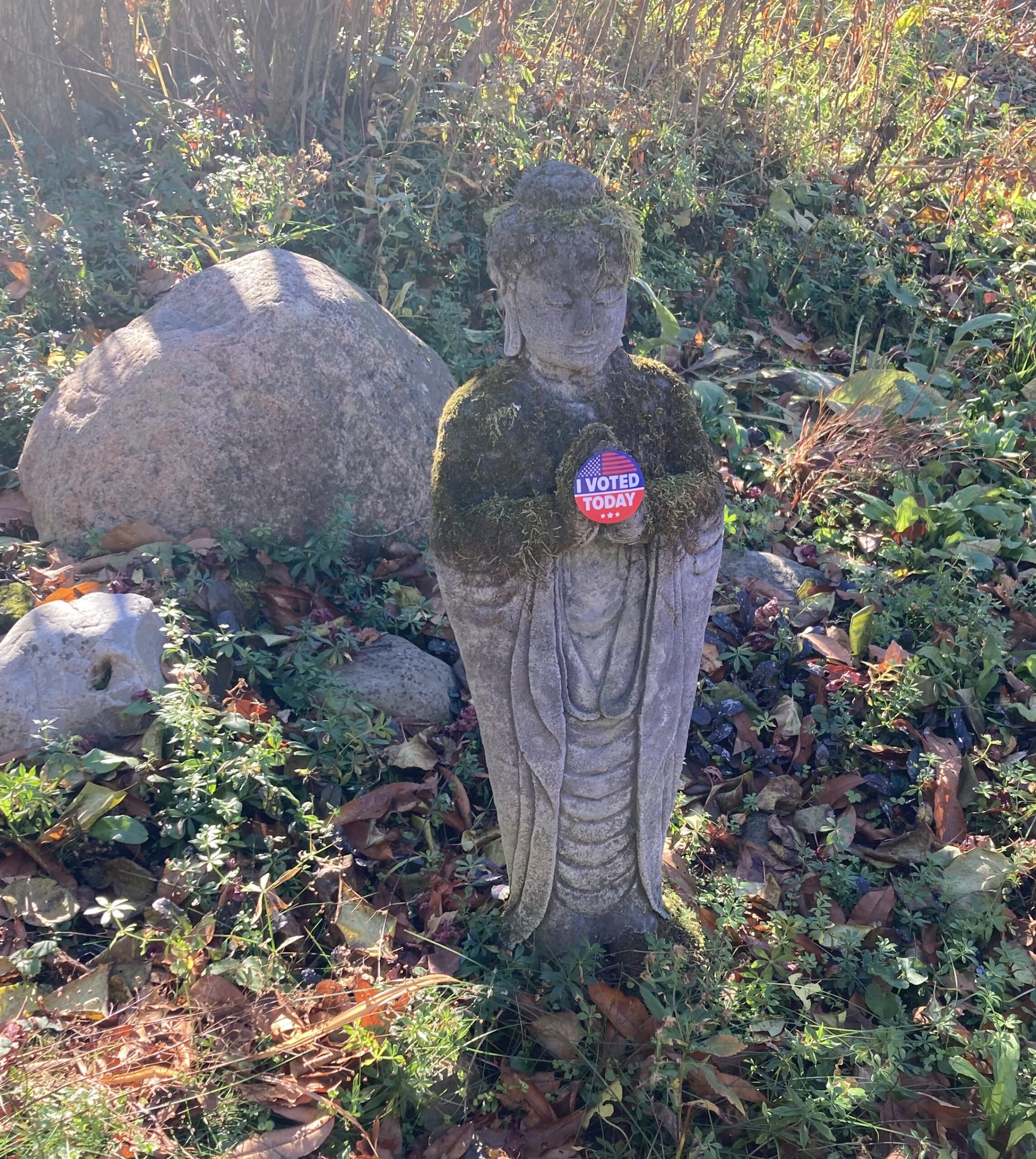
We Need Joy Even When Inundated with Fear and Sorrow, Or Maybe Especially Then: Acting Not for the Quantity of Acclamations but for the Quality of Our Lives

I need to talk about joy. I need to feel it; so many of us need to feel it.


Yet it feels a little weird to talk about joy when such a consequential election is only 9 days away. It’s an election that feels, no, that we know can mean the difference between creating a positive future or losing our right to a positive future; to losing our health care, seeing the destruction of our natural environment, and the loss of the ability for too many of us to achieve a livable income. And when we’re daily slapped in the face with a level of corruption and cruelty from our government that was in all probability never witnessed before in this country.


I’ve thought and written about this before. We need joy even when inundated with fear and sorrow, or maybe especially when so inundated. The emotion has been so twisted and suppressed by DT’s constant and chaotic assaults on almost every aspect of our lives. He not only started a capricious and malignant war against Iran—he started a war within our nation and in ourselves. A wall of hate isolates too many from all others, while a cloud of chaos obscures and disconnects us from our own needs and from our communion with others and our world.


And the bad rep that contentment and happiness have traditionally had in many sections of our society just reinforces this. Many of us grew up thinking how can we be content, or happy unless we’ve found success and security? But in DT’s economy, the possibility of security is getting ever more difficult to achieve. And in the face of DT, if we get past the grief for our world and depression in ourselves, shouldn’t anger, outrage, and a commitment to change prevail?


So many of us, even the critics in my own mind, seem to doubt we deserve joy. We’ve been educated in discontent with ourselves. Yes, anger and outrage have their place; but so does joy.


Historian and activist Tmothy Snyder has written with great clarity about the authoritarian’s playbook and how DT is intent on to filling the air with despair, anxiety, helplessness, defeatism– a sense of being crushed and alone without the power to resist.


Snyder recommends we need to acknowledge the thoughts and feelings DT ignites, without letting them control us. And we need to recognize we’re not alone. In fact, knowing how many people share our feelings and are trying to do something to resist DT’s destructiveness is already a step out of isolation and toward community, and action. To act shows us we can act.


He then said something else that felt so real to me. “You have to be in the moment to get through the moment.”


Fear and depression often thrive when we ruminate in our thoughts about life or about fearful things that might happen instead of being present in what is happening. We might think we can put off joy until the election is over, and if we win. But this can prove counterproductive.


Two weeks ago, I wrote about how emotions are created. Our body, mind, and perception systems follow a natural process to provide direction on how to respond to a situation. First, we come awake. We get a message to “pay attention now.” This is followed by appraisals of the stimulus, whether it’s good or bad, wonderful or painful, a problem or a threat. Bodily sensations and feelings are created with an almost unconscious impulse to go either toward, away, or ignore the situation.


Then our mind gets even more involved, bringing in memories and judgments. Likes and dislikes are created, or a story to tell ourselves to make sense of what we perceive. And then how we respond, what actions we choose to take depends on how we’ve interpreted the situation we face.


Joy opens us to go toward a situation, a problem, a person, not withdraw. One teaching about meditation that has been helpful to me is to notice how the act of meditation itself can be joyful. When we acknowledge and value such feelings, we want to do it again. With political actions. there can be great fear there, but also excitement, a sense of freedom, camaraderie, joy. These latter feelings reinforce our commitment to do it again.


But if we do it just to capture joy, we chase it away. If we do it just for headlines, we lose it. So often in the rest of our lives, we do things transactionally. We act for what we can get. We focus on possessions, money; we focus on who we defeat, not who we are.


To feel joy is to do something for the quality of our lives, not for the quantity of acclamations. When we do something just to do it, or because it’s the right thing to do, we feel joy. We don’t focus entirely on an idea of what should happen, although such ideas and analyses can guide us. Joy arises in being present in a moment. This is why a deep physical exertion can be so joyful, or seeing a child smile at us, or a sunrise. Or hearing a beautiful piece of music or an unexpected bird call or having a deep revelation. Or when someone we don’t know acts to help us. All these can lead us to forget everything except being right where we are, at home in ourselves and the world.


*To read the whole piece, please click on this link to The Good Men Project.

 

Being Aware of the Models of Masculinity and Humanity, We Favor, and the Pain They Can Cause: Who Do We Want to Lead This Nation and Model to the World What It Means To Be A Human Being?

The world today is certainly screwy and frightening. I keep getting shocked, so many people keep getting shocked, and asking ourselves, “what is going on here beyond the obvious?” What is going on in me? What more can I do to make things better?  It would be easy to just dull the shock of this administration’s politics of hate, cruelty, and corruption and lose ourselves in games, streaming shows, or whatever. But many of us honestly can’t do that. And the models of humanity provided by the men leading the nation today, of what it is to be a male human being, are malignant, frightening, painful to listen to. And insulting.


On 9/30 Secretary of Defense Pete Hegseth gave a State of the Force speech at the Pentagon. If you didn’t hear it, or didn’t hear quotes from it, he spoke about how he’s transforming the military. “We are no longer the woke department, or the weak department. Simple translation of that, no fanny—no fatties, no trannies, no beardoes, no weirdoes, no wimps, no radicals, just warriors… The war Department is color-blind, gender-neutral, and merit-based. The ideological clowns are out. The patriotic cowboys are in with testosterone testing on top.” Is he looking in the mirror when he speaks about “ideological clowns”?


As Nicolle Wallace pointed out on MSNBC Deadline White House, he announced a 20% cut in senior military officers, including generals and admirals, when we’re in a war that drags on and on. And which he, and his boss, Mr. DT, started with no clear, justifiable reason or plan, and have no idea how to end. He’s cutting the very people who might have the true expertise to get us out of the crisis, and it seems advised them never to get into it.


What also stood out from the speech was not just the disturbing content; it was the beauty pageant that he demanded for his audience. According to emails reviewed by The Wall Street Journal, not the home of radicals of the progressive sort, the troops nominated to attend the speech had to meet certain “physical standards” including “waist-to-height ratios, [and] be impeccably groomed…” —so, as Wallace said, the ones who didn’t measure up, “literally, the less attractive or fit ones stay on the battlefield” to fight the war without end while, according to Hegseth’s standards, the more fit perform for the media?


And earlier, on September 18th, near the time that Pete Hegseth was calling for the shaping of a MAGA, male beauty pageant of a military, a lawsuit was filed in Ithaca, NY, detailing allegations from 2024 of a gang rape of a woman by fraternity brothers. As reported by the Cornell Sun, a woman described being raped by seven men after being coerced into consuming drugs at a Chi Phi frat house on the Cornell University campus. She is suing the University, several Chi Phi fraternity organizations, sorority organizations, the men who allegedly raped her, etc. The defendants deny the allegations.


The plaintiff reported the rape to Cornell Police almost 3 weeks after it occurred. She was later deeply disappointed in the initial lack of support by the student community. The local district attorney declined to file charges, saying there wasn’t sufficient evidence to do so. Cornell’s Office of Civil Rights and Student Conduct and Community Standards held a title IX investigation. They suspended the Chi Phi fraternity chapter and expelled two students, suspended others. That’s it.


What do we do with these events? Especially viewed through the lens of the Epstein files and a president continuously talking in demeaning, dismissive, even predatory ways about women? A president talking, in the Hollywood tapes, about “grab[bing] them by the pussie.” A secretary of the Defense Department who was investigated for sexual assault in California.


There’s been a great outcry against Hegseth and Cornell and the Ithaca District Attorney.  But will the outcries result in any real and substantive action? Will the demonstrations and outcry about the Rape at Cornell and lack of an appropriate, just, and compassionate response lead to change? Change not just at Cornell, but nationally, and at the ballot booths? We need changes in how institutions treat rape, change in national leadership, and changes in models of and understanding of how we should be with each other.


The New York Times published an article detailing how Jane Doe went from a shamed victim to a powerful, courageous actor. What will we do? What will we learn from these events?


Sometimes, a negative model can be helpful, if it’s short term….


*To read the whole post, please go to The Good Men Project.

How to Better Face What Needs to Be Faced: When We Feel More at Home in Ourselves, We’re Better Able to Act in Ways That Help Heal Our Nation

Wouldn’t it be wonderful to face challenges more freely, happily? Or at least feel less fear?


What can we do when we know we must face something difficult? Or we wish some event, situation, or person wasn’t beating on the doors of our mind? Or when we wish we had a magic wand to make whatever frightens or disturbs us disappear, but we can’t find any such magic for sale in any local store or the internet? Or when a memory or nightmare from a trauma is so hurtful or disturbing, we have no way to even begin facing it?


Our body, mind, and perception systems follow a natural process to provide direction on how to respond to a situation. When we experience a stimulus, an “orienting response” arises, and we come awake. We get a message to “pay attention now.” This is followed by appraisals of the stimulus, whether it’s bad or good, wonderful or painful, a threat or a problem. Bodily sensations and feelings are created with an almost unconscious impulse to go either toward, away, or ignore the situation.


Then our mind gets even more involved, bringing in memories and judgments. Likes and dislikes and mental labels are created for the situation, or a story to tell ourselves to make sense of what we perceive. And then how we respond, what actions we choose to take depend on how we’ve interpreted the situation we face.


We always have such choices about how we interpret a situation and respond. But the behavior modeled by the people we see around us and how we’ve faced such situations in the past greatly reverberates in the present, in the form of the emotional responses this process creates. We can feel fear if we normally turn away, or anger at the mere fact of having to make such a choice. We can feel excitement and run towards it, maybe because we like adrenalin surges, or adrenalin helps us feel alive or helps mitigate the fear. Or maybe we feel engaged and we welcome a challenge. Or maybe the fright tries to wrap the situation in layers of forgetfulness.


In Buddhism, there’s a teaching on what’s called the 84th problem: we all face difficulties, problems. Let’s say there are 83 of them. The 84th is thinking we shouldn’t have problems. Steve Hagen, a Zen Priest, in his book Buddhism Plain and Simple: The Practice of Being Awake, Right Now, Every Day explains this exceedingly well. We might want reality to be different from what it is. There’s so much hurt in the world right now. Too many of us face so much pain and confusion every day.  But just telling ourselves it should be different doesn’t make it happen. Instead, it can make the sense of something lacking or missing in our lives hurt more and be more difficult to face.


A negativity bias can arise from this emotional construction process. This is an inclination or natural push to see the negative first and foremost. This bias, if understood, can help us avoid or lessen any threat to us. But it can also lead us to interpret a situation that could be merely a challenge as a danger.


When we push away or retreat from a situation, we might also push away an understanding of ourselves that could assist us in perceiving how to best face it. In the same way, we might think of ourselves as something separate from a situation we live, separate from others and our world. We might wish we were different from who we are. We might get hooked on wanting what we thought we lacked or thought others had; or we might wish we didn’t have what we had. We then feel separate from ourselves, from our body and mind. Our home becomes some distant place we can’t easily get to. It’s difficult to feel at home in our skin if our very skin feels wrong….


*To read the whole article, please go to The Good Men Project.