
Outrage Directed by Compassion Can Save Us: How Do We Recognize and Call Out the Hate and Blindness that Others Carry Without Letting It Turn Us to Blindly Hate?

Sometimes lately, I worry I’m losing empathy, losing an ability to see myself in others. And this scares me. It can lead me to feel I’m losing the heart of who I am.


I was listening to a program on NPR hosted by Tonya Mosley. She was interviewing Jia Tolentino, a staff writer for the New Yorker, on an article she wrote called Our Plastic Surgery Nightmare. The program went into totally unanticipated topics that I previously thought had little to do with plastic surgery.


Or maybe I should say plastic surgery has had unanticipated consequences. The technology has become so precise as to be practically undetectable. So, what’s the problem? With such advances, it’s easy to feel even more pressure to work to maximize our appearance and make it conform to what we think other people consider beautiful. And when every face can be “optimized,” it becomes less a window into character and emotion, and more another field of artificiality. It becomes something to buy, not to live our way into. No longer will we see smile and tension lines, or other signs of character and the realities of a lived experience. A dimension of the face as a vehicle of communication will be lost. Instead, another vehicle to hide ourselves from others and from ourselves will be born.


What Tolentino found is that the images people are using to model their appearance on are AI generated. And these images are predominantly of people who are white, young, and based on one idea of what’s beautiful. They are also very much alike one another. The face is being separated from the person, the person from their humanity or soul.


The program then went on to talk about “Looks Maxxers,” a purported self-improvement or men’s rights movement I never heard of before and had trouble understanding. It largely began around 2010, during the “Me-too” movement and the Presidency of Barack Obama. It was a reaction against a perceived rise in prominence of feminism and maybe of African Americans, and diminution of strong white men. A large segment of this group blames women for their problems building romantic relationships. This perception tipped these young men into a reactive, hateful belief that women are less than men, more superficial, who do not deserve equal rights.


According to Tolentino, it’s also an attempt to discover and classify the bodily characteristics of successful men to imitate those characteristics. In the “manosphere,” an influencer named Braden Peters became famous for striking his jaw with a hammer, as well as using softer methods like work outs, peptides, supplements, etc. to make his body and face more rugged, more “masculine,” and in his eyes more attractive.


But all these efforts to be attractive are not for sex or even happiness. These men are purportedly heterosexual but show little or no desire to get closer to women. Their purpose is to attract women to display power and dominance over them, and to be seen by a virtual, disembodied audience. She called this “eroticized attention;” it’s also attention that could be used to make money from internet forums.


Tolentino’s article and my emotional response to it alerted me to how much I feel the human world is severely straining my ability to understand it and is close to spinning out of control. We might be facing an array of threats way beyond what was faced by any other generation I can think of. The philosopher Noam Chomsky warned that humanity is approaching [or is now in] the most dangerous and critical moment in history. We have a climate emergency, an economy that doesn’t serve most of the people, as well as too many unjustifiable, unbelievably destructive wars. We even have a fairly new technology, AI, that some reputable experts warn has at least a 10% chance of causing the extinction of all humans in the next decade.


And we have a president specializing in undermining every aspect of our lives as part of a human community. I hope I’m not pushing an analogy too far, but I think this administration is causing many of us to feel what’s been called moral injury. I first heard the term used in describing, along with PTSD, part of what many soldiers experience from serving in a war. According to the Moral Injury Project at Syracuse, University, the injury entails damage to one’s conscience from perpetuating, witnessing, or failing to prevent acts that violate one’s conscience. Many feel harmed by a betrayal of core values, of justice, fairness, and loyalty, by our leaders, by other members of our community, or by our own actions or inaction. We know that many of our leaders have failed not only to protect us but even care about us. We feel our very humanity is being threatened.


Even more than ever, and as much as we individually can, we can ask ourselves several questions. Maybe the most important is how can we hold compassion in the face of hate? Instead of sacrificing our empathy, as the “Looks Maxxers” seem to be doing, how do we instead protect and act in accord with it?


Does every generation of people feel an inability to understand or feel empathy for those born in different decades? It certainly seems true here, in the US. When I was a teenager, I felt my parent’s generation didn’t understand me. They couldn’t understand the reality of life for my cohorts and myself and kept wanting me to conform to their images of success and reality, not mine. Is my trouble feeling empathy for or understanding the “Looks Maxxers” anything like what my parents experienced with me?


And for those of us older people, what might it be like to be part of a generation that grew up with social media and the increasing climate and other previously mentioned threats dominating their world?…


*To read the whole article, please go to The Good Men Project.
Changing the Climate in this Country and World: Stopping the Malignant Madness

It’s raining this morning, but it doesn’t feel like a “normal” rain. The sky is so dark and ominous, and the rain hits the roof and windows like stones, like pellets. It grabs my attention so deeply it doesn’t feel like any other rain. It can’t be ignored. It falls like fear, like power. Like life itself.


The thunder and lightning shake my home. They shake the earth and seem to split open the sky. I hope it won’t split open my roof.


And the rain and thunder are not over there someplace; they’re not at any distance. They’re right here, speaking in words the size of the universe.


It’s raining as I think of Nepal. The flood that we now know killed over 1,114 people, that sent over 4,000 missing; and the pets, animals, all killed, homes, gardens destroyed, washed away, except for memories, except for the grief of loved ones. That flood was right out of my nightmares. Did you see the videos of it? When I was younger, I used to have nightmares of floods and of being totally overwhelmed. Of forces way beyond me.


And then there’s the flood in the Grand Canyon that killed 2, 1 still missing. 80 needing evacuation. Nothing like Nepal but so much closer to home. Floods all over the world this year. And to think we had a part in it? That climate change, human caused climate change played a big part in it? And that our present government and leader are actively pursuing policies that make the situation worse, that make such floods more likely and intense, deadly? That hurts.


And the rain and thunder send images of other sorts of rain and thunder to my mind. Like the thunder and lightning of the wars in Iran, Ukraine, Sudan, Gaza, Israel, etc., etc. According to the Peace Research Institute Oslo, over the last ten years interstate conflicts have increased sharply. They show the world right now is facing more violent conflicts than any time since World War II. And although no one nation or leader is responsible, but rather a whole shift in international relations, our president is greatly contributing to the violence and undermining efforts to reduce it.


He’s ended what some have called the “Pax Americana,” undermined our diplomatic and “soft power,” which used to be one of our primary ways to exercise influence in the world. He’s done this by drastically cutting our diplomatic corps, our foreign aid, Voice of America, etc.


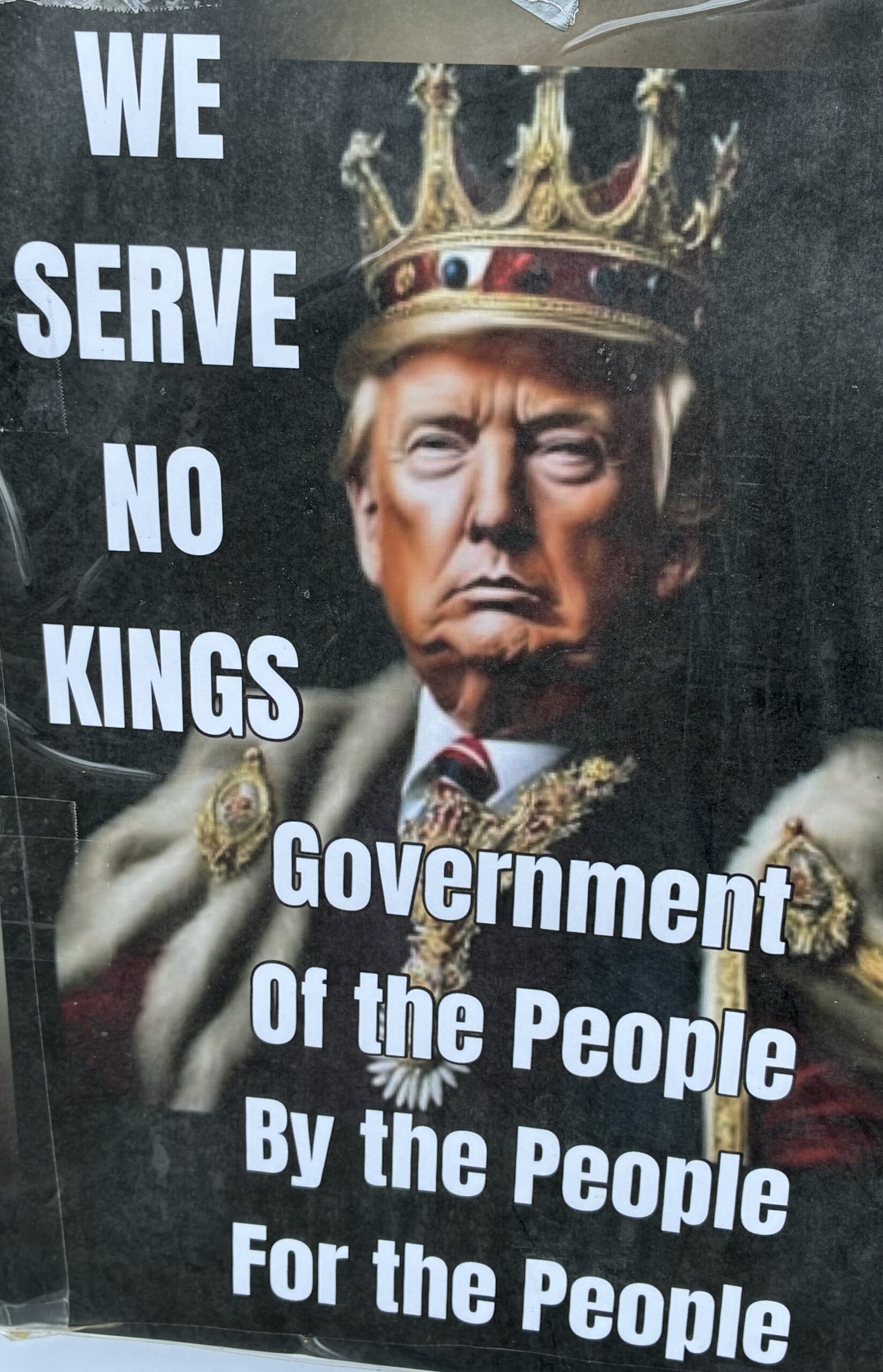
He’s done this by his clueless negotiation strategies. His “art of the deal,” or his “calculated unpredictability,” his public appearance as a “Mad King” crazy or greedy enough to do anything, might have worked at some point in his personal business operations to get what he wanted. But it’s not working now with international relations. As Andrew Roth wrote for the Guardian, his vague and contradictory comments, claims, and actions have failed to bring peace. His foreign policy has “fully passed through the looking glass.” He’s risked undermining the world economy and the lives of millions on a whim.


And he’s totally clueless about how to end what he’s begun. According to Congressman Adam Smith, his rhetoric has strengthened the hardliners in Iran and is designed to drive our allies away. What he’s succeeded in doing is increasingly isolating us and undermining our credibility in the world.


According to columnist and former Labor Secretary Robert Reich, “[DT]’s mind has gone.” Maybe his “Mad King Strategy” is not a strategy at all but a description of the reality of his mind….


*To read the whole post, please go to The Good Men Project: