Creating a Model of How to Live in Friendship with Life Itself: Celebrating An Educator and Education that Freed and Sang to Us

In this time where teachers are being overburdened and education itself is under attack, where propaganda and lies are being elevated and facts, science, and diverse examples of literature are being suppressed, it’s more important than ever to speak of schools where something very different occurs. Where not only critical thinking but compassion and the wisdom and freedom of young people is fostered.


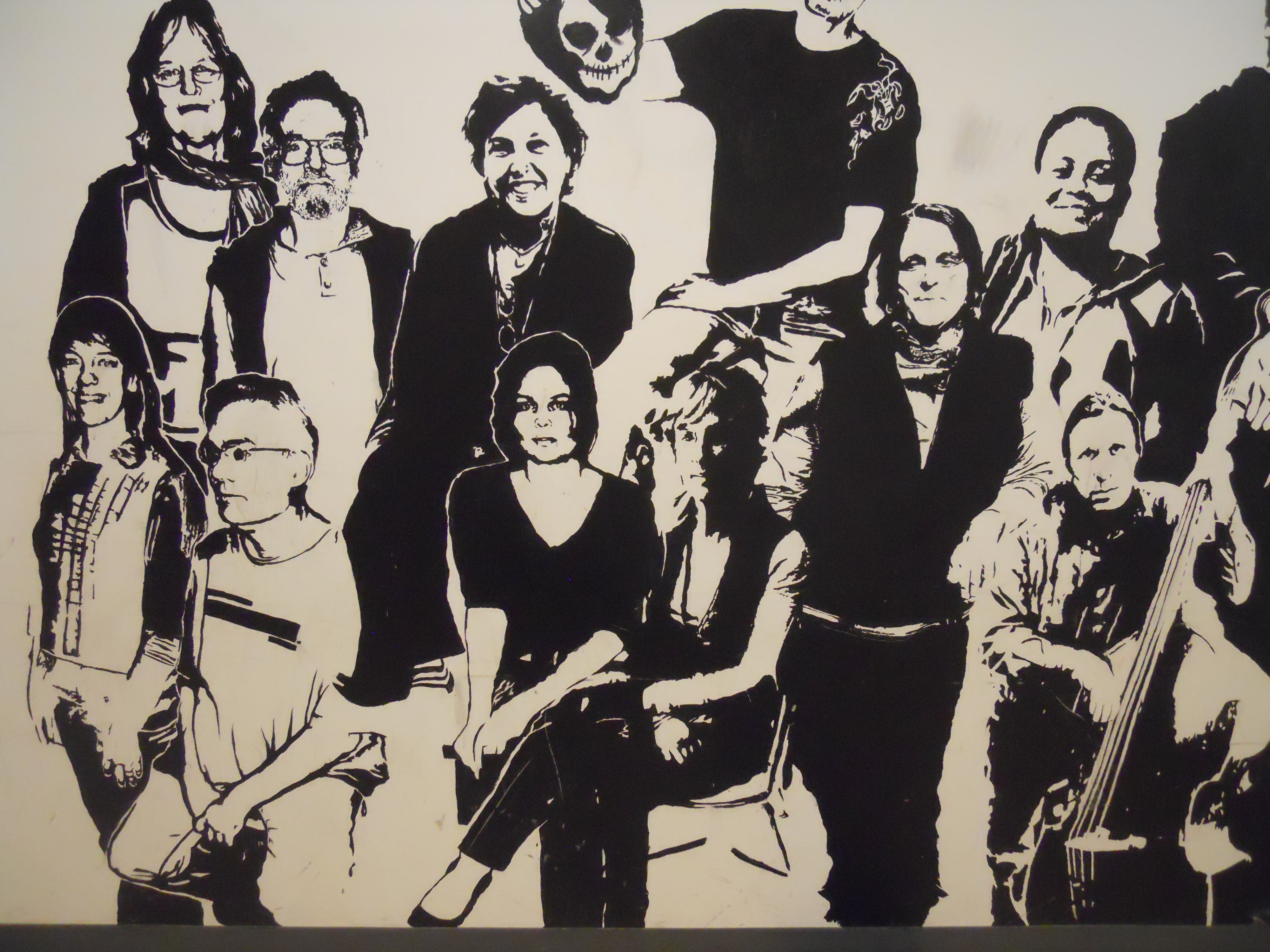
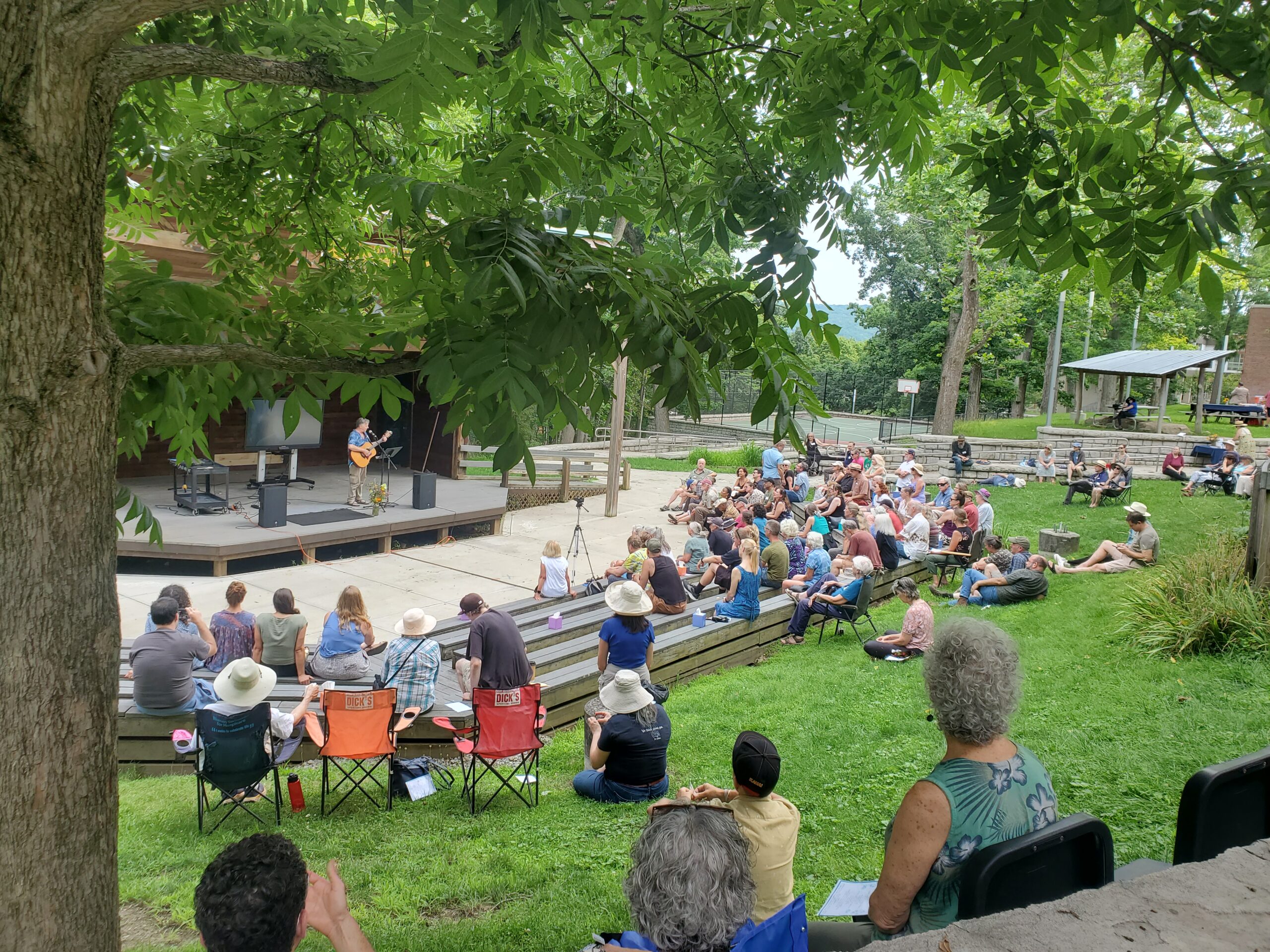
Yesterday, I attended the celebration of life of Dr. Dave Lehman, who died recently. He, with his wife, Judy Lehman founded the Lehman Alternative Community School (LACS), a public secondary school where I was lucky enough to teach for 27 years. Dr. Dave was the principal from 1974-2004. I attended the event as a grieving colleague not as a reporter or chronicler. I didn’t get permission from all the wonderful organizers and speakers, so I can’t mention their names or quote exactly what they said. All I can attempt is to somehow discover and reveal, to you and myself, my feelings about Dr. Dave and the school.


The speakers evoked in me so many memories. I was reminded how Dr. Dave sang to us, or more characteristically, led us in song and joy. In fact, all during the afternoon, whenever I looked around me, I was surprised by memories. Time itself took on new meaning. A former colleague shared with me their own experience of this. We might recognize how then influenced now. But what about the “reverse?” How is now influencing then?


Here we were, people spanning over 50 years of history at LACS. For me, right over there was a student from my first year of teaching and another from when I retired. There was one who went with me to Toronto to study theatre and one who went whale watching near Boston. There was one who helped create a replica of a Paleolithic art cave or read John Paul Sartre. They were 15, 16, 17 then, are 50 now. 50! They have their own children now in the school. How does who they are now illuminate who they were then? Or who I was? Or am?


I was reminded how successfully the school served as a place where everyone concerned, young people and adults, students and teachers, administrators, counselors, and janitors, secretaries and nurses, were allowed and supported in taking responsibility for educating and being themselves. We were learning how to be compassionately aware of our role in creating a community in which we and others could thrive together.


I was reminded that Dr. Dave often spoke about relationships and community as being the heart of a school and education itself, so our school was structured accordingly. Some examples: Each student and staff member had a family that met twice a week to plan and support their education. There was a weekly all-school meeting (ASM) where democracy was taught by actually making decisions about the school. There were committees to help plan the ASMs, clean and beautify the school, give support to diverse groups, take ecological action, and mentor new students. Students had choices in what courses they took and input into what was taught. The course material often grew out of student questions and concerns. Students themselves voted to require, as part of their education, 60 hours of community service.


I got to the school after having left teaching for a while and drifting from one job or area of interest to another. Then a friend told me about an opening at LACS, and I went to an interview. It turned out all the diverse experiences that I had had, all the courses I had taken and subjects that I loved were exactly what the school needed. Before teaching at LACS, I didn’t understand the underlying themes in my story. I did not know the feeling of being both centered and capable of helping others on a daily basis. But then I did.


During the event I kept thinking: how does anyone start such a school? How did Dr. Dave do it? Where did the vision and dedication come from? The persistence? Confidence? He didn’t do it alone, of course. I mentioned his wife, Judy, who ran the office and was like a mother to so many of us. Once started, he recruited an amazing core of educators, ready to give their hearts and enormous amounts of time to the job and with little financial renumeration. Most were so committed to helping young people that, for many years, they gave up part of their salaries in order to increase the number of staff and variety of courses.


And through the first 20 years or so, the school was frequently questioned, doubted, and even attacked by administrators and sometimes residents of the area, for being too different, not fitting into their ideas of what a secondary school should be or what young people were supposed to be. But not often by students and parents. For many years, there was a long waiting list to get into the school; potential students had to choose to attend. Dr. Dave was a great protector. He so capably worked to protect the school and all of us while our education continued.


And he taught us about change. That it was life itself. As one speaker pointed out at the event, he didn’t let us ever get too attached to seeing or doing things one way. For example, he tried to change the 45-minute class structure to 90 minutes, to allow for longer teaching periods and increased involvement in learning. However, after a yearlong trial period, the students voted down the change. And Dr. Dave, instead of getting upset, honored the wisdom and choice of students. Now, some 90-minute classes remain but most are 45.


And maybe most of all, Dr. Dave cared about us and for us. He taught us a language of caring. One example: after I had a difficult surgery, he came to my house to help with my recovery. We talked philosophy, and he helped me think about something other than pain, something uplifting. He did such things for all the staff, as well as students. When doors of such deep honesty and heart are opened, they don’t close so easily. A model for how to better live in friendship with life itself is created.


That’s what this school did for so many of us. Uplifted us. This is what education is about. This is what leaders could and I think should be. I was lucky enough to have known him, to have worked with him. And to have worked and shared with so many people, so many young people and older ones. Such an amazing group of colleagues; such an amazing assortment of students. What a gift.


*Photo by Rebecca Costello.
If 6th Graders Can Learn to Do This, Why Not the Rest of Us, and Society?

There are moments in life when we’re given an opportunity to participate in something special, a once in a lifetime moment.  Or maybe, it’s an opportunity to realize that every moment can be a unique, once-in-a-life moment.


This past weekend was the 50th Anniversary Reunion of the Lehman Alternative Community School {LACS] where I taught for 27 years. It’s a school that gives students, and it gave me, the opportunity to figure out who we were. For me, it was where I spent many of the best years of my professional life. It provided the chance to learn how all the disparate aspects of my life made sense and showed me how to pull all those aspects together. Just when I needed it most, and maybe when the school most needed me, we found each other.


The event began Friday night with a meet and greet dinner. Saturday, we gathered in the gym for welcome activities, photos, a talk from all 4 principals of the school⎼ the one who founded the school and led it for 30 years, and then the 3 principals who followed him.


Then there were school tours, art shows, and workshops; examples included The Seeds of Pedagogy, Climate Activism, Work in the Garden, etc. And the one I helped plan, on how our experiences in theatre classes and productions at the school and elsewhere empowered our lives.


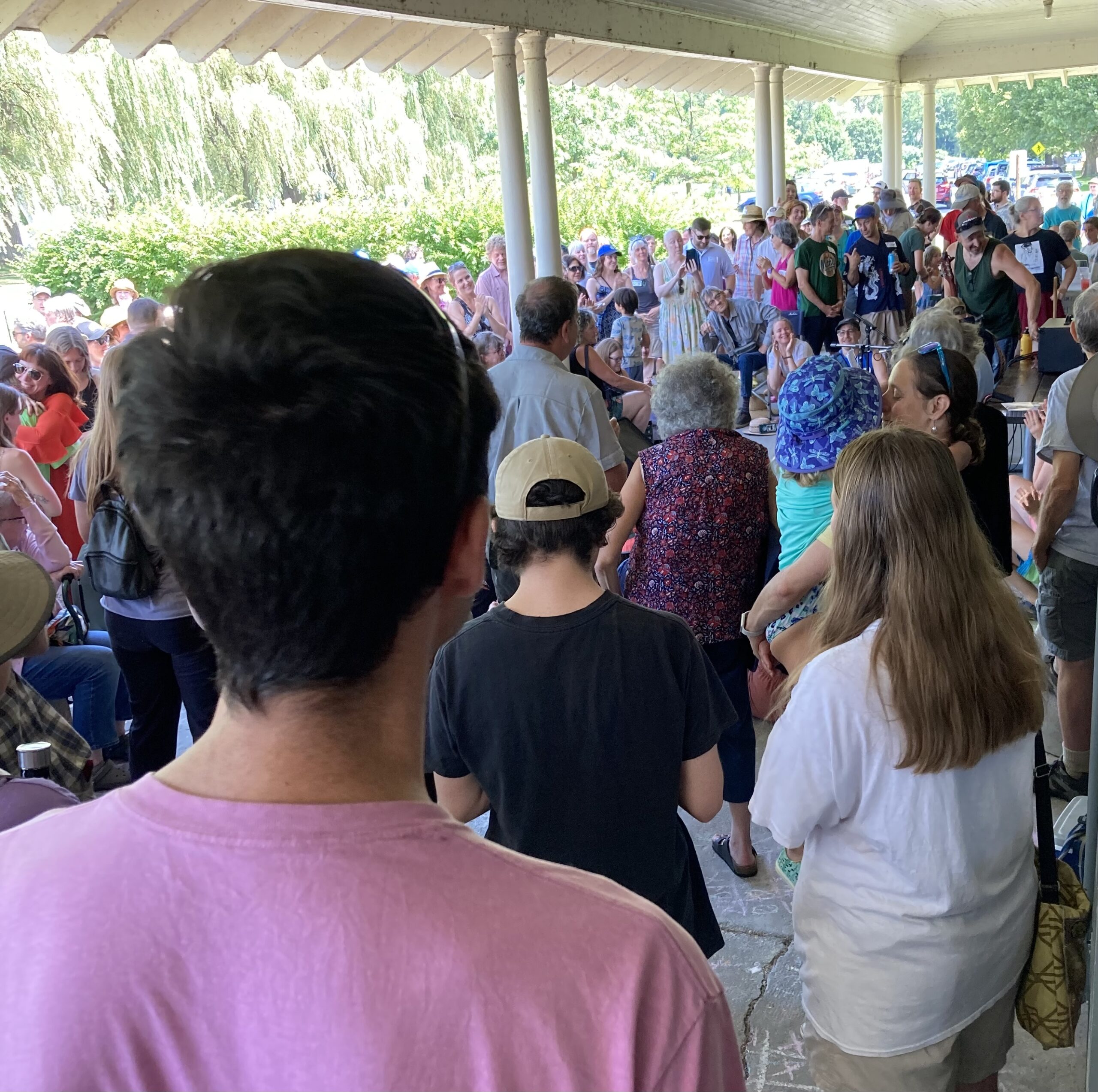
On Saturday afternoon, a movie on the school was shown; there were meet ups for different groups, and an All-School Meeting was held. At night, a talent show hosted by graduates. And on Sunday, a lunch together at a park⎼ that nobody wanted to end until we were all exhausted.


The theatre workshop was a panel of graduates discussing two questions:

How has theatre helped you in your life?

What has been your experience pursuing your passions and exploring your career since leaving the school?

The panelists covered almost 45 years of our history. The moderator was a contemporary senior. 4 of the panelists were theatre professionals or studying in college to be one. The 5th used their theatre experience in their corporate career.


I had few coherent images of how the panel might turn out, just dreams and wishes. But the reality exceeded the dreams. The event was a testament to the profound possibilities that can occur when any group, certainly any group of young people, are trusted and given the opportunity, guidance, and support to openly be themselves⎼ and are encouraged to think deeply about the real issues of their lives and the world.


I was totally engaged with stories by graduates about how theatre, and the school in general, shaped and benefitted them, including how to face adversity and pain. There were stories about how theatre prepared one panelist to testify to congress and directly face all the giant cameras focused on them. Another panelist discussed how their experiences at the school showed them how to love auditions and be successful in movies and tv. Another talked about how it prepared them not only to direct theatre productions in Manhattan, but also to teach acting to college students. Or to follow their hearts and act to benefit others and society in general. An audience member, who is a medical examiner in New York City, shared how theatre prepared them to testify in trials.


Democratic decision-making is at the heart of the school….


*To read the whole article, please go to The Good Men Project.

Improving the Environment for Teachers

According to an NPR report, 40-50% of new teachers leave within the first 5 years. Every school year 15% of the teaching force leaves or moves. The cost of this to each state is about $2 billion dollars. The situation is worse in high poverty areas.


The high turnover rates are listed as due to layoffs, dissatisfaction, inadequate support, isolated working conditions. One recommendation by the Hechinger Report, which reports on innovation and conditions of inequality in education, is mentoring, on the job training and administrative support. Let’s look at what this all means.


A public school is a peculiar world. It is filled mostly with young people of the same age group.  Humans evolved to live in mostly smaller, mixed age groups, where each person is well known. Most schools, by contrast, are large institutions where many students and teachers feel isolated and unknown. Most schools are very hierarchical, and the new teacher is near the bottom of the hierarchy. They often feel powerless. A new teacher coming in to any school often gets the teaching assignments other teachers don’t want. Because the students and other teachers don’t know them, they are often severely tested. All this in addition to the stress created by entering any new situation.


Some critics of education argue that teacher college standards are too low and admit too many unqualified people.  They propose tougher standardized tests to determine who gets in to an education school and who gets out with a teaching degree. This clearly assists test providers but not necessarily anyone else. Character is greatly important in teaching and no standardized test measures that. Education schools need to prepare teachers to be in a room with a diversity of real people in a rapidly changing social world. Teachers need an education in dealing with emotion as well as rationality, different cultures as well as different texts. (See my blog on suggestions for educating teachers.) They need to understand what understanding means, as well as how to teach it. They don’t need to waste time on taking or learning how to give inferior assessments such as standardized tests.


Other people have been calling for more stringent controls on teachers and more accountability. The New York State Board of Regents, for example, developed its own supposedly objective teacher evaluation system. I think such systems are counterproductive. These systems are so “objective” that, just last week, when last year’s results were made public in New York State, the Board of Regents’ own Chancellor questioned the results. Why? Only one percent of teachers were found “ineffective” or deficient. You’d think officials would be happy over the result. Is this a catch-22?  Is a rating system objective only if a higher percentage of teachers are shown to be deficient? Is the system not scary enough, not punitive enough if only one percent is found lacking? What percentage is good enough for these education officials? Is this just another manufactured attack on teachers, as if they are the cause of the problems in education?


One of the best proposals to help ameliorate the situation is mentorship and staff support for new teachers. But if a mentorship program is enacted without other substantive changes, the program is just a superficial add-on. Support and mentorship must be part of the overall climate of a school. Everyone, students, administrators, experienced teachers as well as new ones, need to be supported. I think new teachers leave not because they’re not talented enough or not mentored, but because the whole environment is too stressful, unnatural and unsupportive.


Everyone, to feel comfortable in a situation and handle stress well needs control, commitment, and to feel creatively challenged. To develop control, teachers need a voice. For schools to educate students in democratic decision-making, schools need to be models of such. Teachers need a voice not only in setting policies and running the school but also in choosing what they teach. Everyone has different interests and skills and the more teachers teach what they love, they will love what they teach, and the more successful they will be.


When teachers have a voice in what they teach and how they teach, they can meet the diversity of student needs with creativity. Feeling creative turns a stressful situation into an opportunity. Creativity is, in a sense, its own reward. One of the worst elements of the proposed teacher-evaluation systems, and using standardized testing to rate students and teachers, is that the tests undermine creativity. It makes a teacher fearful of taking chances. Failure can mean loss of job. Such tests are based on punishment and rewards, instead of fostering trust and intrinsic motivation. Students take them not because the tests are interesting and naturally compelling, but because authorities threaten them with poor grades or not graduating. Teachers give the tests largely for the same reasons. Inculcating fear as a mechanism of instruction interferes with learning and undermines the use of empathy. Fear blocks empathy. As I asked in an earlier blog: Is fear what we want students and teachers to associate with learning?


Creative challenge and having a voice leads to commitment. The teacher commits to the job and the students because they feel recognized as a person and trusted as a professional. By being recognized, they are more able and ready to recognize who the students are and, thus, more likely to be successful teaching them.


I imagine some people might respond to my argument by saying that there’s little chance that teachers will be given substantive power over school policy or that decisions in a school will be made democratically. There is almost as little chance of giving teachers a democratic voice as giving the same to students. And that’s the problem.