Becoming Warriors of Presence

William Butler Yeats wrote over a century ago, in the wake of the First World War,

Turning and turning in the widening gyre

The falcon cannot hear the falconer;

Things fall apart; the centre cannot hold…


We easily feel this today. One minute, I look outside my house and see an apple tree greening with spring and hear a raven’s raucous call. The next a car horn. Then, faintly, an NPR report of a bombed Mariupol, and of a GOP Congresswoman repeating Russian disinformation.


Which way does my mind turn? Do I relax into the calm beauty the tree and natural universe provides in this moment? Or do I get ready to battle those aiming to rip the constitutional rights and protections from my limbs and claim them all for themselves? Or who threaten to deny us the very air we need to breathe because we are not able or willing to pay their price?


How do we know what future will be revealed? We don’t. But we know the price we’ll pay for doing nothing is unpayable.


We all want an enjoyable life. One that satisfies. Maybe one with meaning. That makes the world a little better. But when the natural world itself or the sustainability of the climate is threatened⎼ and the human world is degrading so fast it’s impossible to have any idea what will happen tomorrow or if anything caring, humane, and democratic will be left for us⎼ how do we not burn out or give up? How do we live day to day without degenerating into a blubbering mass, knowing we must act but not knowing what it is we can do?


David Loy, Buddhist philosopher, eco-activist and author gave a talk on Friday, April 29th. He spoke about a fellow Buddhist, from Boulder, CO, Wynn Bruce, who had immolated himself on the Supreme Court steps on Earth Day, one week earlier. Wynn’s father said he did it out of concern for our world and the lack of determined action by our political system to save it.


Loy quoted philosopher Noam Chomsky saying, “the world is at the most dangerous moment in human history.” How do we face this? Wynn Bruce acted. But his act was so painful and terrifying. Not the most skillful of actions to take, said Loy. But Wynn’s concern, his fear is in all of us who look and see the climate emergency that is occurring.


Loy went on to share author, eco-activist Joanna Macy’s piece on the Tibetan legend of a Shambhala Warrior. “There comes a time,” she recounts, “when all lives on earth are in danger.” Barbarian powers use unfathomable technologies to lay waste the world. To remove these weapons, the warriors must show great moral and physical courage, and go forth to the very heart of barbarian power. (Putin? The GOP who plotted Jan 6?)


But since the weapons are made by mind, the way to fight them involves mind. Our strongest weapons, she says, are compassion and insight, heart, and knowledge.


It seems right now that we can’t look, and we can’t look away. But maybe we’ve got it wrong. Maybe we’re asking the wrong questions….


**To read the whole article, go to The Good Men Project.


Models of Who We Might Be: Finding the Quiet that Reveals Truths and Informs Our Voice

We are all influenced by others, constantly, and more often than we like to admit. It doesn’t matter if we’re young or old or the time or place. When we’re with certain friends, we act and respond one way. When we’re in school or work or with parents, we present ourselves differently. As the philosopher Aristotle said, we’re political or social beings, even the shyest and most independent of us.


Yet, even surrounded by others we can feel alone, isolated inside our heads as if our joys and pains were what separated us from others, not united us. We might breathe in and out as if each breath secluded us from the world instead of weaving us together. Our minds can feel filled with static when we haven’t learned how to adjust the channels to a receptive station.


The French philosopher and author J. P. Sartre had a character in his play No Exit say that hell is other people. What if this hell was caused by an obstructed or inauthentic view of our self? What if we had a model to follow who could show us how to live and think in authentic ways that are now hidden by contemporary culture?


And sometimes, there is just silence inside us, which can be frightening⎼ or wonderful. Frightening as it reveals that so much is unknown and unknowable, not as set and secure as we might like it to be. And other times, silence is welcome, calming, freeing, or exciting and full of possibilities. What if there are models out there of how to hear silence as the natural sound of mind in tune with the world?


I was recently in a bookstore and found The Socrates Express: In Search of Life Lessons from Dead Philosophers, by Eric Weiner. It is about dead thinkers, mostly men, mostly white, unfortunately. But the book is fun to read and examines not only what the philosophers said but who they were and how they lived.


Socrates was a monumental figure in Western thought, and in my own life. Or maybe it’s just the myth of Socrates. Because he died 2421 years ago, and he wrote nothing. We know him only through what others said of him. It’s not the living person that we know but an image carved by history to serve our collective needs. Or maybe he has become what  psychiatrist Carl Jung called an archetype or pattern of thought and behavior that can guide us to develop ourselves psychologically, morally, and spiritually.


Weiner depicts Socrates as a practitioner of what Buddhists call “crazy wisdom,” someone who casts aside social norms, risking everything to jolt others into new understandings. And he did risk everything. At the age of 71, he was imprisoned and forced to commit suicide by the authorities of his home city of Athens, supposedly for corrupting youth, but most likely because he provoked questions people found uncomfortable….


*Please share and go to the Good Men Project to read the whole post.

Letting Go of Normal: When Looking Is Itself An Act of Creation and Breathing is A Revelation

Although it’s technically spring, it’s still very much winter. The breeze is distinctly chilly and it’s snowing. Hard. Transitions between seasons, and maybe between anything, can be so unpredictable. Winter, as well as old ways of doing things, does not like to let go.


A cardinal, of such a beautiful red color, sits on the branch of an apple tree as the snow filled wind roars around it. How cold it must be out there for it. It waits for the right moment to swoop down and eat the food my wife left for it. And nearby, sits a mourning dove, so much a part of the branch I at first didn’t see him or her or them. Her presence is more beautiful than any work of art, although many artists would love to paint what I now see.


So many of us want to return to a different season, a time without at least the inhumanity and destruction of Putin’s war against Ukraine. We want to return to relating to other people without masks, or not worrying about breathing in the air from another person’s mouth or wondering if our trip to the grocery store would result in sickness.


We want to return to stable supply lines for food and other necessities and no inflation. We want to return to a time, or maybe create a time, that we see a sustainable, enjoyable future ahead of us. We want to think our financial well-being assured.


Or we want to feel the possibility of our rights protected. Our voice not only heard but honored. And justice is, finally, not only possible but a regular occurrence. That the blatant assault on the desire for democracy, real democracy, by the followers of DJT and Putin and white nationalists and others is ended, replaced by a drive toward increasing voting rights and protections. And we want to end the continuing concentration of wealth.


Much of this got relatively better with the election of Biden and Harris. At least the possibility of things getting better, of reason, caring, is present. But the concentration of wealth is getting worse, not better, along with the lies, hate, and support of malignant autocrats by much of the GOP. All we need do is listen to the racism implicit in the GOP questioning of Ketanji Brown Jackson to understand what their party represents.


We want to free our nation of the racism, sexism, anti-Semitism, anti-LGBTQ+ etc., of the hate that drives too much of our society.


We want to end the anxiety over climate change, of the increasingly destructive weather: tornadoes, hurricanes, fires, and drought.


But this is our world right now. There is so much and so many to mourn. We can’t crave what we remember as “normal” in the past, because what was normal and good for one was not such for others. We want something fairer and more stable. So many of us care about all these issues but feel that caring hurts too much. Is too painful. We feel facing it means no more joy, no love, no companionship. And yet, we know if we turn away, it will only get worse….


*To read the whole post, please go to The Good Men Project.

Life Is Our Question

Right now, we are inundated with so many questions. So much uncertainty, fear, and grief. So much awareness of how tenuous life is without an equal awareness of how to face the tenuous. The fragile. The uncertain.


We often want to return to at least a semblance of stability. Security. We want answers. Sometimes, like for many of us, right now life can be too much. And all too often, the answers we search for are delayed or too difficult to uncover. And living in a state of questioning is uncomfortable. It is also uncomfortable to go through our day or at night to sleep with our questions as our bedmate. But often, that is the only answer. To just sit, sleep, ache with our questions. Or be grateful for the fact that we can ask them.


The poet Rainer Maria Rilke said, in answering a letter from a young poet, to “be patient to all that is unsolved in your heart and to try to love the questions themselves.” The point is to “live the questions” so at some point we can live our way to an answer.


He was mainly concerned with love relationships, creativity, and integrity. But I think this advice applies to all questions that could change the direction of our lives and heart.


One of my favorite contemporary philosophers, Jacob Needleman, developed this further and wrote: “Our culture has generally tended to [try to] solve its problems without experiencing its questions.” We want a solution quickly, even before we feel the full dimension of what we face. We too often want what’s easy and immediate.


But rushing for an answer forces us to leave out what could be most important, and to favor what’s “practical” over what’s compassionate, our bias over reality. It weakens us just when life is trying to teach us how to be strong.


I noticed when I was teaching secondary school that the students loved to grapple, in the classroom, with real, tough, open-ended questions. But with adult friends and relatives, not so much. Finding solutions was preferred over asking questions that might have no verbalizable answer. Needleman said that when we open any newspaper, or today, look at our phones, and we see every news item breathes philosophy. Breathes deep questions. Ethical. Existential. Metaphysical. Epistemological.


We read about Putin’s war against Ukraine and ask about the nature of evil, or human nature, or⎼ how do we stop a war? We read about the climate crisis and ask about reliable evidence, truth, or ⎼ how do we get people to realize this crisis is so real we must stop and change what we’re doing?


We read about racism, attacks on LGBTQ+ children, and so many other forms of hate, and ask⎼ How do we talk to a neighbor who hates so deeply they create violent walls around everyone they know? Or we read about the pandemic or attacks on women’s health and ask⎼ How do we turn the richest society in the world to one that actively cares for the health of its members?…


**To read the whole article, please click on this link to The Good Men Project.

Collective Trauma Will Only Be Solved by a New Dawn of Compassionate Action


President Biden is sometimes criticized for not helping Ukraine get fighter jets from Poland, or for not pushing NATO to establish a no-fly zone over the country so Russian jets can’t bomb and strafe the Ukrainian people. Biden says he can’t risk escalating the conflict and starting a World War, but critics maintain we’re already at war and so should go further in supporting Ukraine.


But the strategies endorsed by some critics would mean NATO pilots either flying jets to Ukraine or flying over the country and could result in NATO, including Americans, shooting it out with Russians. Maybe, they think, we should just bomb Russian troop convoys and artillery.


Where is the line between helping an invaded nation and going to war alongside it? Or where should it be? What constitutes enough of a motivation to risk World War? To risk nuclear war? Does anything warrant that risk? Talk about an environmental crisis.


The President is expertly weaving a very fine line here. He has moved that line as he has led NATO to come together like it hasn’t before.


The World is not at war. Ukraine is at war with Russia, or with Putin. Ukraine is being attacked. The Ukrainians are dying. The Russians are losing not only in world opinion but often in the ground war and so are purposely targeting the civilian population. Ukraine’s cities are being destroyed. Their democracy as well as their homes, bombed. The rest of Europe, the U. S., most of the world is not.


Yes, Russia, especially, has facilitated cyber-attacks against us, against our elections and businesses. But so has China, North Korea, other autocrats. Yes, our sense of humanity is at war and our nation is divided against itself. Yet, we are, or most of us are, relatively safe.


Yes, we are paying higher gas prices. We face shortages. We face rising anxiety and fear. We face a constant news assault on our sense of shared humanity. On our future. But we are not facing bombs. Disinformation bombs. Yes. New strains of COVID. Yes. Organized hate and 5 years of assaults on our rights. Yes. On our education systems. We are facing a climate emergency. And now, this war against a people, a nation, against democracy.


That is where we need to put our effort. Into strengthening our humanitarian work, into helping Ukraine defend itself and into stopping autocracy here as well as Ukraine.


If we think we are at war, now, in most of Europe and the US, as many say we are; if we stop maintaining a conceptual as well as physical line between supporting the Ukrainian war effort and refugees and actively, militarily fighting Putin, then we are lost. We must find other ways to oppose autocracy and stop the killing.


Putin’s War can show us what we might face if we don’t do whatever we need to do, not only to stop Putin, but stop autocrats in this country, too. If we say we are militarily at war with Russia now we might create the false impression that we can go on with a relatively normal life while autocrats are attacking us⎼ or if Putin and those who support him, like DJT and other GOP, continue their attacks. That is a dangerous idea.


Every time we see it in the news, we might imagine ourselves being bombed. And this empathy might actually help us take appropriate action⎼ as long as we can also let it go. We also need to be able to find moments of peace in ourselves. When we respond to a crisis with inertia, we seed anxiety. When we respond with compassion and action, we seed a sense of agency. Strength. We respond more fully, think more clearly, and feel more alive. Feel more powerful.


We need a new dawn of caring. Of compassionate leaders. Of listening and collective action. This is what will, hopefully, save us all. We can diminish the collective trauma here by using mindfulness and studying ourselves, psychology, philosophy, history to uncover and dissolve the hidden pain, hooks, biases, and expectations that autocrats use to seize our attention, manipulate, and hurt us even more. We can send resources to Ukraine and help get out the vote here. And we can find our own ways to care for our families and neighbors, be creative, join hands with others, and stand up together to end this war.


*This post was syndicated by The Good Men Project.

 

A Question that Brings Us Right to the Ground We Stand On

How many times have we changed our viewpoint or come to like what before we disliked? We all have done this, but for many of us, it’s not easy. A feeling of like or dislike can seem so set and permanent. More part of a thing perceived and not an artifact of our own mind.


Yesterday, my wife and I needed to put the news aside for a moment and decided to look at woodblock prints by a contemporary Japanese artist named Shufu Miyamoto. We both found many of his prints distinctly beautiful, but one stood out in a peculiar way. It was called A Spring Dance. I noticed it before she did and liked it⎼ then I didn’t. Something seemed off to me.


It depicted a field being planted, with yellow flowers both in the foreground and towards the back, with a forested mountain behind the field and a pink-orange sky. And in the very middle, a magnificent tree, maybe a cherry tree, covered in white blossoms, with many of the blossoms blown about in an invisible wind. These features were what attracted me to the artwork.


But the field under the tree was plowed into rows only faintly outlined, in a dull brown or grey, and the farmer or gardener planting the field was so indistinct as to barely make his, her, or their presence known. They almost faded into the field. I thought it a mistake by the artist.


Then my wife joined me and immediately said she loved the piece. Loved not only the tree, which stood out for her, but the contrast between the bright flowers and the soil. And she admired the way the gardener faded into the field.


So, I looked again. I realized I generally like the quality of openness in a work of art. I like being taken inside the scene. With this work, the haziness of the field, the indistinctness, mystery, or moodiness at first made it hard to grasp what I was seeing. Or it asked something of me that I wasn’t yet ready to give.


What is indistinguishable can gnaw at us. Like a question. Questions can be hypnotic. Some questions can be so big we wrap our lives around them. “What drives my life? How can I feel the depths and joys of life more consistently? How can I stay informed yet clear-headed and sane? Can we create a less violent and more caring, just society? How do we face death?”


I remember taking a course in Ericksonian hypnosis and the teacher asked a question, then let us sit there and realize how captivated we were by what he had said. When I was teaching, I suggested to students that if they started an essay or a story with a good question, the reader would be hooked and continue reading until an answer was uncovered. Or if I started a class session with an engaging and open-ended question, the session itself would become an adventure, a communal treasure hunt for an answer….


*To read the whole article, please go to The Good Men Project.

The Power that Liberates vs the Power that Corrupts: The Skills Needed to Obtain Power and Lead Effectively are the Ones Most Likely to Deteriorate Once We Have Power

What is the root of real power, power that is consistent with having a satisfying life? That inspires others? That makes us effective leaders?

The people of Ukraine especially, but really the whole world, have been suffering due to political leaders like Putin and DJT politicians whose idea of leadership is to center power on themselves alone. Too many people have this maladaptive idea that only by being selfish and ruthless can we be an effective ruler. Some even think that only by being ruthless can we succeed in making the world a better place.

I was just re-reading two articles from the May/June, 2017, Scientific American Mind that clearly show research on power proves the opposite to be true. The first is about the psychological effects of power on the powerful, and that one of many reasons the common idea of power is maladaptive is because it can undermine the motivation by ethical and empathic people to want to take political action. The second article is on self-compassion.

The British politician and historian, Lord John Acton, has often been quoted as saying: “Power tends to corrupt, and absolute power to corrupt absolutely.” He was mostly speaking of Popes, Roman Emperors, and absolute monarchs, but he could be speaking of Presidents.

In an article called Power Moves: Success Changes How People Think and Act—Often, But Not Always, For the Worse, psychologist and science writer Theodor Schaarschmidt asks if the corrupting influences of power are real and attributable to the mere fact of having power? Or is it that ruthless people are the ones most likely to search for power to begin with? The article discusses psychologist Susan Fiske’s research—as people gain influence, they change. They act with less empathy and with a reduced concern for details.

In general, those in powerful positions tend to overestimate their skills, take greater risks, think in terms of stereotypes, and ignore outside viewpoints. The more power they get, the fewer social norms they tend to follow. They can become “Machiavellian” and disregard moral or even legal limits and feel free to use others in the pursuit of their own status and advantage. Schaarschmidt cites research by psychologist Kibeom Lee showing that when Machiavellian traits combine with narcissism and psychopathy, people act with less honesty and humility.

At first glance, it might seem from this research that empathy is somehow in opposition to the sense of agency and motivation to assume power. However, in his book The Power Paradox: How We Gain and Lose Influence, psychologist Dacher Keltner says it is social intelligence, or the power to understand, value and advance the goals of others, that yields true power; and it is involved in every relationship and interaction. Without this social intelligence we tend to act like patients who have damaged their brain’s orbitofrontal lobes (the parts of the brain critical to empathy and socially appropriate behavior)….


*To read the whole article, please go to The Good Men Project.


**This article is an update and re-write of an earlier piece I wrote, https://irarabois.com/power-liberates-vs-power-corrupts/

https://archetypeinaction.com/index.php/en/more-tools-to-change-society/162-politics-a-rhetoric2/political-psychology/4770-the-power-that-liberates-vs-the-power-that-corrupts

A Crazy Dream: When We Teeter on the Edge Between Depression and Hopefulness

I am dreaming that what seemed impossible yesterday will be possible tomorrow. Or as Anne Applebaum put it in her recent article in the Atlantic, the Impossible Suddenly Became Possible. People are waking up to the fact that war can still happen, yet we can and we must not only save Ukraine but save and expand democracy.


On February 28, Ali Velshi, substituting for Joy Reid on the MSNBC program the ReidOut, discussed results unexpected by Putin, and maybe by many of us. He didn’t expect President Zelensky of Ukraine to be such a determined, inspiring leader. He didn’t expect so many Ukrainian civilians to take up arms. Didn’t expect university students, bartenders, common citizens to make Molotov cocktails in their classrooms, bars and homes. He didn’t expect ordinary Ukrainians to sit down in front of tanks. He didn’t expect thousands to protest in Russian cities, and cities throughout the world. He didn’t expect former Soviet satellite states like Belarus, or Hungary, to refuse to send troops or support him, but instead to speak out against him. To help isolate him.


He didn’t expect Russian troops to surrender their arms and admit to reporters they were told they were being sent on maneuvers or a peacekeeping mission, not being asked to kill fellow Balkans. He didn’t see NATO coming together after his protégé, DJT, did all he could to undermine or destroy US alliances with other democracies.


All through the world, as well as here in the U. S., people who want to live in a democracy, who were shocked by DJT, GOP attacks on voting rights, white nationalist violence, COVID, global warming, economic insecurity into being afraid or hopeless saw what we dreaded most played out. Putin made them see, made us see, what we could lose. Made us see what might happen if we did not act. If we got so caught up in ourselves that we forgot that we share this world, this suffering, this love of life with others, billions of others. We realized if we hadn’t already done so⎼ we cannot allow the forces of autocracy to be emboldened any further.


In-between the perception that something is wrong, and the action taken to stop it is a gigantic space, and an opportunity we all have, to find our communion with others. To find our power. To find the way that we, the unique people that we are, to act, to help, to speak. Seeing what the Ukrainians are facing and doing can inspire us to act. But will we act?


Yet, as Dana Milbank put it in a Washington Post article, Republicans are so eager to see Biden fail, so eager to undermine democracy, they act in ways that help Putin succeed. Act in ways that threaten not only Ukrainians, and other Europeans, but us. Here, in the U. S. They are supporting an autocratic ruler who is causing an unknown number of deaths and, so far, almost one million refugees with the goal of destroying a nation’s freedom and way of life.


There is the popular expression about using a carrot or a stick to get people to learn, or to act ⎼ using praise or blame, prizes or threats, inspiration or fear. Due to the awful conditions we face right now and might face later, from COVID, climate change, white nationalists, and Putin⎼ this is the stick. We can see what we fear happening here or everywhere. But there’s also the carrot, the opportunity, the prize. But this prize is not something someone else gives us but one we give ourselves. We get stronger. We get closer to others. More compassionate. We build a better society.


Because of Putin we might be shocked into action. Because of the Ukrainian people, we might be inspired.


As Heather Cox Richardson put it, “…Ukrainian resistance to Russian president Vladimir Putin, supported by the cooperation of the U.S. and European allies and partners in strangling Russia’s economic system, was forging a global alliance against the authoritarianism that has been growing in power around the world.” It’s time to join that resistance. To speak out in support of, to send aid, money, supplies to Ukraine.


As I fear what the Ukrainian people are facing, and teeter on an edge between depression and hopefulness, it is beginning to seem more possible that we can build a resistance and maybe create a better world for us to live in. We can build or actualize a love for this world. I hope I’m not just dreaming.


**Many people and organizations are working to aid the people of Ukraine and stop not only Putin but international and American forces of autocracy. One list of organizations to support is provided by Timothy Snyder, historian, and author of On Tyranny. You can also read his newsletter on Ukraine. Charity Navigator is another resource.


***This article was syndicated by The Good Men Project. Please go to this link.
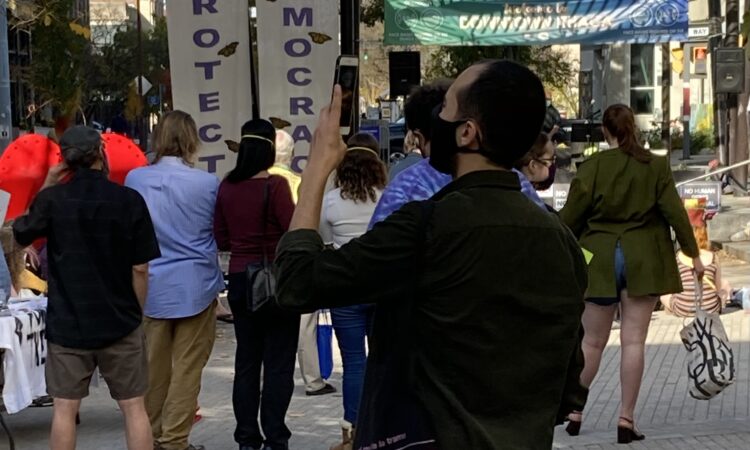
 

War: Only If We Care Will We Listen. Only If We Listen Will We Hear.

At 10:30 pm EST on Wednesday night tv programs were interrupted for a special report no one wanted to hear. War.


I’m sitting here, like millions of people, horrified. Watching a nightmare unfold on tv. Americans, Europeans, people all over the world, but especially Ukranians, who were being awakened at 5:30 am to the sound of bombing, too shocked, too frightened to speak.


I was watching NBC and at one point the reporters, I think it was Tom Llamas and Erin McLaughlin, just stopped and let us see the city of Kyiv, at night. We saw in the forefront a beautiful cathedral, a beautiful city lit up behind it. And we heard a moment of silence interrupted by explosions in the distance. The silence of the reporters was like a prayer for the lives of these people. And maybe for all of us. A last look at a beautiful city threatened by an enormous cloud of violence and malignancy.


And I thought, what will this city look like tomorrow? The reporters told us about bombs, missiles, and the threat of infantry. And all of this preceded by cyber-attacks, disinformation, all combining to interrupt the connection between the government and its people; the government and its military forces. To isolate in fear. Russian agents going through the streets looking for Ukrainian leaders or people of influence. To arrest? Murder?


This is now. But we’ve seen it coming, although almost all of us prayed in our own ways that it wouldn’t happen. Putin has been building up to this in Ukraine for months and years. And in the U. S. we’ve seen forces of autocracy, oppression, malignant greed, narcissism, ignorance attacking democracy and decency at the root. Attacking education. Attacking unions. Attacking a free press and the very concept that a news organization should aim at truth. Attacking authentic political speech and protests. Attacking diversity of thought. Gender, race, religious freedom. And many on the right, in the GOP are supporting Putin. Supporting Russia and war.


And cyber-attacks are happening here, in the US, too. Led by agents from Russia and other nations. Other autocrats. Not only in the 2016 election but since then.


Attacking democracy is not an abstract attack just on a political system. Democracy means everyone has a voice, which means everyone has rights and a bit of power, responsibility, and value. Just for being alive. Democracy is attacked so only certain people will have power, will have rights, will have value just for being human, alive. Attacking democracy is happening so one small group, less than 1% of the population, can steal the wealth of the many to give it to the few. Democracy is attacked so one group can turn other groups from fellow humans to items with value only for what they can contribute to the one small group in power.


What we’re seeing played out in front of us in Ukraine, the U. S. and elsewhere is the Shock Doctrine actualized. Behind recent threats to democracy, internet security, etc. is the threat of chaos. Loss. Shock. De-stabilizing society so even those not threatened by direct violence from Putin will feel threatened. We will feel threatened also by those who were on the streets of Charlottesville and elsewhere. Or from increasing gun violence, while that violence is indirectly protected by those who claim to only want to protect their right to own guns. (In 2020, according to the Pew Research Center, more people died from gun violence than any other  prior year. The violence continues to increase today.) Many in the GOP and those who support them seem to want us so afraid, so on edge, we will accept the unacceptable. But we won’t.


I can relate to people, now, who want a gun to protect themselves, their family. Their rights. I want to protect myself, my family. My rights. But there are more important and proficient ways to arm ourselves. It is more important to make ourselves strong inwardly so what we do outwardly makes the situation better, not worse.


When we feel so strongly the horror being inflicted on others, and fear so strongly who might be next, it is our responsibility to make our hearts open and our minds as clear as we can. The situation is so traumatic that to let our minds digest information and think critically we need to be kind to ourselves. Empathic.


We need to be as literate about the media as possible. And question what we hear as we search for the truth amongst all the lies and distortions. Who is giving us this information? What is the source? What is the bias or perspective? Is it from someone expert in the field? Is it firsthand, second hand? Is it backed by a reputable agency or university source?


And how do we listen? Do we recognize the source as another human being, as fragile and tender as we are? And as we listen to reporters, pundits, neighbors, do we listen to ourselves? Do we hear the thoughts in our mind or hear sounds outside our room or home as part of the music of our life?


Do we feel the sensations in our body? Our breath? Can we feel ourselves as one of all the selves in this world? Can we feel ourselves in community with those in Ukraine? Can we take on minor burdens to help those facing the worst of burdens? Can we send *support to Ukraine in any way we can? Can we help those physically fighting autocracy by opposing autocracy here?


Only if we care will we listen. Only if we listen can we hear. When the world is threatened and our hearts are afraid, that is the most important time to pause and listen. That is a moment we can make a difference.


*To send support to Ukraine, one resource is Charity Navigator.

**This article was syndicated by The Good Men Project.

Is it Time to Retire? Finding A Meaningful Life After Ending a Teaching Career

I can’t imagine a more complex and challenging time to think of retiring than today. When I retired from teaching, I felt I was doing what people had done forever. I was 65 and had reached an age where change and slowing down was needed. But now, as I try to empathically feel what a teacher might be experiencing as they contemplate retirement, I’m filled with such contradictory feelings.


We might be retiring because we’re exhausted. Our job, our whole profession has been attacked for years. We might feel unsafe due to the pandemic and the inadequate response by our school district to that pandemic. We might be retiring because we’re sick of hearing from people, possibly parents, who don’t want their children to be educated in history, particularly the history of racism in the U. S., or about global warming, democracy or whatever.


And maybe, it is just that time. We’ve experienced a challenging era and survived; hopefully, we feel fulfilled, that we’ve helped so many people. And it’s just time to move on to another phase of our lives.


But what troubles many of us is what will we do with ourselves once we no longer have such a busy life? I noticed this fear myself, but it turned out to be mostly a fear of the unknown speaking. Every retiree I know has told me finding something positive to do was not a problem.


Yet, it’s best if we retire to something not from something. As a teacher, we are a person with a calling to help others. This doesn’t end when the job ends, although taking care of ourselves can now come first.


Steps to Take:


Since the world has been so tough lately, one of the first things we can do is heal….


**To read the post, please go to MindfulTeachers.org.