
Hitch-Hiking the Unknown: The Intimacy of Night

It’s 3 am, no moon, just darkness. I’m sitting in the living room in a la-Z-boy and turn on a lamp to provide just enough light to write by. And it feels like a whole universe fits under this canopy of light. It’s so quiet. So alone. Nothing yanks at me for attention, except maybe the hands of sleep. They almost close my eyes, almost.


There’s this woodblock print by a prolific and fantastic Japanese artist named Kawase Hasui. It’s of The Sanggye Pavilion or temple, located by a body of water in Korea. The structure is so strong, but bare. In the background, trees, of beautiful oranges, reds, and yellows. A man stands alone by the bright trees and water, just like I sit alone by the dark.


We might often think of ourselves as alone, especially when it’s night, and we’re in pain of some sort, or afraid, have suffered a loss; or we feel the breath of death on our face. Maybe that’s why the man in the woodblock gets to me. He’s clearly not young, but still very upright. He’s looking off to the autumn trees. Is it autumn in the woodblock because it’s late in the man’s life?


It’s so hard to look directly at our own aging and to understand it. It sneaks around all the seconds of life until suddenly, it’s just there. A pain, a sickness, a lost friend. How do we come to realize we only live because we age, and that our constant changing is what carries us through life? And when we’re awake to these changes, like we can be in the quiet dark of 3 am, so much becomes clearer to us. Our mind and the world feel so intimately here for us.


And when we’re awake like this at 3 am and we’re lucky enough to be relatively pain-free and open to consciously focusing on our existence in this very moment, we can better discern and decide the great matters of our lives. Consciousness was created just for this purpose, to see who we are, see ourselves both here, alone, and in a greater context, carried by the entirety of life, so we can better make decisions about what we do next with our life.


When I was 24 or so I hitch-hiked from NYC to San Francisco and Berkeley. It was the 1970s, a very different time than this one, and soon after I had returned from the Peace Corps in Sierra Leone. Hitch-hiking was never the safest way to travel. But I was trying to figure out what to do with my life.  And when we’re out there like that, on the road, thumb out, so blatantly in the realm of the unknown, with little to serve as protective walls between us and the vagaries of what we might be exposed to, anything can happen at any time. We can get arrested, attacked, run into people from our past. Run into insights and beauties of all kinds.


I ran into someone from college, who had been in the theatre group I was once part of, and we spent a wonderful afternoon together. I met and stayed with one cousin and by chance ran into another. What I needed, I found.


One day, I decided to hitch-hike north, to Mendocino, California, to find a friend I had grown up with. All I knew about where she lived was that she was part of a commune in northern California⎼ and there were communes in Mendocino. I got a ride to a small town most of the way to my destination. But then nothing. No cars, no rides.


I was beginning to think my whole plan was crazy. How could I imagine I could just set off without knowing my destination and actually arrive there? Then a car stopped on the opposite side of the road and a woman emerged from the car. She had a small backpack and soon put out her thumb. After maybe a half hour of doing little but standing on opposite sides of the road wondering about each other, we smiled back and forth. I crossed the road, and we started to chat.


She asked where I was going, and I told her I was looking for a friend (I’ll call) Jo, who was living in a commune somewhere in northern California. My new acquaintance said she lived in a commune in the area. And a housemate of hers, named Jo, had just left for New York to meet up with a friend who had just returned from the Peace Corps. Me.


Just then a car stopped for her. She told me the name and location of the commune and then left with her ride. I eventually got to the commune, stayed for a few days, and then returned to Berkeley. It took a few months before Jo and I could get together….


**To read the whole piece, please go to The Good Men Project.
When Trees Speak: The Dark Does Not Descend on Us. It Emerges from Inside Where Eyes Meet Others

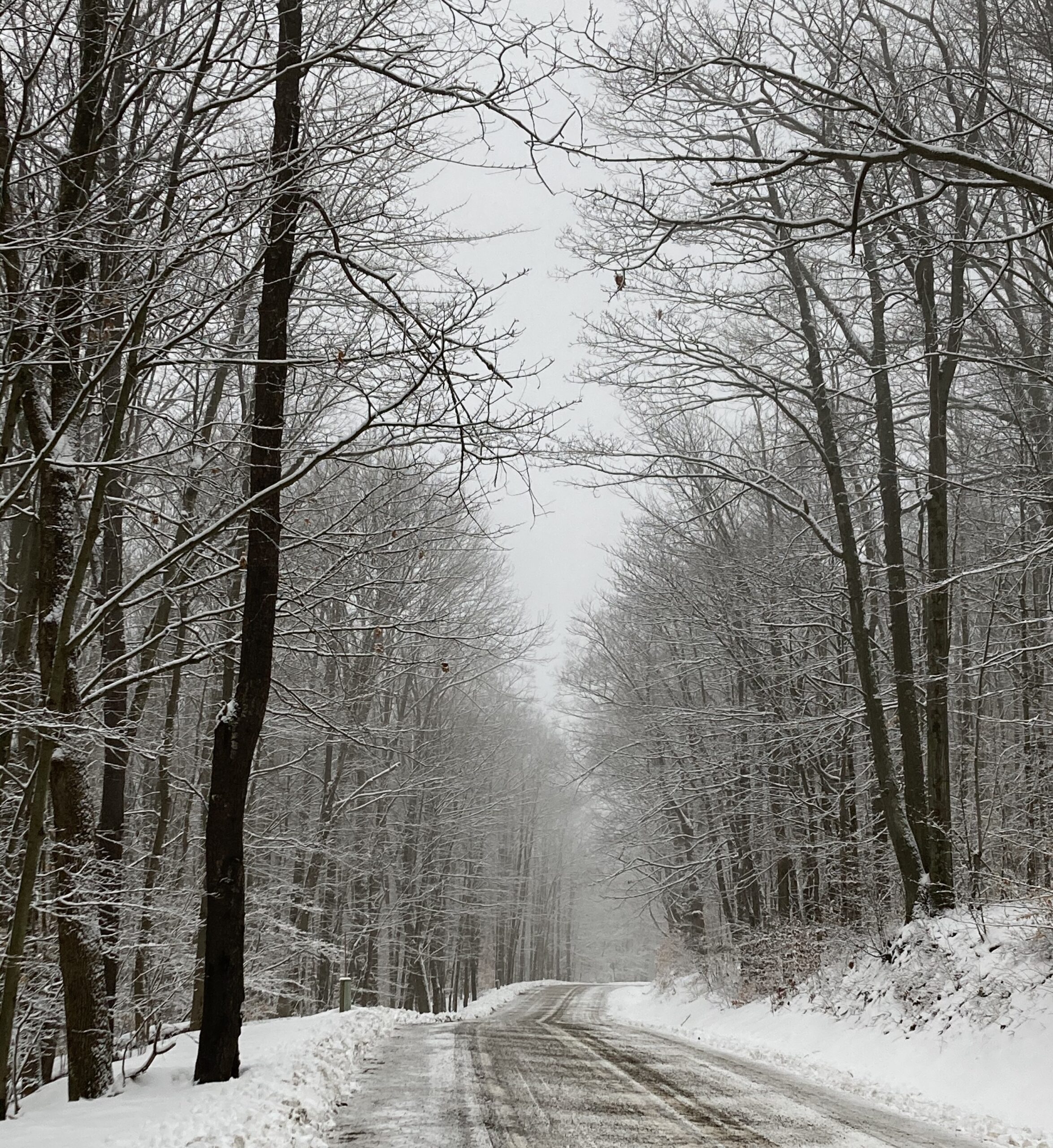
My wife and I took a long walk late in the afternoon. The sky was mostly dark grey. It had rained earlier, with a touch of snow. With the dropping temperature, the rain turned to ice, which coated all the bushes, tree branches, and electric lines. There was just a hint of the setting sun, but that hint was reflected and augmented by the ice, so everywhere we looked there were individual hands and fingers of light, thousands of them.


As the light disappeared further, instead of the dark descending on us from above, it was as if it emerged directly from inside everything we noticed⎼ from each tree or bush my eyes met or from the road itself. Details and colors, and the remnants of light icing the branches seemed to be sitting on darkness and winking out.


In previous years, during the winter I did not often go outside to exercise. It takes heavier clothes and boots, mittens, and hats, and the road and paths are often slippery. I used to work out in the gym or martial arts dojo. My wife did yoga classes. Now, due to the coronavirus, especially with new and more virulent strains⎼ and the vaccine so close yet not widely available⎼ our home is our gym and we hike steep hills in almost all sorts of weather. An added benefit is we also see our neighbors more than we used to, or at least the ones who walk.


Walking has become a stable part of our day, not only a way of getting out of the house and getting exercise, but a classroom and a way to constructively structure time. As we walk, we study how the light plays with the road and trees, and how the trees play with sound. By paying careful, mindful attention, we better understand and feel more at home wherever we are.


It’s usually so quiet we can hear the other residents of the road. Three ravens live in the pine forest and often fly over us, speaking with their hoarse cry. The trees speak with unexpected voices. The pine forest occasionally makes sounds like a cat calling out. When I first heard the sounds, I responded, shouted out the names of my cats to see if one of them was in there. But no cat emerged. Other times, especially when it was windy, the pines sounded like wind chimes. Further up the road, a very different voice. Oak, maple and ash trees leaned into each other, speaking in groans, sighs or whispers. Each tree or pair of trees had its own voice.


When we arrived home today, the mail was waiting for us. It was not just ads but a package. A new book, or actually an old one I had to search for, a translation of The Four Chinese Classics, by David Hinton. I took off my coat and gloves and sat down, excited to see what the book would offer.


I opened to a random page. It was in the Chuang Tzu, one of the two most important books of Taoism, and read the following passage spoken by an adept named Piebald: “In the awesome beauty of mountain forests, it’s all huge trees a hundred feet around, and they’re full of wailing hollows and holes⎼ like noses, like mouths, like ears, like posts and beams, like cups and bowls, like empty ditches and puddles… When the wind’s light, the harmony’s gentle; but when the storm wails, it’s a mighty chorus.” …


To read the whole piece, please go to The Good Men Project.


Did You Ever…

Did you ever walk into a bookstore, or any store, and there, on a display table, was exactly what you were looking for? You might not have even known what you were looking for until you found it. But there it was.  And you knew it. Or, you go into a bookstore and you have a question in the back of your mind. You open a book—and there, on that page, is the answer to your question. You can tell that I like bookstores.


Or, I wake up and know I have to work on writing my blog. And I pick up some essay or book that feels meaningful or appropriate to what I’m writing. I’ll read three of four pages—and suddenly I have an insight or idea to write about. Or I drive into town, thinking I need to ask someone a question or I worry about how someone is feeling. I park my car and walk a few blocks and there she is, coming right toward me. You know these experiences, right? They don’t happen often, but when they do, life seems just right.


Some people, like Carl Jung, have called these experiences “synchronicity” or an “acausal connection through meaning.” According to a book by physicist Victor Mansfield, synchronicity is a correlation between outer and inner events that is meaningful to the person (or persons) involved, but one event doesn’t cause the other. My thinking about the person doesn’t cause her to appear, yet there she is, and it feels meaningful and even mysterious to me.


Can a similar thing happen even in a conversation? You don’t know, at least not consciously, what it is you want to say to the other person. But suddenly, it’s there for you. Maybe you even know you had to say something to a friend and you couldn’t figure out how to say it. You fretted, worried, and imagined all sorts of negative results. But then, you are with this person. And your heart opens and you just say it and it’s perfect. Is this the same as what happened in the bookstore? The first examples are, apparently, a synchronicity between internal and external events. In the second, it seems to be all “internal.” Is it?


All I know is that sometimes my attention is awakened. I feel more alive and clear headed. And then I know what to say or do more than at other times. Does meditation assist this? Practicing compassion and empathy? I think so. Or is it just luck, whatever that is?


It’s valuable that teachers and parents talk with their students and children about how they experience their lives. This includes not only thoughts, emotions, and ethical quandaries, but more subtle experiences like synchronicity. Why? Because it happens, and it’s one of those moments to savor. There are so many inexplicable moments in life. Savor this and other mysteries might be revealed, other questions answered. And by doing so, teachers and parents communicate to children the value of their lives, the value of being aware of their experience, and the value of sharing and examining one’s own experiences with others.