
Hitch-Hiking the Unknown: The Intimacy of Night

It’s 3 am, no moon, just darkness. I’m sitting in the living room in a la-Z-boy and turn on a lamp to provide just enough light to write by. And it feels like a whole universe fits under this canopy of light. It’s so quiet. So alone. Nothing yanks at me for attention, except maybe the hands of sleep. They almost close my eyes, almost.


There’s this woodblock print by a prolific and fantastic Japanese artist named Kawase Hasui. It’s of The Sanggye Pavilion or temple, located by a body of water in Korea. The structure is so strong, but bare. In the background, trees, of beautiful oranges, reds, and yellows. A man stands alone by the bright trees and water, just like I sit alone by the dark.


We might often think of ourselves as alone, especially when it’s night, and we’re in pain of some sort, or afraid, have suffered a loss; or we feel the breath of death on our face. Maybe that’s why the man in the woodblock gets to me. He’s clearly not young, but still very upright. He’s looking off to the autumn trees. Is it autumn in the woodblock because it’s late in the man’s life?


It’s so hard to look directly at our own aging and to understand it. It sneaks around all the seconds of life until suddenly, it’s just there. A pain, a sickness, a lost friend. How do we come to realize we only live because we age, and that our constant changing is what carries us through life? And when we’re awake to these changes, like we can be in the quiet dark of 3 am, so much becomes clearer to us. Our mind and the world feel so intimately here for us.


And when we’re awake like this at 3 am and we’re lucky enough to be relatively pain-free and open to consciously focusing on our existence in this very moment, we can better discern and decide the great matters of our lives. Consciousness was created just for this purpose, to see who we are, see ourselves both here, alone, and in a greater context, carried by the entirety of life, so we can better make decisions about what we do next with our life.


When I was 24 or so I hitch-hiked from NYC to San Francisco and Berkeley. It was the 1970s, a very different time than this one, and soon after I had returned from the Peace Corps in Sierra Leone. Hitch-hiking was never the safest way to travel. But I was trying to figure out what to do with my life.  And when we’re out there like that, on the road, thumb out, so blatantly in the realm of the unknown, with little to serve as protective walls between us and the vagaries of what we might be exposed to, anything can happen at any time. We can get arrested, attacked, run into people from our past. Run into insights and beauties of all kinds.


I ran into someone from college, who had been in the theatre group I was once part of, and we spent a wonderful afternoon together. I met and stayed with one cousin and by chance ran into another. What I needed, I found.


One day, I decided to hitch-hike north, to Mendocino, California, to find a friend I had grown up with. All I knew about where she lived was that she was part of a commune in northern California⎼ and there were communes in Mendocino. I got a ride to a small town most of the way to my destination. But then nothing. No cars, no rides.


I was beginning to think my whole plan was crazy. How could I imagine I could just set off without knowing my destination and actually arrive there? Then a car stopped on the opposite side of the road and a woman emerged from the car. She had a small backpack and soon put out her thumb. After maybe a half hour of doing little but standing on opposite sides of the road wondering about each other, we smiled back and forth. I crossed the road, and we started to chat.


She asked where I was going, and I told her I was looking for a friend (I’ll call) Jo, who was living in a commune somewhere in northern California. My new acquaintance said she lived in a commune in the area. And a housemate of hers, named Jo, had just left for New York to meet up with a friend who had just returned from the Peace Corps. Me.


Just then a car stopped for her. She told me the name and location of the commune and then left with her ride. I eventually got to the commune, stayed for a few days, and then returned to Berkeley. It took a few months before Jo and I could get together….


**To read the whole piece, please go to The Good Men Project.
Schools of Education Should Become Academies of Listening: Finding A Magical Eloquence

I woke up at 1:15 am. I didn’t want to be awake. I wanted to rest and dream. To be unconscious. Then, in the background, I heard a wonderful mix of sounds that surprised me with its steady presence. And my attention shifted to it⎼ to the continuous song of crickets, harmonizing with the individually louder, more irregular song of cicadas.


And maybe it was some quality in the sound itself or maybe it was in the focusing of attention, but the sound became everything. Afterwards, I thought it a bit magical, because all inner dialogue, all talk about missing sleep or missing anything, had also disappeared. This was not something supernatural, but revealingly natural. Inner dialogue requires a sort of split in being, an idea of a me to talk and another to talk to. But the song of crickets was both the speaking and the hearing, the subject and object. For a moment, hearing the crickets and cicadas was hearing listening itself. Then I fell asleep.


Sometimes our lives can be so precarious, painful, and bleak. Or it can seem banal one minute, and alive, unexpected, instructive the next. The focus on crickets doesn’t always work; it’s not a sleeping pill. It’s not automatic. But, I think, we all want experiences that are engaging and interesting, or that make us interesting, to ourselves, as well as to others. That, as the poet David Hinton says in his book Orient: Two Walks at the Edge of the Human, awakens in us a good story, one that exposes our uniqueness. This simple magic does that. We need a quality of attention to get there, that allows us to hear the eloquence of crickets and cicadas. That allows us to find in that eloquence a universe larger than where we often imagine we reside.


I usually meditate and exercise in the morning. For years, I’ve been learning how to keep attention awake to whatever arises inside or around me, and to attention itself, so it doesn’t get lost in distractions. Or I’d do a standard practice of counting each breath. This entails counting each exhalation. Then being aware of each inhalation and the space between the two. As I exhaled, I’d silently say onnnneee to myself. Then I’d feel the pause⎼ and let the inhalation happen simply by itself. And with the next exhalation, I’d say twwwooo to myself. But on this day, each pause became clear, and not just something to get done or cross off a list. Every breath, every moment became important.


I realized how my “normal” awareness often skipped over moments. And I didn’t want to skip so much of life. I didn’t want to lose the moments when crickets speak, for example.


And there’s another reason why the sound is so important to me. It has a personal meaning. Crickets get so loud at the end of summer. And when I was still working, still teaching, and August came around, the crickets would remind me that my vacation was almost over. The  new school year was about to begin, and the sense of summer’s freedom was almost gone. I had to take advantage of this moment now, before it was lost to me. So, each night, I would sit on one of the steps of my deck, one of my cats on my lap, and I’d do nothing but listen.


And this pausing in my life helped me prepare for the school year….


*To read the whole article, please go to The Good Men Project.
Feeling More Comfortable with Aging: Maybe If We Stop Fighting Ourselves Our Lives Might Not Seem to Pass as Quickly

All through my life, I felt I would continuously get better at doing things. With practice, I’d improve in sports, or writing, carpentry, cooking⎼ whatever I set my mind and body to do. Maybe most of us feel this way. Practice improves performance. But this is no longer true for me, at least not with physical skills and activities.


I had in the past assumed that if I had a pain, it was temporary. And if I treated it kindly, wisely, and went to consult a doctor or some form of healer, it would eventually go away. No longer. Pains appear and do not always go away. They change all the time, but do not disappear forever.

And meanwhile, time, life can go by too fast. Aging is changing.


The older we get, the faster our days, weeks, lives seem to disappear behind us; or the speed at which our life passes is directly proportional to our age. This seems to be a syndrome that plagues all (or most?) of us as we age. Maybe we should call it the aging time syndrome.


I first heard about it in a college philosophy class. The professor said it was often used as an argument against the existence of an omnipotent, omniscient, and omnibenevolent creator. How could a beneficent God allow time to speed up for us as we got closer to death?


Why it happens is not understood. Is it caused by a slowing down in our ability to process information so we can’t keep up with time passing? Or is it because aging means we have more memories of old moments to shorten our habitation of the new? I don’t know.


But the more I think about it, the more it becomes clear that what happens is not that the present goes by faster. We still have moments that can seem to last forever. What happens, I think, is that as we age, the past gets larger quicker. We look back and suddenly feel the day, the week, the decade⎼ they were here one moment, and too quickly, they’re gone.


Is this sense of the past getting larger quicker an inherited alarm clock? An inborn prompt that evolved to teach us to live the last years or moments we have left more fully?


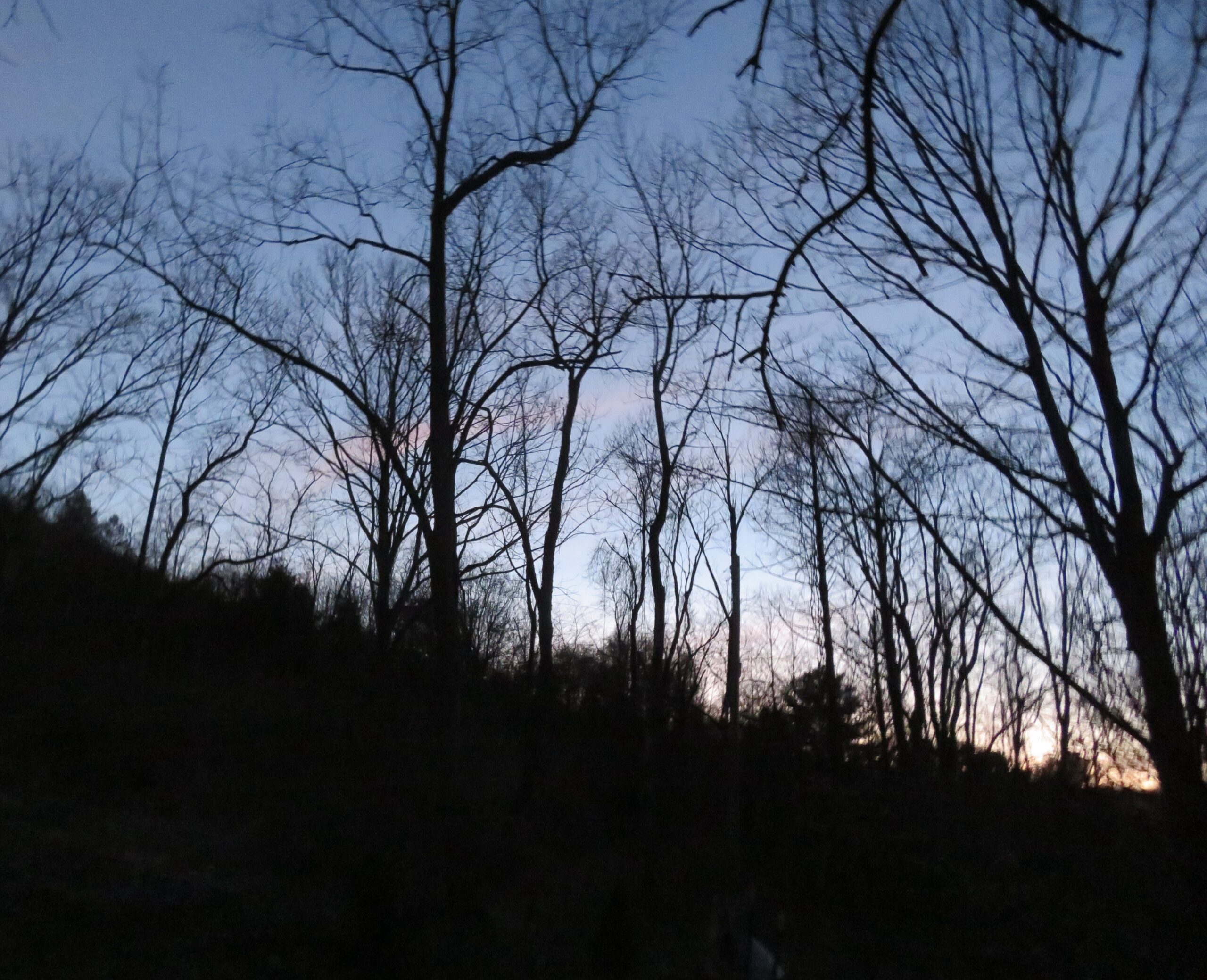
Last night, I discovered new twists in an old exercise. At 3:30 am, after pain woke me up and I had trouble getting back to sleep, I decided to return to window watching, a practice I had begun earlier this year. But I changed it a bit and discovered new applications for it.


Instead of gazing out the window to simply notice the beauty of the world, I took a breath and then looked to see what before I might have missed. I asked the night what beauty is here that in recent times had eluded me? What had I never verbalized to myself or others, or never felt? Or: what can I perceive now because of what I had noticed before? I looked outside; then closed my eyes and visualized the scene in my mind. Then l opened my eyes and looked again….


*To read the whole article, please click on this link to The Good Men Project.


Even If We Don’t Get Sick, We Can Feel Sickened by the Crisis: Remembering A Better Future is Possible

Last night, I woke up at 4:50 am. It was dark, no moon was visible, and I felt very tired. All I wanted to do was go back to sleep. But images I had seen on tv of an overcrowded New York City hospital started to play in my mind and I felt a roughness in the back of my throat. I wondered if that roughness meant I was just getting a sore throat or was it the first sign of the coronavirus.


I began to think about the one day in the last week I had left home to pick up vitamins and groceries and to worry if my attention might have gone lax, or if I had done something stupid that exposed me to the virus. Even if we don’t get sick, the crisis can make us feel sick.


So I went downstairs to the kitchen, closed the door so my wife wouldn’t be disturbed, and gargled. That helped. Then to the living room, to turn on a reading lamp, and sit in our recliner. Reading a novel was an option, but my eyes wouldn’t stay open.  So I closed them, took two gentle breaths, and started to change my mental channels to focus on something more calming.


I pictured my own smile (you could also use the smile of someone you care about) and placed it in front of me. That felt good. I pictured it on my face ⎼ pictured me smiling. I turned it into a smile meditation. But it was too dark, and I was too tired to see it well. I tried to add some white, healing light, and move it to my throat, where I had felt the soreness. But the night was like a black hole and absorbed all the mental light I could create.


So then I decided to experiment, to see what would give me comfort and let me sleep. I thought of my blogs, and the comfort or beauty and sense of their own strength people said they found in them. The image of my students came to mind. If I got sick or died, they would have to find someone else to teach them. That revived me. Compassion for others replaced worrying over myself….


To read the whole post, go to The Good Men Project.