

It was about 9:00 am. I opened my eyes and got lost in colors and sounds, some of those sounds soon becoming voices. The voices were possibly from outside the house or inside, outside my head or inside a dream. They were just sounds, with a hint of something familiar. And I was just there, listening; listening to everything, and not wanting to do anything but lie there in the easy tired warmth that can come at the end of night.
I remember one time sitting with one of my cats. She gets so happy she almost talks, her words a language of cries, snorts, and kneading of the blanket. It’s a language I of course didn’t totally understand, but I get the drift. She also loves to rub noses, which always evokes a deep smile in me. I feel so full in her presence that all that remains of me is a deep and gentle laugh.
In both instances, I’m right there. But let’s say I want to tell someone about it. I get an urge to write this blog, for example, to talk about my funny cat or my taking refuge in the deep comfort of a warm morning, and I lose it. To write about her, I need to step out of my deep loving laugh as a snorting cat and look at me thinking about, and distinct from, her. But I guess writing can be another way to feel full or immersed, another sort of magic.
I was reading Zen master teacher Dainin Katagiri’s book, You Have to Say Something: Manifesting Zen Insight. He talked about there being a subtle feeling that exists before we decorate, expand, separate from or bury it with words. Before we move to approach, avoid, or stay still; before like, dislike, or feeling neutral arises. There’s a subtle state, he says, that we usually zoom right past. In that state, there’s “a oneness of our feeling with the object of our feeling.” A oneness with no sense of someone looking at it, no impulse to speak about it. His words shook me up and felt so alive and fresh. But as soon as I wrote them down
that life of meaning disappeared.
Back in February, I wrote a blog about re-discovering a leonine version of a Teddy Bear that I was given back when I was 5 or 6 and now lives on the back of the couch in the den of our home. That lion has seen so much of my life.
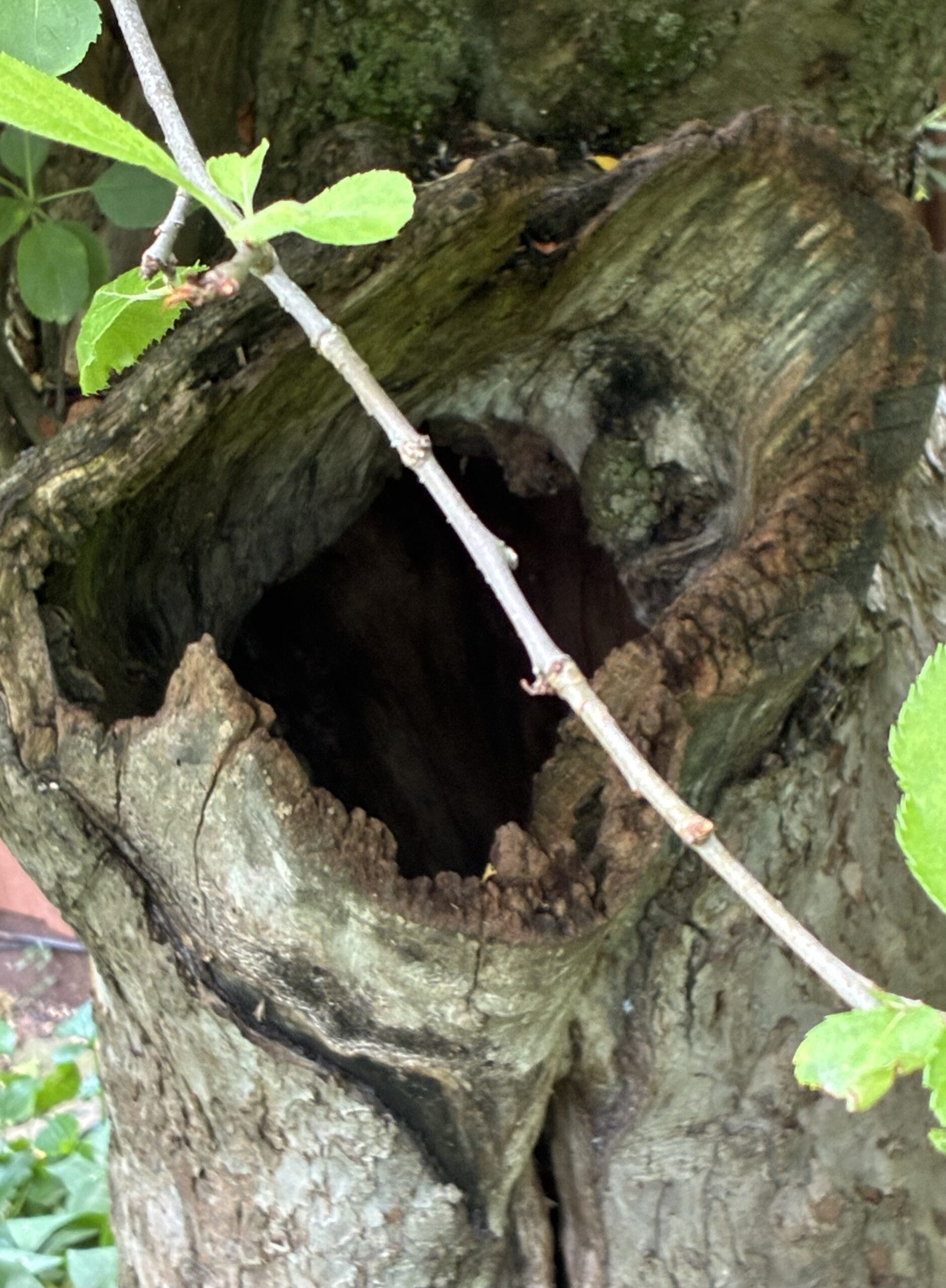
I look out my window at an apple tree that has been living outside our front door since we first built that door in 1972. That tree is so old, and so many limbs have fallen off, that what remains is a shell of what it once was, hollow, seemingly held up only by history and memories. And that tree goes back to other trees, a maple that had once lived in front of my ancestral home in Queens, NYC, back to when I was gifted with the lion. It goes back to pre-school, to a drawing of a tree that was used to formally teach me the word. It goes back to when I first spoke any word, probably Mama— Mama maybe being the root of all words. It goes back to ancient Sumeria and the roots of written language. It goes back to prehistoric caves like Lascaux in southern France and maybe the first symbolization. It goes back to the first humans or first hominids or first creatures to draw a breath. Or back maybe to the wind.
The tree isn’t me. Yet, without me and my wife and cats, who would know it, enjoy it, tell stories about it? When I see it, a universe of me can appear….
*To read the whole article, please go to The Good Men Project: