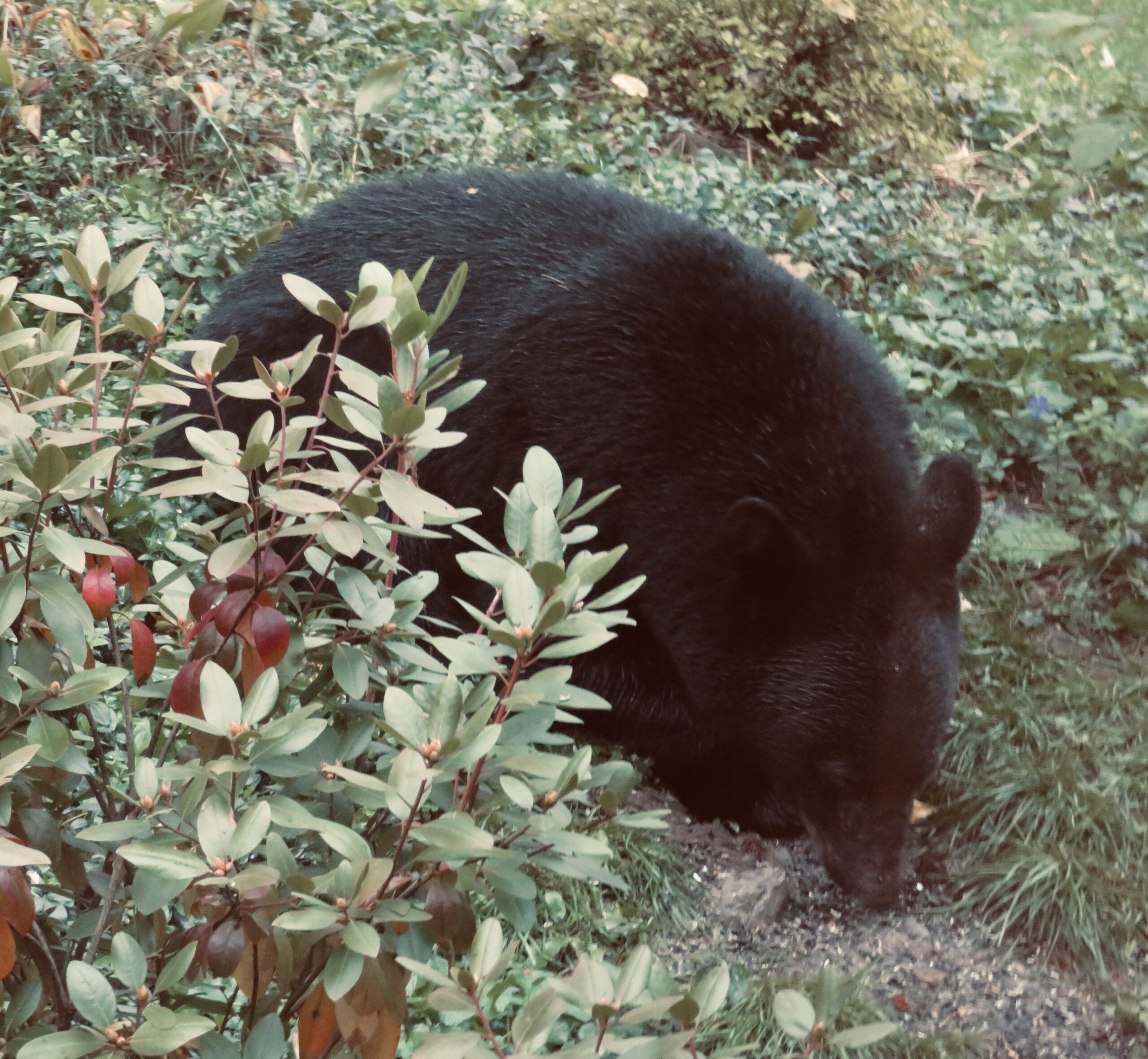
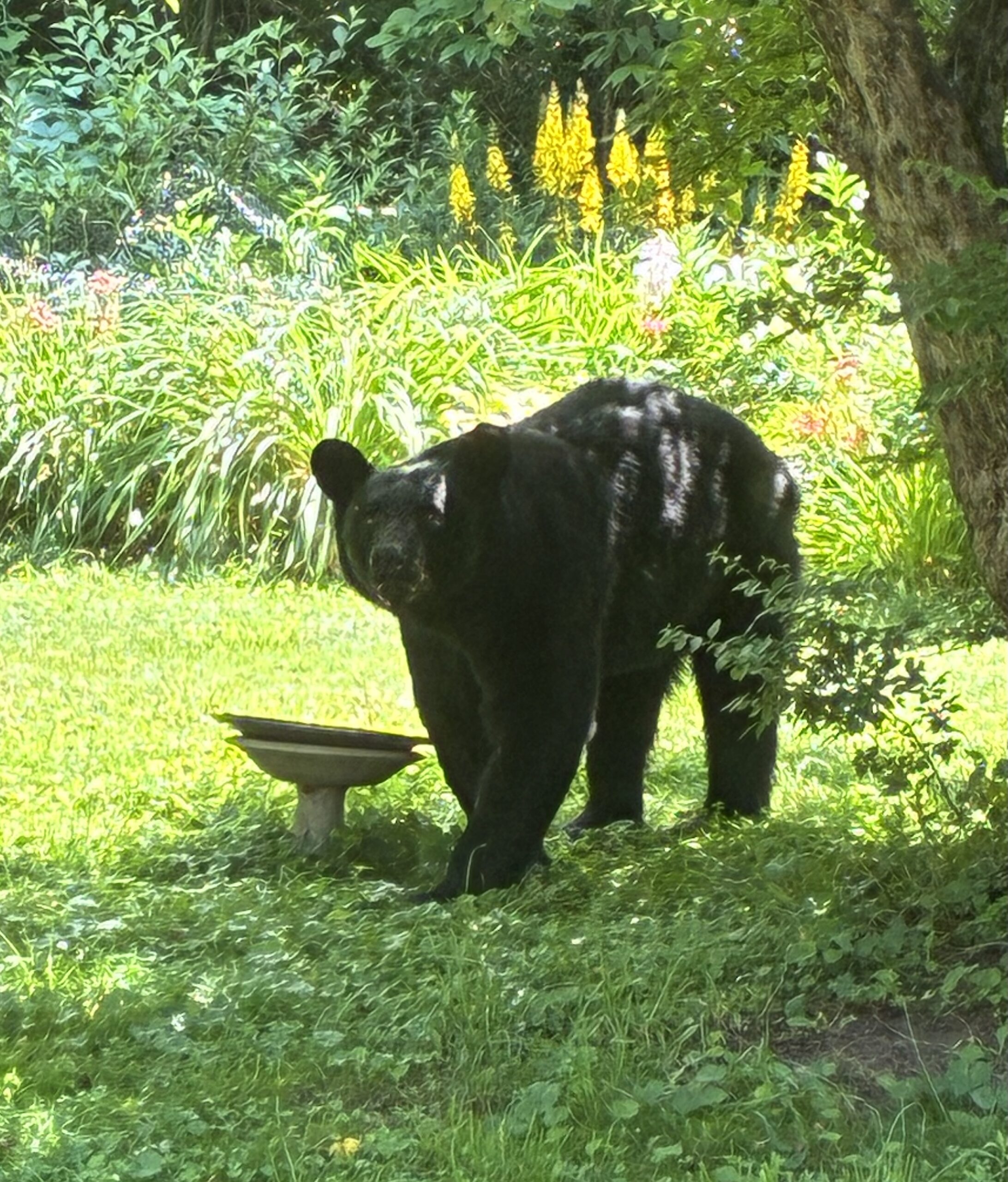

Last Sunday, around 2 pm, just as I was beginning an afternoon meditation, a black bear emerged from the woods behind my home. At first, I didn’t realize what it was. It was hidden by bushes and flowers, and all I could see was its massive side. Then it walked right by the door of the den where I was sitting. I went to the door, thinking my presence there would scare it away. It ignored me. It just continued on its way toward the front of the house, where my wife had earlier put out bird food.
I’ve seen bears before, several times. Four years ago, in the early morning, one came right to our front door and raised its paws as if to frame the window and look inside at the bird food stored there. I then went to the door, clanging 2 metal rods together; it immediately ran off. Not this bear. I shouted at him and he just leisurely walked on its way. Its presence was almost overwhelming; so, of course, I got my phone and, from inside the house, I followed him around taking pictures.
But at that moment when I first saw but couldn’t identify what it was, it seemed like a black cloud was walking through the yard and into my life. It felt like the unknown was taking shape and emerging from the darkness of the trees, a force both beautiful and fearful. All else was forgotten.
Maybe what was taking shape was the silence that resides before speech and memory can be born, and it shook me with its immense size. Maybe all such large, wild animals can seem almost mythological to us. Our Paleolithic ancestors, when not consumed by fear or the drive to hunt for food, were likewise overwhelmed when such animals appeared. And instead of taking photos, they drew bears, bison, or elephants, etc. on the walls of a cave. And then they could more deeply appreciate, remember, study, or spiritually enter the awareness of the animal. Such wild animals even today can allow us to touch the ancient lives of our ancestors.
When the bear came out of the woods, what message was my life perceiving in it? Clearly, it took me out of the realm of the usual. And, yes, it was also a great story to share with my friends and family, and you.
When it came to the front of the house, I once again got out the metal rods. But it didn’t run off until I walked out the front door shouting and clanging the rods together. It then disappeared—for the moment. Later, I heard a noise, like a window shaking. It was the bear ripping from a window a bird feeder mounted there, and I had forgotten to take down. When I once again clanged the rods together, it grasped the feeder in its arms and ran off.
The depth of meaning that any event can hold for us is rarely, if ever, clear. Nor can it be encompassed by words. To truly understand our lives, we need some humility about our ideas. But I did realize one lesson: when we delay doing what needs to be done, we pay a price. And it can come to bite us, or to steal our bird feeders and rattle our windows.
One of my favorite books is Joseph Campbell’s A Hero with a Thousand Faces. This book greatly influenced George Lucas in his creation of Star Wars and other movies. The movie follows Campbell’s analysis of a cycle or pattern that heroic characters have possibly followed in their path to enlightenment, redemption, or saving lives. It can be seen in widely divergent works of literature, myth, and religion such as the story of the Buddha and Bilbo Baggins, Edmond Dantes in The Count of Monte Cristo to Gilgamesh, the hero of the first story ever written. It can be seen in The Odyssey and ET….
*To read the whole article, please go to The Good Men Project.