

The Look We Give and the One We Get in Return Are Two Sides of One Reality: The Mirror that Makes Civilization Possible

I remember being told by my father not to catch anyone’s eyes when walking down a big city street. If we catch another person’s eyes, we might truly see who they are, but we’d also be seen by them; we’d become vulnerable. Seeing and being seen are linked. The look we give and the one we get are two sides of one reality.


Likewise, most of us have experienced yawning when we see another person yawning. Or felt tears coming to our eyes when we saw someone weeping– or felt bad when we noticed someone else feeling bad. Maybe for a similar reason, simply smiling can make us feel more like– smiling. Why is that?


In the book Ethical Wisdom: What Makes Us Good, the author, Mark Matousek details how “a newborn baby, barely able to see, can imitate the facial expression of adults within one hour of delivery.” When the child imitates a caregiver, this creates a coupling between the baby’s expressions, its emotions, and the other person. When a baby sees its mother or guardian, it waits for the other to see it. And when she does see him, her, or them, the baby lights up.


Science fascinates me. Or maybe it’s the ability to closely study reality and recognize patterns and connections underlying what drives us to do what we do or feel what we feel. It can help us perceive the universe more “objectively,” meaning relatively free from the enclosure of ego, or without too many of our biases and personal stories getting in the way.


When I was teaching Psychological Literature for high school students, we read chapters in books by neuroscientist V. S Ramachandran, especially The Tell-Tale Brain: A Neuroscientist’s Quest for What Makes Us Human. This book exemplified what I loved about science. It talked about so many topics that expanded our imagination and understanding of our humanity. It introduced us to imposter’s or Capgras syndrome, where we look at a person we know well, like our spouse or parent, and experience them as a stranger. Or synesthesia, which is when we blend our senses, so we might taste colors, see sounds, or hear shapes.


Students both loved the reading and yet had trouble believing the power of our brain to both expand our sense of ourselves or distort how we experienced the world.


It introduced us to one of the most fascinating discoveries in recent memory, the discovery of cells in the brain called mirror neurons. This discovery so captured the imagination of many people that it led to intense speculation; both scientists and non-scientists drawing conclusions before the science could catch up with our yearning for answers. I felt if the discovery hadn’t been made, someone would have had to make it up. As a result, attacks on the science began, and the whole subject went from the bright lights of headlines to the darkness of doubt and anger.


In the 1990s, a group of Italian scientists led by Giacomo Rizzolatti, at the University of Parma, discovered something weird. They were studying monkey behavior. When a monkey noticed an object, or interacted with it, for example reaching out their hand to grasp a peanut, certain sets of neurons fired. These same neurons also fired when the monkey watched other monkeys doing the same thing. In other words, they were understanding what the other was doing through having their own neurons fire as if they were doing it. They were “reading the other’s mind” by modeling themselves doing the action. Ramachandran described these neurons as virtual reality simulators provided by nature to help us understand the intention of others. They were natural empathy generators.


One of my students asked, if we can so model the actions of others, how come we don’t repeat them? Why don’t we constantly walk around imitating others?…


*To read the whole article, please go to The Good Men Project:
Who Are We? The Way We interpret An Action Determines How We Respond to It

How can we best understand ourselves and our history as a species? We humans have created so much violence, environmental degradation, inequality. Yet, we’ve also created incredible art, science, and love relationships. How do we emotionally and otherwise take in these absurd contradictions?


This is not just an intellectual question. It’s a huge and infinitely complex one. It concerns the nature of our mind and body, what we’ve inherited from parents or biological evolution, and what by history and cultural evolution. It has tremendous social-political implications as well as personal. It can affect how we feel about, and how much suffering we cause, ourselves and others.


Three friends from college and I zoom together once or twice a month. We often share poems, music, articles, suggestions, and questions. One recently shared article was particularly relevant to this question. It’s by Adam Kirsch and published in the January/February Atlantic. It’s titled The People Cheering for Humanity’s End: A disparate Group of Thinkers Says We Should Welcome Our Demise. It focuses on two opposing theories of where our species is headed, or where our evolutionary traits are driving us.


Most of us realize that the possibility of extinction is very real but would prefer to delay that ending as long as possible. But Kirsch says a variety of thinkers have challenged that assumption and revolted against humanity itself. The two most prominent of these theories are Anthropocene anti-humanism and Transhumanism.


The first states that our self-destruction is inevitable, but we should welcome it. Our species is destroying our home and the other creatures we share it with. What we most glorify in us, namely our reason and the scientific and technological achievements it spawns, is precisely what is destroying us. To preserve our home, we should leave it.


The second theory, Transhumanism, expresses a love for what the anti-humanists decry. Transhumanists imagine that some of our most recent and illustrious discoveries, like nanotechnology, and genetic engineering, will save us by allowing us to abandon the frail, destructive being we are now in favor of a new species that we’ve created. For example, a cyborg or hybrid of human and computer; or maybe a brand-new artificial intelligence.


Both theories are responses to the climate emergency we face, but they do so in opposite directions except, says Kirsch, the most fundamental. They both share the necessity for the demise of humans. And as I read the article and thought about my friends, what became clear was how our theories about life, and ourselves, are key to our responses, and actions. And this quality of mind and heart is precisely what most makes us human.


The theories, at least as far as I understand them from the article by Kirsch, do not deal enough with “why”— why do we act so destructively? Or, since it’s not all of us, why do so many of us act so destructively? Is it Ignorance? Self-centeredness? Greed?


Or maybe we’ve been so destructive due to patterns of thought and behavior inherited through cultural evolution as opposed to traits we’ve inherited through biological evolution. Has every human culture been so destructive? Maybe a culture that preaches we’re created in the image of God ⎼ that we must be fruitful and multiply and have dominion over all the earth and over every creeping thing ⎼ might be more narcissistic and less attracted by stewardship, less willing to control its fruitfulness, than one that emphasizes the interdependence of all beings….


*To read the whole post, please go to The Good Men Project.


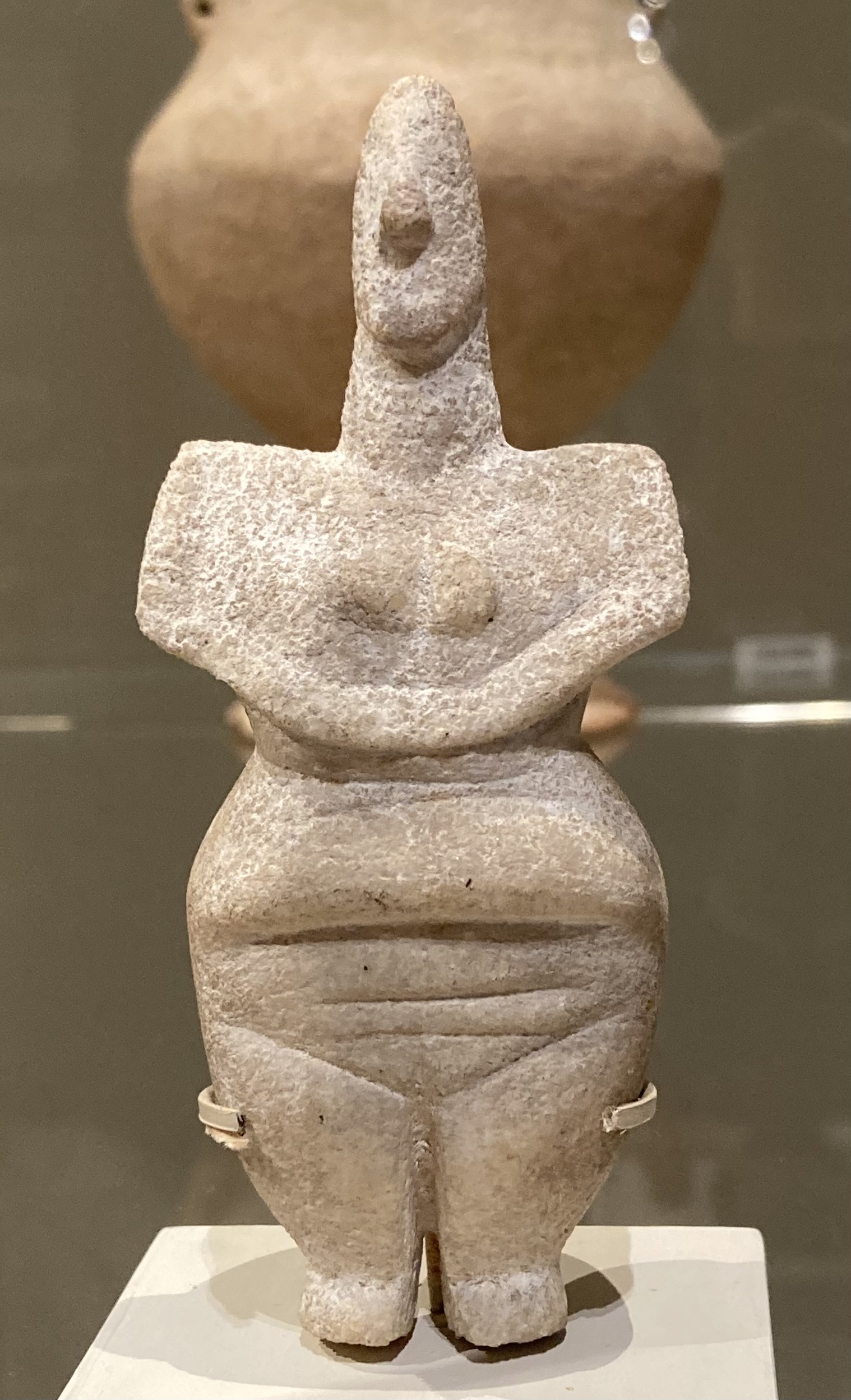
**The photo is of a Mother Goddess figure, from the Metropolitan Museum of Art, NYC.