Sitting In Silence

Can you sit still for 15 minutes and just think, without getting up or turning to a distraction, a phone, a book, a pen, music—or something shocking? A study recently reported by NPR says that most of us can’t. Besides asking people to just sit, alone, the study included a little twist. It allowed people who felt bored or incapable of just sitting to deliver a physical shock to themselves. The result: 70% of men and 20% of women could not sit for 15 minutes without shocking themselves, some repeatedly, despite the pain of the shocks. With the women subjects who didn’t shock themselves, researchers were not clear if the women were better at sitting still or better at not shocking themselves (or both? something else?).


Why is this? The study could only make conjectures about that. How do we want to understand this information? Does it mean that we are so dependent on media or on distractions that when we try to be without them, we can’t take it? Are we habituated to our media? Or is this evidence that most of us are not comfortable with ourselves? Maybe there are too many shadows lying in wait in the mind that people feel they can’t or don’t want to face? Or are we just uneducated about how to live in our own heads, or of the role of the mind in creating our sense of the world?


In our world today, not only are we bombarded with messages and pressures to keep up with the latest technology, we feel that doing so makes us appear more important. The busier we look, the more important we feel. Being constantly connected means people value you. The ping of the cell phone is an affirmation. So, especially for young people who grow up with digital media, being disconnected can mean being less valuable.


I think this experiment, as the authors themselves indicate, invites us to study our own thinking and experiencing. Other people’s answers won’t really help us. And we don’t need only ideas of why this might be true but a truth tested in our lives and feelings. If we can’t be with ourselves, who can we be with? Schools need to join in this self-study. Do we want to raise a generation of people who need an Ap or GPS to find themselves? With increased awareness, we feel less driven. Media becomes the car, not the driver.


Think of a time that you could do nothing but wait. Waiting is not the same as just sitting by yourself for 15 minutes, but in both you might start counting moments. When you wait in line to buy something, for example, you have this idea: “I have to buy this new ipod. When I get it, I will be thrilled, happy.“ Or: “I just want the movie tickets already. I just want to get her in the theatre, so we can sit and…” Or you’re waiting for news or for the next text. In any of these situations, you feel suspended in time. You have an image or idea of a future you, when you have whatever it is you are waiting for. And there is this other you, defined by what you’re not, by what you don’t have or what you lack. In fact, you are suspended not in time but between two ideas. You are taken out of time into a mere idea of time. Or maybe not suspended but enclosed in a box constructed of ideas taped shut with emotion. This is suffering.


So study or deconstruct what you think and feel when your cell phone pings or calls to you. You might think that these feelings come with the phone, but they come with you. You are the being who feels and thinks. And notice how your culture speaks of the value of media. Notice each ad on television, each time a phone appears in a movie. Notice if there are messages about being alone. And then notice the indifference of a tree or the breeze. Does the tree need to send a text to be noticed? When you focus on the feel of a gentle breeze on your face, do you still think about your phone? What is deepest about your phone is your collection of ideas and feelings about it.


Or you might think, ah, a 15 minute respite. I have nothing I have to do. Great. And if you interpret the situation as a moment of freedom from work or whatever, a moment to just relax, then yes, that’s wonderful. But is that what actually occurs when you put away your phone?


So, just sit. Pick someplace where it is easy to sit without slouching and you can be mentally awake. Maybe close your eyes so you can better notice your thoughts, emotions, sensations, and images. What comes up for you as you just sit? All you have to do is notice. You don’t need to add anything to the noticing. There’s no need to judge the quality or value of any of the thoughts or feelings, or judge yourself for letting them pass through your mind. Just witness what’s there for you and be open to yourself, kind. If you are open, the thoughts and feelings will arise and pass more clearly. Witness even the judgments as you watch clouds passing by. And notice, also, the sun when the clouds are gone, when there are no thoughts. By notice, I don’t mean note, like write a note with your mind, or bother to remember. Just be aware. Notice the stillness when the sky is vast, blue and cloudless. Patiently, calmly, notice whatever arises, as if your mind was that vast blue space. What is important is your patient interest, your awareness of your life unfolding. Now, just sit with that calm, still awareness


When you sit alone, just notice the thoughts or sensations. Let them be just the clouds in the vast sky, or the universe noticing what is arising in itself. The thoughts will then wink out, and what will be left is a universe of awareness silently enjoying itself.

Are We Purposely Undermining Our Public Schools?

So, here are my questions. These are not new questions for me or for many of you, but I thought I would just put them out there. There have been waves of attacks on public schools in the U. S. for the last 30 years or so. Are these attacks part of a larger war on the concept and institutions of democracy? One of the functions of public schools is to educate all students to be able to understand and meaningfully participate in a democratic government. It is to “level the playing field” so at least most people who put in the effort can create a good life. Are we now purposely creating “separate and (certainly not) equal?” And what role do the Common Core Standards play in this possible scenario?


Diane Ravitch argues in her book Reign of Error that different corporations, working with political institutions and individual politicians, are leading an effort to undermine public schools by undermining teachers, teacher unions, and the very concept that a public institution working for the general good, instead of a for-profit corporation, can successfully manage and direct an educational system. The strategy calls for publicizing deceptive and often inaccurate information to create a sense of a crisis in education so corporations can step in and save the day. For example, A Nation At Risk, a report issued by the Reagan administration in 1983, claimed public education and teachers were responsible for everything from a declining college graduation rate to the loss of manufacturing jobs. It said, “If an unfriendly foreign power had attempted to impose on America the mediocre educational performance that exists today, we might well have viewed it as an act of war.” It said graduation rates, SAT scores, etc. were decreasing—all later proved untrue. Academic achievement from 1975 to 1988 was actually improving, and not only for middle class white Americans. The divide in academic achievement between rich and poor, white and African-American, Latino, Native-American, was diminishing. But the A Nation At Risk report was just the beginning.


With the fomenting of decreasing trust in teachers and public schools, there was also increasing pressure to turn to private companies to create assessments, curriculum, and even to decide who would be allowed to teach our children. In 2001, President Bush supported and signed the No Child Left Behind legislation. This was a noteworthy achievement. It increased the number of standardized tests that our students had to take so we are now the most tested nation in the world. Then came President Obama’s Race To The Top legislation in 2009. Amongst other things, this set the stage for the Common Core, mandated that test scores be used in teacher evaluations, and encouraged the closing of public schools whose students “underperform” on test scores. And what was the result? Those dire claims about the education of our children began to come true. The divide in achievement between rich and poor, white and people of color was becoming either flat or increasing and test scores in general were either going flat or down.


Once most of the country was fooled into thinking of public education as facing a large scale crisis, there were increasing calls to privatize schools and create privately run, publicly funded, charter schools. From 2010-11 to 2011-12, for example, the number of students enrolled in charter schools rose from 1.8 to 2.1 million. This number continues to rise. With charter schools, public money is transferred from teachers and administrators, who are mostly in the middle or lower class, to corporate investors. In the case of cities like NYC, hedge fund managers, whose primary goal is fast profits not serving the public, have taken over several charter schools. Secondly, these schools, as Diane Ravitch points out, “…are deregulated and free from most state laws… This freedom allows charter schools to establish their own disciplinary policies and their own admission rules.” Unlike public schools, which must take any and every student who comes to their door, charter schools can screen for the most advantaged students. Despite this screening, charter schools are no more successful then public schools. And, when adjusted for the economic situation of students, statistics show they often do worse. Charter and other privately run schools can hire uncertified teachers who are not unionized, not as well trained, and who can be paid less. The public sector can now be drained of funds and left to educate the most disadvantaged students with fewer resources.


Public schools were further undermined over this same time period by federal, state, and local cuts to educational budgets, including cuts in teaching staff. In 35 states, for example, the funding in 2012-2013 was below 2008 levels. At the same time, there was an increase in spending on standardized testing. I don’t think it’s smart to try to increase the performance of schools by decreasing the number of teachers.


Now let’s discuss the Common Core Standards. They are so new that I don’t think we can fully judge their potential efficacy in improving instruction. What we can say is that if the standards are assessed, as they are now, through high stakes standardized tests, the Common Core will be largely irrelevant. In my opinion, it has been extensively and clearly shown that standardized testing is an inferior and inequitable way to assess educational achievement. These tests hurt our children by creating fear, limiting the depth of instruction, and wasting time and resources. They serve no diagnostic function. So, as long as the standards are assessed in this way, they are not being assessed at all. It is claimed the tests can help judge how well teachers or schools are doing. Good teachers are essential in educating students. But students all begin school in a different place. If you want to predict who will do well on a standardized test, what matters most is the economic standing of the family and community.


One danger of national standards is too tightly defining what should be taught. This can lead to the creation of a national curriculum, where all students are expected to learn the same material in the same way at the same time. Some school districts are already demanding that schools standardize the “sequence of the curriculum so students will be able to switch schools, districts, even states and not be out of sync in a new classroom.” I don’t think we want to replace the old situation, where states set their own standards, with one that requires everyone to move in lockstep—or fail.


If our society truly wanted to create an equitable educational system, and truly teach all students how to think critically, it would begin by investing more money in schools where the need was greatest. It would treat teachers with the respect that they deserve and need in order to creatively and compassionately meet the educational needs of students. It would do a better job of treating students as whole people with emotional, social, and health needs as well as intellectual ones. It would do any of these things before it would spend one nickel on corporate created standardized tests, charter schools or curriculums—or even national standards. So, is the corporate “reform” agenda part of a larger move in our country to undermine not only public education but the power of the public in general? I hope not. But, I think, that is the result.

Musings On A Reunion, Dreams, and Compassion

For too many students, schools are like factories, large institutions where they are inspected, tested and rated until they are passed on to other schools or employers where they are further tested and rated. But for others, at least many students from The Lehman Alternative Community School, school was a place where dreams were born, where the education of the capacity for imagination, for feeling that life was alive with possibilities, had a place along with the capacity to think critically. This insight was inspired by a graduate of LACS, John Lewis who, when still a student, created a mural of Peter Pan characters whose faces were those of students and staff from the school, youthful dreamers dreaming.


Two weeks ago, LACS had its 40th Anniversary Celebration reunion. I went to the reunion thinking about all the dreams that students had had for their lives, thinking even about my own dreams, and wondering how many saw their dreams realized or felt happy with their lives. How many would remember the school, and me, fondly and think we had prepared them well for the world? As soon as I opened the door to the beautiful guest house where the first event was held, I had my answer.


But first, think about dreams. There are so many different. even conflicting, ways we use the word ‘dream,’ some positive, some negative.  Start with night dreams. They arise out of a mystery, or they often feel like a mystery, and arise when we are most vulnerable. They can feel like an expression of what is most intimate to us, unknown not only to others but even to our own conscious awareness. So, we often push them away. Many of us remember few dreams even though we have four or five cycles of dreams (dependending on how long we sleep) each night. So we live our lives surrounded by a largely unknown territory of our own making.


Then there are day dreams. By daydreams we can mean those moments when we drift from the reality of now into flights of fantasy. Or we can mean imaginatively exploring possible courses of action or the meaning of what we think we truly desire. We can use the mind like a chalkboard or play movies of our own creation in order to explore scenarios of what might be. We set our mind free.


How well we use our capacity to dream depends on how much we are aware of what we’re doing. After a night-dream, we might think of our self as the hero or heroine. But that can be very deceiving. We perceive or experience each scene in a dream from either the perspective of a character in the dream, someone who looks like us, or from a “godlike” perspective looking down on it.  We can take this person who looks like us for the self, but I think that is a mistake. I think that each dream image is ambiguous, probably in several ways, but one way is that each element of the dream is yours. You are not just the central character or any one character but the whole scene. When you have the nightmare of being overwhelmed by a flood or wave, you are not just the being overwhelmed but the force of overwhelming.  When you are hugged by the love of your life, you are hugged by yourself. You need to take in the whole perspective as revealing something about your self, not just one element of it.


And this gets us to the reunion. The reunion lasted from Friday night to early Sunday evening. Saturday included an ASM, an All School Meeting, as part of a Symposium on Education. At our school, once a week the whole school meets to discuss some issue or proposal or to share an event together. So this was a poignant blast from the past for many graduates.


Dr. Dave Lehman, the founding father of the school and first principal, brought a proposal to the group. In our school handbook (we call it a footbook, to tell us where we are going) we define the school’s mission as creating global citizens, persons of character who strive to be caring, kind, sensitive to others, trustworthy, recognizing when there is bias, and such. Dr. Dave proposed that we add compassionate. Quoting the Dalai Lama, he defined compassion as “concern, affection, and warm-heartedness;… the essence of compassion is the desire to relieve the suffering of others.” To take action to relieve suffering. We ignore our own inner lives—and the inner lives of others—“at our own peril.” The motion passed overwhelmingly.


In her introduction to the ASM, Diane Carruthers, the present principal, quoted Septima Clark as saying that “education is freedom.” I’d add, to go along with Dr. Dave, that the recognition of interdependence is freedom. Compassion is freedom. A graduate, Megan Hanna, helped develop this connection. She said that compassion for others begins with compassion for oneself. We are too often miseducated into thinking that our welfare is opposed to that of others and so we often feel torn, bound, isolated. Like in a dream, recognizing that the whole dream situation and all the characters in it are you is liberating. Compassion is liberating as it wakes us up to how important other people, relationships, our surroundings and the quality of our experience are to us. It allows us to open up in inconceivable ways. We ignore this truth at our own peril and the peril of our planet.


Certainly, one of the tasks of childhood is to bounce against boundaries. We test out where we end so we can discover where we begin. We begin this homework assignment as children but our education in this subject continues throughout life. We start life with no notion that we, or our needs, end, but soon we start thinking of the skin as our boundary, that we end at our skin. But one of the main functions of skin is to feel the world. And certainly, as teenagers, we feel. What we think of as our end is thus a beginning. We realize our own capacities not as much by opposing what is “outside” the skin but by contacting it. Only then can we know it. Even to fight something, we need to first know it. Our end, the skin, and the “rest of the world,” or, in reality, our capacity to feel, is thus where we begin.


And this is what the reunion showed me. Leaving the school was an opportunity for graduates to learn the meaning of their dreams, which includes learning the meaning of their schooling and community. We are always embedded with others in a world, like a dream character is embedded in the whole of the dream. Students said, both in the ASM and in private conversations, that what LACS did for them was allow them to be themselves. It gave them the freedom to trust and thus discover themselves and to speak from that process of discovery. It did the same for me and for other staff members. We staff members knew we were doing something meaningful for others. We trusted (with some careful watchfulness) and tried our best to nurture others and in turn were, as much as we could be, nurtured. What we gave we received.


I came to the reunion hoping to hear that every student was a success and their dreams realized, but students made clear to me I had an outdated notion of success. Success is not really about worldly recognition. The mark of a successful life is how we live, and how much we feel we play an important role in other people’s lives and they play a role in ours. It is how we deal with our struggles and the world. This all ties in to the mirroring quality of compassion: how we live with ourselves is mirrored by how we live with others. We are all, as John Perkins said, dreaming the world together. And in recognizing that, I think most of our students are clearly a success, or they’re on the way to it.

Have You Noticed That You Are Getting Older?

If you look at your body and you’re over 70 or 60 or for some, 40 or earlier; all of us perceive aging differently and think of ourselves as “getting old” at a different age. And you see wrinkles and you feel aches and pains which before you never knew existed. And you wonder if you have some illness. You might have an illness. But the malady you’re experiencing, if you think of it that way, is aging. Is change. Is impermanence.


Aging is an illness only if you fear it. Only because you label or were taught to label wrinkles as something to fear, or pain or change as something to fear. But then, the fear is of fear itself. You fear your own sensations. You battle with your own body. And this can be awful. It makes any pain you experience feel worse.


You might have this idea of yourself. But the idea you like best is of a young woman or man. Our culture teaches that youth is beauty. So the aging self is seen as a younger self decaying, falling apart. So you never see your self as she or he is, now. You see only falling apart. And, truthfully, even that image that you had of yourself back when you felt young—that wasn’t very real, either. Do you think any image, any abstracted idea of a you, could encompass all that you are? You knew back then that your reality exceeded your idea of you, so even in your twenties or teens, you were nervous about your self and who she or he was. Even as a young person you suffered from thinking of change as something to be feared, and you labeled parts of your self beautiful or handsome and others as awful or not-to-be-perceived. You walked even then with a shadow.


So, what do you do? Understand this. Look back and perceive all the changes you have gone through and know that everything changes. If everything changes, even your fear and ideas can change. Notice what is deeper in you than your ideas. Your thoughts, that sensations of aging are symptoms of illness, are there primarily to reveal how you are thinking and how you are creating a sense of suffering. When you feel sensations of fear, when you start sweating and your stomach tenses and feels like the contents of a castanet played by some hyperactive child, these sensations are telling you about themselves, not you. They are saying: you are holding fear, but you are not fear. You can release it and put your attention elsewhere. Notice it. Greet what arises with as much openness as possible, then let it go. When you are open to whatever arises, this means you stop fighting your own life. You feel freer, more joyful. Is it easy to be open to change or to others? No. But noticing how this emotional process works is important.


And there is no way to age “correctly.” There is only doing it honestly, with kindness and the recognition that everyone—everyone, hopefully, goes through this. Look around you. We are all wrinkling.


When I was 66, after practicing Karate for 37 years or so, I felt that I was finally beginning to understand how to practice Kata—not that I could put this understanding into words very well. A Kata is a pre-arranged series of movements, each of which has meaning in terms of self-defense. Katas are at the heart of traditional martial arts practice, yet the part that I had the most difficulty doing well. Suddenly, there was good focus in my practice and a feeling of flow of movement. The judge who used to sit on my shoulder and make snide comments had, for the most part, disappeared. It was just the Kata. And I enjoyed doing it. There was pain, but it was just part of the practice. It is so wonderful to move in a way that accepts whatever shows up as just something new to perceive and greet. It doesn’t happen all the time, but when it does, I love it.


And to do this in a class, with teenagers—to discuss aging, discuss how we look at our selves and our bodies—can be liberating. To discuss what we fear most means that even what we most fear can be faced directly. Now that is an education.


*Next week: Dreams and reunions.

Freedom Of Mind

In 1969, after being in the Peace Corps in Sierra Leone for about four months, I was unsure if I was doing the right thing. I felt a personal sense of isolation. The culture was so different from what I had previously known. And I was only 22. I wasn’t sure that I knew enough to teach anything useful to my students. I took a trip one weekend to visit a colleague. There was no public transportation. To get anywhere, you hitchhiked or flagged down a lorry. I was at a crossroads and a man came to speak with me. After greeting each other, he asked where I was from. I told him. He asked how long I planned to be in Sierra Leone. I said that I wasn’t sure. I admitted that I felt like leaving. He said: “You can’t leave yet. You taught us how to eat with spoons. You can’t leave until you teach us how to make them.”


This story is very similar to a quote, of disputed origin, which is popular now but I didn’t know back then. “Give a man a fish and you feed him for a day; teach a man to fish and you feed him for a lifetime.” Instead of doing something for someone, teach him how to do it himself. The quote has also been interpreted in other ways, for example, as speaking about the value of teaching technological or employable skills. However, I think it is primarily about independence of mind. Knowing how to make the spoons you use frees you from dependence on other manufacturers. Knowing how to make your own choices frees you from mental dependence. It is mental freedom that is most important.


Learning a skill, like fixing cars or repairing computers or writing stories can be glorious. Career readiness is important. Many people think, as reflected in the Common Core, that the first priority of schools should be college and/or career readiness. However, without an equal concern with state of mind and social skills, this emphasis can teach students to focus in the wrong place, on some idea of the future instead of on what they are doing right now. Students can feel that being in school is not real living, and thus distance themselves from their own education and actions. If now isn’t real life, why care about consequences? And without the understanding that each moment is both real and important, students might feel that “real life” might never arrive. Learning is a moment-by-moment process, which is obstructed when the future, the imagined product, is valued over the process.


So, what exactly does freedom of mind mean to you? To me, it means having this broader perspective. ‘Freedom’ is the opposite of being controlled by someone else’s interests. It is the opposite of being restricted, stuck, bound or feeling lacking in some way, unless those bounds are mindfully self-imposed in order to accomplish some important goal, for example.  It means you think and act readily and fluidly. You rule yourself. To rule yourself, you need to know your own mind. To know your own mind you need to know how to think clearly and ask appropriate questions. It means understanding and being aware of your emotions and thoughts, so you know when your thinking and perception is distorted and how to let go of that distortion. It means that you can understand and thus better deal with the difficulties that arise in life. It means understanding how you create a sense of happiness and satisfaction. You can have all the academic and job skills most schools teach; yet, what does it matter if you never feel good about or satisfied with your life?


To rule yourself also means that you are free even from your idea of freedom. It’s not the idea that you want but what lies underneath it. An idea is not the same as nor as deep or complex as the reality it tries to describe. As I said in an earlier blog, your description of the taste of an orange is never as delicious as actually tasting an orange. The underlying reality is your ability to know, taste, change, and feel. It is the fact that you are never isolated from the world no matter how isolated you may feel.


Ruling yourself requires that you are attentive to how you influence others and they influence you. This requires empathy and the ability to hear other people’s viewpoints. So, when you find yourself holding so tightly to an idea or concept that your very identity or sense of security is dependent on it, focus instead on your awareness of what you are doing and with whom you are doing it. Realize that freedom of mind is the ability to perceive clearly and act fluidly, adaptively, in a harmonious relationship between your own mind and heart and that of others and the world.


When you combine the limited job situation in the U. S., the debt many college students accrue in order to get a diploma, and the habit of focusing on the future over the present, it is easy to understand why graduates can be filled with fear and anxiety once that future arrives. College graduates having difficulty finding a satisfying, well-paying job might easily feel something is lacking in them, their options greatly limited, or their lives held hostage by debt, afraid to speak out and take chances. A life aimed mostly at an imagined future only teaches you to live an idea, not a reality, and so misses the point of education–to learn how to live a good life, contributing to the reduction of suffering in the world. When you understand your mind, you realize there is nothing lacking in you. Only an education that fosters this understanding of mind is truly an education in freedom. And this needs to be made a central focus of schools and the Common Core.


*The photo is from Maui.

Summertime

Do we all grow up with a longing for summer? Even if we have no connection, as adults, to the school system, summer can remind us of childhood, the celebration of the end of the school year, warm weather, and vacations. And if we’re teachers and don’t have summer school or don’t have to work a second job, we can have free time once again.


Summer is a time of renewal. What does that mean? This morning, I woke up early and went outside. Two crows were screaming as they flew past. Our home is in a small clearing surrounded by trees, flowering bushes and flowers. The shade from the trees was vibrant, cool and fresh, the colors sharp and clear. The light so alive it wrapped the moment in a mysterious intensity. Time slowed so deeply that once the crows quieted, the songs of the other birds and the sounds of the breeze just added to the silence.


This is what I look forward to. Even now that I’m retired, I so enjoy summer. It doesn’t matter to me if it gets too hot and humid or if it rains. This is it.


When I was teaching, summer was a time to fill up with life outside my classroom. I also took classes every summer, in whatever interested me. I just wanted to feel like a kid again, and a student, open, fresh, playful. I wanted to take in what I could and let go of the rest. We all need this. So that even in winter, we know moments of freshness and quiet exist. Not just as memories but reminders. Renewal can happen at any time. We can let go. Time can dissolve into silence.


We can notice and accept change. Summer is, after all, just a label. A season is a rhythm of nature. Rhythm is the pulse of change. So, feel that pulse and all the different rhythms of your life. There are biological rhythms. There is the circadian (around the day) rhythm, the 24 hour sleep-awake cycle controlling core body temperature, pulse, blood sugar, motor control and such. There is the ultradian (within or beyond the day) rhythm, a 90-120 minute cycle controlling things like dream cycles and which hemisphere of the brain is dominant. What other biological rhythms do we have? Menstrual (infradian rhythm). Our blood has tides. Even cells oscillate. And all around us, cycles of the moon and sun, cycles of trees and animals. Cycles within cycles.


Why all these cycles? Maybe they fit us together. Not just us, people to people, but everyone to everything. Our internal rhythms can, if we pay attention, link us to external ones like time of day (sunlight), time of month (moon cycle). The more in tune we are with nature, the more in sync with ourselves. So this is another part of renewal, to feel this pulse, rhythm, and move with it.


One example of not being in tune with nature is the starting time of many secondary schools. High school students in this country are seriously sleep deprived. Their natural rhythm is to stay up later and wake up later than adults. Several studies show that starting schools at 9 a. m. instead of 7 or 8 a. m. would improve student alertness and performance and decrease absences and depression. My old school, the Lehman Alternative Community School, tried this and it worked well.


The metaphor of a dance is fitting. As T. S. Eliot put it—“…at the still point, there the dance is …/Except for the point, the still point,/There would be no dance, and there is only the dance.” So, let’s allow ourselves to enjoy summer and dance with the rhythm nature has given us.

Learning From Different Viewpoints

Recently, I had a startling experience. I got into an intellectual argument with two acquaintances over the Affordable Care Act. What startled me was the fact that these two seemingly reasonable people were saying things that were, in my estimation, totally unreasonable. Yet, they had a great many facts to back them up, or what they thought were facts. They had more facts then I did. They also had more conviction, so much conviction that I couldn’t even begin to get across my viewpoint. I tried to listen to them. They took my listening as an opportunity to repeat their view again and again. Anything positive I had to say about the ACA was, in their view, not just inaccurate but an abomination. They picked out as important very different aspects of the question than I did. We were looking at totally different realities.


After the incident was over, I felt bad. I had failed to convert them. Even more, our previous peaceful coexistence was, at least temporarily, ended. I was unsure what would happen when we next met. Then I realized I had learned a great deal from these two men. I realized I did not know as much as I thought. I realized how difficult it is to actually think from another person’s viewpoint. And I was reminded of how holding tightly onto an intellectual position can distort the situation you are involved in.


The possibility of such disagreements occurring is enhanced by the fact that many of us listen exclusively to people we agree with. One of the men in the discussion about the ACA said he researched the act with three different sources, but all the sources he cited were from the same political perspective. It can be difficult, unsettling, even threatening to be in the same room with people who you know have viewpoints, political ideologies or religions different from your own. The loud voices often used in political speech, for example, can easily remind you just how threatened people can feel from hearing differing viewpoints.


In the early 1970s, I often hitched rides. This gave me the opportunity to learn valuable lessons about talking with people who held viewpoints very different from my own. On one occasion, I was hitching to California from Arizona and was picked up by a marine who had recently returned from Vietnam. I was recently returned from the Peace Corps in Sierra Leone. He was very upset about how anti-war protesters spoke about soldiers. I had the long hair of a protester. Somehow, he started talking about the snakes and insects he had encountered. Maybe he was trying to scare me or gross me out.  However, Sierra Leone has an abundance of wildlife. After dueling with scary stories, we particularly bonded over our experiences with black mamba and other snakes.


So, how do you deal with different perspectives? Be aware that when you take on an intellectual viewpoint, it’s easy to think your viewpoint is the “right” one. You might think your position is privileged, outside or above it all and you are looking down on your “opponents.” You might think you know something that they don’t and if only they knew what you knew, they would repent. In Aristotelian logic, something is either true or false. It can’t be both. So, if this “other” view is correct, that means your view is incorrect. And most people I know don’t like being “wrong” or being looked down upon.


Start by mindfully noticing your thoughts and the story you are creating in your mind. Realize that as you are thinking of your “opponent,” she or he is thinking of you. Your viewpoint of this person, or of whatever question you are discussing, no matter how deep, can never encompass the reality of the person or question. Our description of the taste of an orange is never as delicious as actually tasting the orange. However, when you talk honestly with others about the reality of your life, often a connection is made. But, if you use buzz words with deep emotional and intellectual connotations, you can lose both the sense of yourself and the others you are with. When you hold your viewpoints with some lightness or humor, this leaves more room for others to enter.


These differences can also show up in a classroom. Students can seem to teachers to be “intransigent” or just “not getting it” when in reality they are simply disagreeing with something we said or the way that we said it. Teachers can seem, to students, to be judging them, imposing a viewpoint or value on them.  Of course, with students, teachers can have agreements about how to examine and analyze evidence, derive conclusions, and what constitutes a sound argument—something that is more difficult to pull off in the world outside the classroom. We can teach students that the most valuable lesson to learn in a class is how to learn, understand, and change. In that way, when they face a viewpoint that is different from their own, they take it as an opportunity to learn, not a threat.


So, when you run into perceived opposition, take a breath. Notice what you’re feeling. Breathe in the sense that this is another person you are speaking with. You are speaking with a person, not an idea. Feel the fact that the person is feeling something just like you; you feel you have the correct view, she might feel the same. Maybe he is feeling scared or defensive. As you breathe out relax, look at the other person, and only then begin to speak. Hopefully, you and the other person will then meet.

The Interview


Sasha Lilley, producer and interviewer of Pacifica Radio’s Against The Grain, interviewed me a few weeks ago. The interview was about alternative education or student centered learning, the attacks on public schools, how to teach to meet the needs of a diverse population, and how to teach critical thinking using mindfulness. It was aired on the radio last week. Here is a link to it.


Mon 6.16.14 | The Radical Philosophy of Alternative Public Education | Against the Grain: A Program about Politics, Society and Ideas


In the interview, I talked about using questions to engage students and develop their critical intellect. As an illustration, I used the historical question: Why was Socrates executed by his city-state, Athens? In the interview, I did not give adequate background to the question.


Socrates, who was one of the most influential philosophers in history, certainly Western history, was probably both a hero and a pain in the butt. His methods clearly irritated many of his contemporaries. He was charged with impiety and with corrupting minors, by encouraging his students to question their assumptions and beliefs. He was the teacher of several notable people, including Plato, who taught Aristotle, who taught Alexander The Great. He was executed in 399 BCE, just five years after Athens had lost the Peloponnesian Wars, had lost their once glorious empire and seen their democracy destroyed and rebuilt. The wars had spanned over 30 years. When given the opportunity to escape a death sentence but be exiled from his home, he declined. So, why was Socrates executed?


I was also unclear in explaining why test scores are poor vehicles for diagnosing what students have learned. When tests compare student achievement, as by using a curve or by ranking how the student stood in relation to other students, they do not say what a student actually knows. If everyone in a group does poorly, scoring 90% does not mean you did well. If everyone in the group is a high achieving student, scoring only 10% might be vey good.


And there are so many other reasons not to use standardized tests to assess student, teacher, or school achievement. So, why are the tests still pushed?


Also, this week LACS received good news. The radio interviewer asked me if an alternative school, which de-emphasized tests, grades and competition, could prepare students for the tests and other challenges of the world. I said yes. To support my assertion, the SAT scores for the year were announced this week. LACS outscored all the other schools in upstate New York. (Despite this, I still argue that standardized tests infringe on learning more than they assess it.)


I hope you enjoy the interview. Any questions or comments?


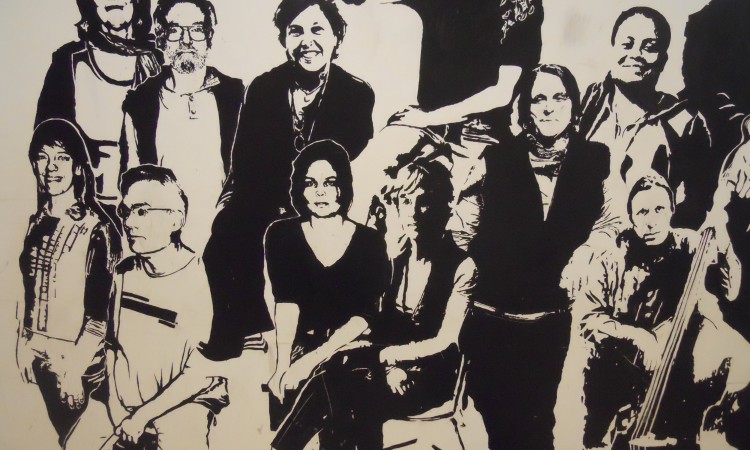
*The mural is by LACS students. The blue ox is the Blue ACS, symbol of the school.

Endings

What are helpful ways to bring the school year, or anything, to an end? How do you pull everything together so the year concludes on a high note and you don’t try to cram in too much and stress yourself and everyone else? One complaint I hear from students (about other classes, of course, not my own) is that by the second week of May they suddenly have too much to do and they claim no one prepared them for this.


And teachers, when preparing students for the standardized tests at the end of the year, can wonder if they did enough. They can be angry at the state for imposing new requirements; angry at the principal, a student or themselves when they feel they didn’t teach well or an issue remained unresolved. Stress arises whenever something lingers and you feel you can’t control or handle it.


While it might seem difficult, a teacher should begin the year by planning the end. Ask yourself, what do you want students to be able to do at the end of the year? What skills, knowledge, deep understandings do you think they should have? What standards must they meet? This is the backwards design process. Once you know where you’re going, you can develop a process for getting there—and let students know the plan. I encourage you to take a further step and have students help in the course design. Find out, once you have answered the above questions for yourself, what students want to know and think they need to know. By incorporating students into the course design, they will be better prepared. And engaged. Maybe part of the crisis mentality at the end of the year comes from students having distanced themselves from the class at the beginning.


In a good year, the end energizes me. I wake up to the fact that I have so little time left with the students. I want to give them whatever I can. Even if I am tired of all the effort teaching takes, I don’t mind so much. I pay closer attention. I feel the value of each moment. During the year, I sometimes resist the work; now I can’t.


Not being prepared for the ending can occur not only in school, but anywhere–when a relationship breaks up, or there’s a death, or you’re preparing for an event. It can seem a total surprise. It can feel like something was going on of which you were totally unaware. You feel that you weren’t paying attention. So one strategy is to pay attention, moment by moment. You don’t want to mourn for your own life.


Why don’t we pay attention? There are all sorts of reasons. Certainly, frequent use of multitasking with social and other media doesn’t help. Another reason might be that we never learned how to do it well. Attention training is not usually part of education. ‘Attention’ comes from the root ‘attendere’ which literally means to reach or stretch towards and can also mean mental focus, interest, and caring. Attention is not automatic; it requires energy. It is an active reaching out. We show we care with our attention. Students might not pay attention because they don’t care or they consciously or unconsciously resist the experience. And then, at the end, they might realize what they have lost and they panic. Or they get so used to panic and stress that they think they need it to get anything done.


So, it’s helpful to teach students about attention. Mindfulness can do this. With mindful focus, there is more clarity about what needs to be done and less stress about the year ending.


Also, people might stop paying attention to the end because it reminds them of the very fluid nature of the world. Change can be upsetting. Change means endings but is so much more than that. Taking a breath means change. Talking means moving lips, breath, thought. To know and learn is change. Fear arises when you cling to an end as if it continues and does not change. But even endings end. Change is just another way to say living, feeling, understanding. So, trust in the ability to know and feel the living world.


Take a moment. Let your eyes close, your body relax and your mind turn inwards. Have you ever just sat by a stream and watched the water pass by? Picture that stream, the water, the scene around it. Maybe there were trees nearby. Maybe there were rocks in the streambed around which the water streamed. Eddies were formed by these rocks. Some were small, some very large. Yet, the water continued on, adjusting. Maybe you could see the sunlight reflecting off the water, sparkling, like a jewel. Maybe you could feel a sense of comfort in looking at the stream as a whole and the scene around it. Just feel it. Isn’t there a sense of beauty in the whole? Notice that you can focus either on the constantly changing water, or the whole– the trees, the rocks, the streambed, the sky. The two perceptions, of the flowing water and the whole, support each other and you could go from one to the other fluidly. Now, just take in the scene and rest in it. If any thought comes, or feeling, let it be carried away in the stream and then return your mind to noticing the whole scene.


So, ending the year isn’t the problem. It is how we think about it. We all draw conclusions, about others, about the state of the world and, of course, about how our day, month, moment, or year went. We need to realize the nature of thought. Why do we have thoughts? What are they? When we think about how the year went, are we trying not only  to sum up a year but create an image of who we are? “The year went well; I am a good teacher. The year sucked. Do I suck?” We try to create a secure image of the past that can be projected into a secured future. But is any thought or abstraction of an event as encompassing as the event itself? Can we enjoy our memories without distorting them with judgments? Can we teach the importance of critical thinking and intellectual understanding, yet recognize that the world always exceeds our ideas about it? We need to hold our ideas more lightly and the world more intimately.


The value of reflection at the end is not only about what lessons have been learned, but about coming back to now. It is to view being in a classroom from a larger perspective. You are a human being living a life of which this school is just a part. The purpose of an ending is to bring you back to where you began: vulnerable, not knowing what will happen, but open to what occurs. In a class, that means that at the end of the year, reflect not only on what has been learned in school, but what being in this situation feels like right now. What do you feel about this new, unknown, ending, or beginning, and about going on with your life without the structure of this class? Always return to the reality of being a human being, in relation with others, now.


There Are Alternatives

I realized recently that there is a great irony in my blogs. For most of my adult life, I opposed what I thought was happening in public schools. Now, I am defending them.


In the early 1970s, after teaching for a year in a “normal” or traditional public school context, I taught in a private “free school” until it closed, largely because there wasn’t enough money to keep it going. In 1985, I started working in an alternative public school, which was then called the Alternative Community School. (The name was changed to The Lehman Alternative Community School or LACS after the original principal and founder, Dr. Dave Lehman, retired.) What is meant by a “free” or an alternative school is not always agreed upon or clear. Today, ‘alternative’ is often used to refer to schools for high needs or “underachieving” students. However, it has an older definition, influenced by the progressive movement of the late 19th, early 20th century, as providing something meaningfully different from the predominant model of a public school. I can think of five characteristics of this difference which many of these schools share.


First, alternative schools are small. The free school I worked in had 20-30 students. LACS had 185 students when I started teaching there; by the time I retired, it had grown to 310 students, largely due to school district pressures. Traditional public schools are larger, at their worst factory-like institutions where students face great pressure to conform and can easily feel lost. The high school I attended, although at the time was considered a fairly good school (especially for the white middle-class students), had over 6000 students. The alternative is a community of learning, where everyone in the school knows, by face and hopefully by name, everyone else. Teachers and students get to know each other comparatively well, which fosters empathy and support.


Secondly, following A. S. Neill, Alfie Kohn, John Holt and others, alternative schools focus more on intrinsic and not extrinsic motivation. People have a natural drive to learn, as learning is necessary for survival. So, alternative schools aim to develop in students this personal and natural motivation. Traditional schools often track students and use grades to rank student learning. By ranking and comparing students they create competition which motivates through fear and hope of reward while undermining or hiding away intrinsic motivation. LACS and other alternative schools do not track students and some replace grades with detailed, narrative evaluations which give students deeper and more personal feedback on their learning. They motivate by documenting growth—and demonstrating that what students do is seen and heard by teachers.


Intrinsic motivation is developed by incorporating student interests, concerns, identity, and ways of learning in both the content and methodology of instruction. So, thirdly, the curriculum is tied more to real life concerns and the student’s own authentic and personal questions. I think the label “free schools” was inspired by the “freedom schools” of the 1960s.  As far as I understand it, freedom schools arose as part of the civil rights and voting rights movements. For example, in Mississippi, during the summer of 1964, schools for citizenship were created. In order to change the socio-political system and awaken “the conscience of the nation,” students needed to learn how to think and communicate well. Alternative schools, inspired by this struggle, aim to create a curriculum that has real meaning for students, that teaches critical thinking and talks about issues like justice, rights and power.


Fourthly, alternative schools are democratic. Decision making is not limited to administrators but shared with the entire school community. In this way students learn how to speak their minds. They learn that what they do day by day, even outside the formal classroom, is part of the curriculum.


There’s a fifth characteristic that is not always stated. Education is not just about preparing for the future and getting and holding a job. It is about learning how to live and learn right now. It is about empathy, compassion and relating not only to others but to our world. There are depths to the human heart and mind that can neither be measured nor ignored and education must be about those depths.


So, why have I changed my attitude toward public schools?


To begin with, I was upset when I discovered that what I was hearing in the news about the state of public education was often inaccurate or lacking context. Public schools, instead of failing their students, are mostly doing the best job possible considering the economic and other realities they are facing.


Also, a democracy requires an educated citizenry. Privately owned schools, because of agendas other than the simple education of their students, cannot do this. Only a public system has a chance at creating a situation where all children have even a relatively equal chance to learn and succeed. It’s very debatable right now that we have either a functioning democracy or an educated citizenry—but without public schools, the situation would only get worse.


My last school was and is a public school. And it is only one of many. There are schools and coalitions such as the Coalition For Essential Schools spread through several areas of the nation providing an alternative.  They should be supported against “reforms” that could destroy them. Contrary to what “reformers” are saying about the state of education in the U. S., these schools are doing for children what schools should do for children. Despite frequent cuts in staffing over the years, these schools continue to show the enormous possibilities inherent in a public school. They are giving students what they need to grow up, develop their minds and hearts, and discover their gifts. As one LACS student put it: “The school took me in. I went from a situation where I was led by the hand– or tied by a rope to other students—to one where I could decide where to go and what to do.” By needing to make meaningful choices, he learned the responsibilities of choice. Stimulating classes gave him “enough to think about for the rest of my life.” He learned how to learn (and think and communicate) because the school became the context for his life, not something removed from his life. Learning was not just academics. It was about the reality of living.


It is schools such as these that not only should be defended but modeled.


*The mural of Rosa Parks was painted by LACS students.