We Are Dancing to Oppose a Dictator and Possibly Save Our Lives: The Price We’ll Pay If We Don’t, and the Wondrous Benefits to So Many If We Do

Imagine being in a room outlined with gray clouds and not clearly delineated walls. And inside, so many people, either in black tuxedos and white shirts, or pastel-colored dresses. A few, however, stood out with slightly sharper but still muted colors, some red and blue, others orange, like a sunrise, or purple like dusk. It felt a bit like a dance competition on a fantasy world.


But there was a challenge and a threat in the air. How much opposition would we show in the uniqueness or individuality of our dance steps? How much would we say to our partners or shout to the room?


The opposition was, of course, to DT and his regime. But nowhere was HIS name spoken or did HIS image appear. It was all unstated, forbidden, but everyone knew what was going on. We were dancing to oppose a dictator and possibly save our lives, despite at the same time knowing that anyone who stood out too much, anyone who seemed too “different,” and especially anyone who took the role of leader could be “disappeared.”


I was standing a bit on the sidelines, occasionally talking with people, mostly watching; and looking much younger than I am now. One person I was watching was this older person, in their 80s or 90s, dressed in what traditionally was a woman’s clothes, yet in a sharper red. And they were dancing like a pro, with moves so individual they were shockingly in opposition to conforming and surrendering one’s freedom. I began to wonder if she would soon collapse and be taken out on a stretcher or just disappeared. And crazily, unbelievably, I was beginning to imagine letting loose like that, and dancing in ways I’ve never danced before. Would I then be disappeared? Would my health deteriorate? Or maybe, it was exactly dancing that made me feel young?


It’s remarkable that I had this dream the night after deciding to write a blog about a president that is so crazily, dangerously set on building displays to his ego. Tolerating any opposition to his ideas or any differences at all, or any policy that benefited the nation but not his own power and financial situation, was unthinkable, forbidden.


ABC News recently published a list of people attacked for defying him. It includes Democrats, Republicans, his former cabinet members, etc. The article could also include all the election workers, victims of Epstein’s crimes, tv hosts and entertainers, reporters, judges, and so many others who spoke out against him; or women alleging sexual misconduct, former employees suing him for nonpayment of wages, etc..


And his war against Iran– when DT claims he has brilliantly brought it to a conclusion, remember that he started it to begin with for no clearly justifiable reason.  Did he start it imagining he’d be glorified and thinking he would bring regime change to Iran as quickly as he subdued Venezuela? Did he start it to destroy Iran’s missile stockpile, end their nuclear capacity, or to help his friend Netanyahu? Or maybe he did it to reap profits from the war? Maybe it was a crazed whim? Or maybe, as some have alleged, it was to distract the nation from the persistent, increasing reports about his possible participation in Jeffrey Epstein abuses and crimes? His rationalizations kept changing.


His treaty or memorandum of understanding to end the war, is just an agreement to search for an agreement. And does it improve the situation in the Middle East? In an article in the Atlantic, national security scholar Tom Nichols wrote, “it is clear that Trump has failed to achieve every one of the goals he put forward for this war of choice, and now he is determined to deliver America’s capitulation as quickly as possible.” Historian Heather Cox Richardson agrees with Nichols. Iran is battered but stronger while we are strategically worse off than before the war.


Although the fighting will hopefully stop, Iran is now under an even more extremist regime than before, even more strongly in the grip of the Islamic Revolutionary Guard Corps. The Strait of Hormuz will hopefully, sometime be opened– but it will be administered by Iran and they can shut it down at any time. They still have the capacity to sponsor terrorism– and we have spent billions, depleted weapons supplies, disrupted alliances, and lives have been lost not only of our soldiers but civilians in the Middle East. NPR reported the war has increased ‘disquiet’ in the military and worsened our ability to retain troops. Moody’s has calculated the war cost taxpayers $100 billion & counting.


In terms of Iran’s nuclear capacity, Iran promises not to develop nuclear weapons. Promises promises. But clearly, we are worse off than before 2018. It was in 2018 that DT tore up President Obama’s treaty of 2015, which had been successfully working to limit Iran. Even now, Iran is nowhere near developing the bomb.


Senator Cassidy, Republican from Louisiana, called the war the “Worst foreign policy blunder in decades.”…


*To read the ending of the post, please go to The Good Men Project. Thank you.
The Movement Has Begun in Earnest⎼ And Just in Time, I Hope

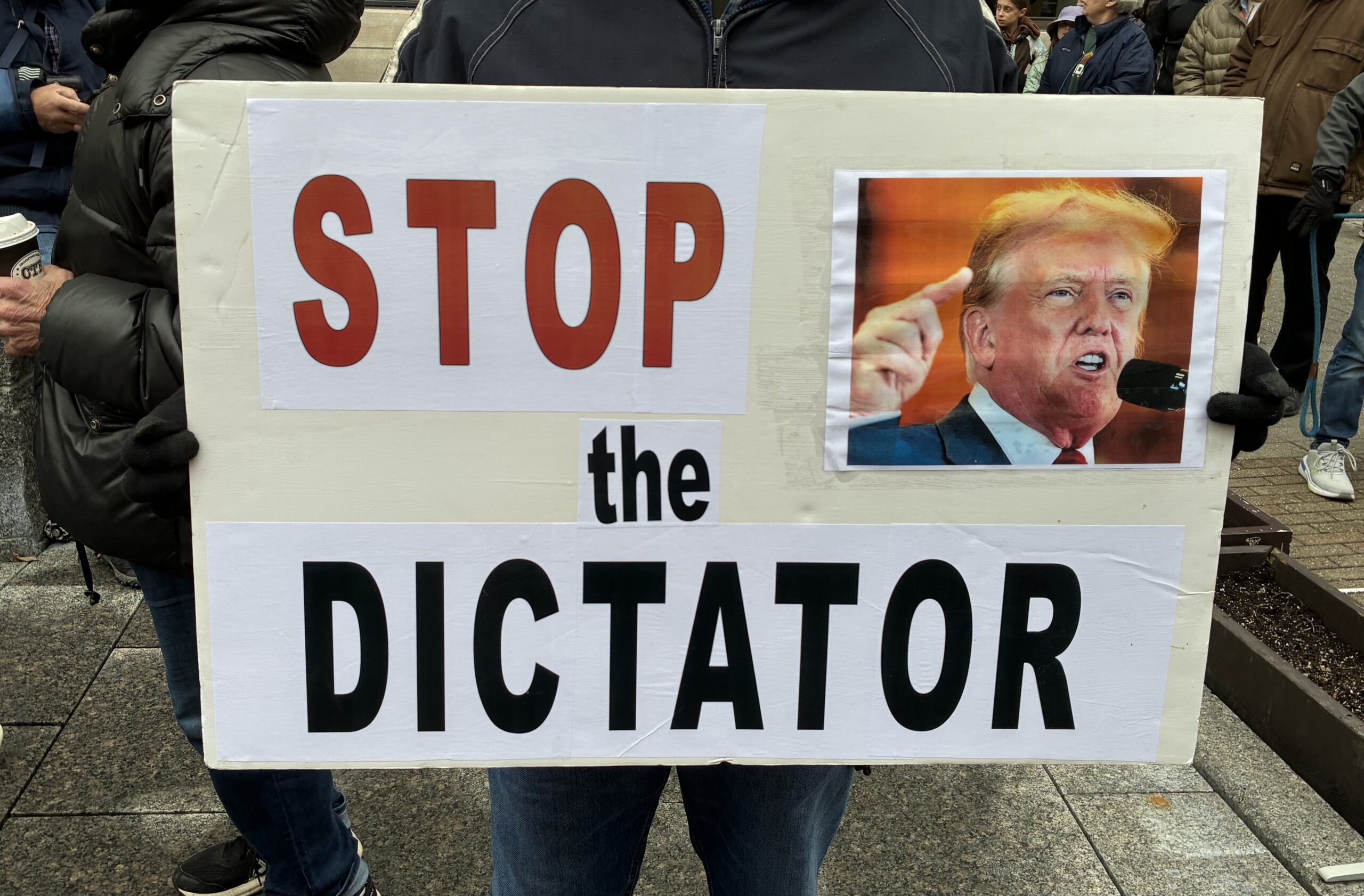
I joined maybe millions of others in over 1400 cities and towns across this nation in the Hands Off rally and march on Saturday, April 5th. It was both deadly serious and wonderful; a reminder of the terror we face and an awakening of the heart⎼ an awakening of a commitment to act. And an act of caring for ourselves, others, and our physical and social worlds.


It was deadly serious for obvious reasons and maybe some not so obvious. After about 40 minutes of speeches and songs, the rally became a march, from the downtown commons to a Community Center. It stopped at a busy intersection, where it became a “honk & wave” demonstration. So many cars honked to join in and support us, 50 times more than those that gave us a thumbs down. Many cars even had signs supporting ours.


At that point, I was with a good friend, standing on a busy street corner crowded with cars on the roads, and protestors for several blocks filling both sides of the sidewalks. I leaned in, giving a thumbs up to a car, and my friend grabbed me by my coat and pulled me back. He said you never know when someone opposed to our message might come by and try to push you into the street in front of cars.


The obvious reason of the deadly seriousness of the march, of course, was DT, EM, and their attacks on every aspect of our democracy, almost every aspect of life. They’ve attacked our rights to free speech, due process, voting; to health care, in the process destroying federal agencies and the lives of workers who’ve dedicated themselves to looking out for our health. They’ve fired, attacked, and  threatened anyone who speaks out against them or shares the truth about DOGE, illegal deportations, etc.


They’ve attacked our children in so many ways, but one major attack was the dismantling of the Education Department, making it more difficult for our future generations to get food, get the support many need, and receive a good education. They’re attacking our future economic security, dismantling Social Security.


They’ve increased tensions throughout the world, undermined our international standing and our national security in countless ways, from firing thousands from the defense and state departments, destroying the Voice of [Democratic] America, which formerly had enabled people in nations with censored media to get reliable facts. They cut USAID, threatening our influence over third world countries. DT even threatened to invade our closest allies, Canada and Greenland.


DT’s tariffs not only threaten American businesses and the pocketbooks of most of us but have started trade wars with allies! The tariffs undermine both our national security and our personal incomes. One reason for the tariffs is to pay for tax cuts for the rich and corporations. Such cuts lead to an increase in the concentration of wealth and power into fewer and fewer hands, and a loss of power for the majority. And it means the rest of us will have to cover more of the costs for government functions, for so many things, from repairing roads, to researching cures for illnesses, and protecting our food system from contamination and us from criminals and terrorists both foreign and domestic.


They’ve undermined our environment by dismantling whole sections of the EPA and transforming its mission from safeguarding the environment to increasing the huge profits corporations get from our natural resources, while destroying our heritage of forests, polluting land, air, and water. They’ve even removed bans on forever toxic chemicals.,,,


*To read the whole article, please go to The Good Men Project.

The Deeply Personal Can Reveal the Universal Patterns that Empower Us to Act: Curiosity & the Transformative Power of Awe

I so enjoy writing and reading about subjects and experiences that are deeply personal, or that bring me greater insight, more than ones about hate and inhumanity. And I don’t think this is just me; it feels clearly true for most of us. When there’s so much in the news about DT and his fear and hate-filled executive orders and pointless cruelty, I need to also discover and support what feeds my sense of love and demand for justice and humanity. But it’s an awareness of the deeply personal that strengthens this sense of ourselves, this sense of connection with others and this world of ours. And it’s this awareness that fuels our ability to face what is most difficult to face.


One experience and emotion that particularly feeds and strengthens this deeply personal strength in ourselves is awe. Awe brings together a need to feel and preserve our sense of beauty, love, and wonder so we can face the destructive and horrible around us, to face realistically our fear of hardship and death.


Our brains are hardwired to worry, to perceive negatives, threats first. And according to research from the Greater Good Science Center, there are good reasons for that. Our hunter-gatherer ancestors had to be aware of any danger that might emerge from the world around them and prioritized this awareness. But to do that, they had to be ready, open to search beyond themselves, so they could discover ever more about themselves and the world. They had to let go of what they thought they knew to accurately perceive what they hadn’t known. In other words, they had to be curious.


And part of curiosity is that feeling we have before a discovery, that sense of not-knowing, worry, anxiety, and possibly fear of what might be there. Science has shown that our reward centers of the brain, and dopamine, our happiness and reward neurotransmitter, is released not only when we get the pleasure, the goal, but when we seek it. And when we feel wonder, awe at what we notice, the memories of and ability to be curious, is strengthened.


What is awe? Dacher Keltner, researcher and Professor of Psychology, writes about this in his book Awe: The New Science of Everyday Wonder and How It Can Transform Your Life. One definition of awe that he gives us is “the feeling of being in the presence of something vast that transcends your current understanding.” It can transport us back in time or to a sound or aroma, or an epiphany that de-stabilizes our past understanding; that takes us out of our sense of being separate from everyone and everything else, and reveals the vastness around us, reveals an awareness of the mysteries of life.


Everything, every experience, says Keltner, originates in how our minds process information. Our emotions are those feeling states accompanied by thoughts, expressions, physiological responses which enable and direct our actions. When we’re locked into emotions about self-preservation or being selfish, feeling totally separate, this undermines our ability to adapt to present circumstances. Awe does the opposite. The sense of vastness, of something beyond ourselves integrates our scattered beliefs, and all the unknowns we experience, so we can create a thesis about the world, a deepened understanding of whatever we need to face….


*Please go to The Good Men Project and read the whole article.

This Is Our Moment: Giving Breath to the Government of, by, and for the People

Our problem is that we don’t believe it, or don’t want to believe it. It’s too incredible. We know it intellectually. We can see it and feel it. Every time DT’s face appears on the tv screen or we hear his voice we have a stress response. We feel our stomachs fall to the floor or we shout out curses involuntarily.


Or we hear numbers of new COVID-19 deaths or of states experiencing spikes of illness or disenfranchising voters or of the incredible concentration of wealth in the hands of the .1%. Or we hear the name of a brown or black person murdered by police and we get angry. We demonstrate. We make phone calls. Or we wonder⎼ what can we do?


Or we hear about a plot by white militias to kidnap, maybe murder, Gretchen Whitmer, a sitting Democratic Governor, attack police and incite a civil war. And what we don’t hear from the President and his party is outrage. Instead, DT tweets attacks on the threatened Governor. He supports the terrorists. Even though one of the terrorists called him a tyrant, it was DT who augmented and manipulated the extreme division in this country that helped incite their actions. And we wonder⎼ how can this be? It is too incredible. We have moved to a state called shock.


Democracy is a government of, by, and for the people, and must be about maintaining a quality of relationship amongst all its members. We must recognize the need for a diversity of viewpoints and the rights of others, and all can, must take part.


But politics, like any competition, can become, like Mao Zedong said, war without bloodshed. Right now, one group is trying to divide the nation into two exclusive and conflicting sides. One group is trying to remove the restraints on violence, not only to frighten both sides but to stroke the flames of frustration, fear, and enmity into murdering democracy itself. They are trying to set the constitution in flames. They are not trying to win an election but to eliminate them.


They are trying to make us feel that ‘order’, and the ‘rule of law’ are impossible, mere dreams, and the words are meaningless sounds, by calling themselves the law and order party or their leader, the “law and order President”.  They are the enemies of the rule of law. For them, ‘order’ or ‘rule of law’ is twisted to mean rule by one side, one person, only. For them, the only time there will be peace is when all opposition is terminated, all diversity of viewpoint has ceased. …


To read the whole post, go to the Good Men Project.


Happy Holidays! A Time to Remember That What We Need Can Be Fought For and Won

As many people do, I have almost always looked forward to the holidays. When I was a child, I looked forward to gifts. As a student and teacher, I looked forward to a vacation from school. For most of my life, I looked forward to getting together with family and friends. However, there were years in college and as a teenager that I dreaded the holidays, especially the New Year, if I didn’t have a party to go to or a date.


The holidays have become so commercial that many now dread them. This commercialization is characteristic of our contemporary culture and it buries the deeper meaning of such moments in time. My wife and I ignore gift-giving for ourselves. The only gift we give each other is our presence.But for the children we know and charities⎼ that is a different story.


The holidays could be so rich. Hanukah is a festival of light and freedom. Kwanzaa of family, community, and culture. Christmas of joy in the birth of Jesus. So many holidays.


Humans have celebrated the winter holidays possibly forever. The time is obviously near the solstice and the longest reign of night, at least in the Northern hemisphere where I live. For us northerners, it is the darkest and coldest time. It is traditionally a time to engage in rituals to assure that the sun will come again, that spring will follow winter, renewal follow hibernation, warmth follow cold.


Many holidays have this sacred dimension or shadow that connects us to a depth of history. This history is not just about days of religious significance. These holidays provide workers a break from intense labor. They signify a recognition of shared humanity, however dim that recognition often was in the past and might be so again today.


Every one of us needs time to rest and connect with others. Every one of us needs time to step back and contemplate why we are here on this earth, to renew our selves, our relationships with fellow humans and the earth that sustains us. The fact that we have days of rest is beyond a right; it is a sacred necessity.


Americans, as well as people from most nations, fought in the past for a five-day workweek. They fought against those who would oppress them and were successful. But today, the GOP are giving to the rich and taking from most of us, so we need to fight this same battle once again.


This year, everything is both normal, like always, and yet totally different from any other time. Never have Americans had a President who has threatened so many of our values and institutions, and who brings with him the possibility of a truly frightening future. Yet, day follows night. We wake from sleep. Many things continue as they have.


Much is changing; much is staying relatively the same. It is time to determine exactly what, on the level of our daily lives, might benefit from a change. For many of us, it might be finding ways, each day, we can integrate opposing the President and his cabinet and working for justice and democracy. Or there might be local issues that drive us. We might dedicate ourselves to improving our understanding of history and ourselves.


This time of ritually facing the darkest time of year might remind us that in some ways, this is what nature calls to us to do, to face the darkness so the light will come again.


Have a great holiday season and New Year. Renew, enjoy, and celebrate with friends and family. It is something we all need, deserve, and share. It is a reminder that we do share so much, and that what we need can be fought for and won.

The Boy Who Thought He Was The Messiah

A story I wrote several years ago:

I was in the third grade when I first thought I might be the Messiah. This was back in the fifties and I was attending one of those elementary schools in Queens, New York that had no name, only a number, PS 46 or 192 or 238. It was the usual type of building, red brick with bars on the windows.


The thought came to me soon after an incident in the morning assembly. The principal, like usual, had walked onto the stage at eighty thirty a. m., flanked by two of the oldest teachers in the school, and told us all to bow our heads as he got ready to read us a prayer. This was before the Supreme Court had outlawed this sort of bowing in schools.


Seated in the audience, I remembered being told in Hebrew School that Jewish people do not bow their heads, at all, to anyone, except in G-d’s own house and to Him only. Bowing outside of G-d’s house would be to acknowledge a god other than the Almighty.


Back then I thought of Him in a very spatial way. He was The Man Upstairs, looking down on us all. And even though I had never met Him, at least not face-to-face, I clearly wanted no trouble with Him. Sure, I was very curious. I mean, He was quite a celebrity and I wanted to know all the details about Him, like what He looked like and if He held a grudge.


But none of the answers I was given made any sense. The adults that I talked with obviously knew no more about Him than I did. So, I wouldn’t bow my head. My unbowed head attracted attention. I was taken to the principal’s office and my parents were called.


I remember sitting outside his office. The halls were empty, as everyone else was still in the assembly. Despite the isolation, I felt safe, because wasn’t G-d who inhabits the heavens and created the universe larger than a principal who inhabits a dusty eight by ten office? The principal was physical, someone I could touch and see, but who could touch G-d? Who could see eternity? My math teacher couldn’t even define ‘eternity.’ And especially to the limited view of an eight year old, this principal could be defined quite easily.


As students and teachers began to crash through the halls to their classrooms, his secretary rushed me into the principal’s office. The move was so abrupt as to be almost violent, and I began to wonder what it was about my action that had brought this on.


For a moment I faced doubt. My knees began to shake. I felt I was walking a tightrope of mind, stretched between what I assumed to be Heaven and what I feared to be Hell.


Then the principal entered. He tried to look angry and severe but it was too difficult a job for him. Confusion seemed more appropriate. “How could this eight year old boy,” he must have been thinking, “defy my authority, defy my whole idea of what should be happening, defy my whole notion of God?” He didn’t realize that we were talking of two different deities, his and mine. His, I could defy quite easily. But not mine, not the Almighty, Blessed Be He. He was Christian and I was Jewish and I would not let my religion be placed second to any other.


I must admit that the whole incident might have arisen from my looking around for something to act up about. You know how life is; it just goes by, day by day, and we read about exciting and courageous deeds that other people do but we don’t see them, not often, not first hand. And to live one? To live a heroic moment, to live as the Hero of G-d—how could I give up the opportunity?


That was what I thought I was doing—I was acting like the Hero of G-d. The principal had said, “Bow your head,” and I thought, “This prayer is not a Jewish prayer, so why bow my head?” And I realized, “This is it.” This is my chance to stand up next to my G-d, who had been wronged throughout much of history. The G-d who was mistakenly blamed for the death of Christ and who the Nazis had attempted to exterminate. This G-d I would not abandon. So, I proudly kept my head up and one of the teachers—all I can remember is that it was a female teacher—told me to lower my head and I said, “No, “ and she said, “Come with me,” and I went.


When my parents entered the office I didn’t know what to expect. Of course, they, too, were Jewish. The principal, seated behind his desk with us facing him, had my father and me sit in children’s chairs. There was only one other adult sized chair and my mother got that one. And the principal asked me why I wouldn’t bow my head, and I told him of G-d’s commandment. I told him I was Jewish and the prayer he had used was not a Jewish prayer. He said that the prayer was non-denominational, whatever that meant.


And my parents—I wasn’t sure of their response. I feared they’d feel ashamed or afraid. My father had been called all the way from work and he hadn’t even been told on the phone what had gone on. All he knew was that I had supposedly committed some awful act. The principal then gave his side of the story and I waited anxiously for my parent’s response. Would they be angry with me? Would they be meek before this thief of G-d? Then my father, I will never forget his response because for some reason I never expected it—my father said that I was right. I had done the right thing. He agreed with me against the authority. It was one of those moments that you want to live over and over. I jumped up, laughing, and what could the principal do in the face of this family unity but let us all go.


In the aftermath, I guess I expected that my parents would then share with me their own stories of being picked out for being Jewish. However, despite my new heroic status, this did not occur. Sure, I could feel something of what they felt. For some reason they wanted to hide their religion. It wasn’t until almost fifteen years later that my mother told me that all through my early school years, whenever she rode the local bus, she had been forced by the stares and comments of our Catholic neighbors to ride at the back of the bus, where none of them would sit. She told me about disturbing phone calls and there were other things she would never verbalize. She hardly felt like a hero before anybody.


To tell the truth, I didn’t feel like a hero for very long. I didn’t want to feel different because of my religion or any reason.


One day, soon after the incident in the morning assembly, I was lying on my bed at home, staring up at the eggshell colored ceiling. And I began to ask myself all these questions. In the past, when I thought of my Jewishness, I thought of Passover and the miraculous escape from Egypt. But on this day, I thought of the none-escape, of Nazis Germany and the Holocaust, and a gigantic hole opened up in me, a tremendous longing. How could this be?


I had trouble understanding any injustice, my brother getting away with hitting me, the bullies in the schoolyard, homeless people on the street—but this? Maybe this explains my nightmares about those years. If G-d could save the ancient Hebrews from the Egyptians, then where was He when the Nazis tried to exterminate the Chosen People? Had they, we, sinned so awfully, so disastrously, that G-d was punishing us? I had heard that He could be vengeful, but wasn’t this taking vengeance a bit too far? And to allow hatred to win over good for so long, I couldn’t accept that. What did you do, Oh Lord? Have You seen too much? Have You run away and left us to correct the mistakes that You yourself had made? Are we now ugly before Thee?


How could I possibly think of myself as a hero before G-d? How could my act or any act correct this hurt that is so deep even the earth itself must have felt it?


And then I knew—someone had to come and save the world. I mean, it was clear to even my eight-year-old eyes that the world needed help. Someone had to do it. The fact that all of us had a hand in the problems of the world was not something I could then grasp. One person was needed, and if not me, who? Was not this the only way to be a hero, to be the Messiah? Was this what I had to be?


Then I thought about my dog. You know how the mind can jump around and make unusual juxtapositions? This idea just came out of nowhere—or so it seemed. I remembered that when I was walking my dog, a beautiful Irish setter, I felt closest to G-d. That might sound funny, but truth is like that; it’s funny sometimes.


Anyway, I usually walked my dog in the woods that bordered the golf course that was only a block from my home. At some point in the walk the dog and I would take off and run as fast as we could. As we ran together I would feel this sense of freedom, joy and companionship. The wind, the pull of the leash, the letting go, was all that I felt.


And when we stopped, with nothing on my mind but finding a nice place for my dog to shit, a sense of quiet would settle over me. The world would stop. Any tension that I carried, especially on my face, would melt away like butter left out of the refrigerator on a hot day, and a new face, one that I hardly knew, would take its place. I’d have what could only be described as a sense of gratitude. And in that gratitude, I thought, was a communion with the G-d of the Chosen People. In that moment I was not forsaken.


As I lay in my bed, an eight-year-old boy lying in bed staring up at an eggshell colored ceiling, I wondered if that communion that I had felt signified that I was the one. That I, sometime in my life, would unconditionally and without doubt be touched by G-d’s hand. And the weight of the world would be mine.


Of course, my shoulders have been slumped ever since. And even now, over sixty years later—even though it’s clear to me that no one could ever be the hero I once expected myself to be—I still wonder if G-d, in that unconditional way, would (or did) ever touch


This story was originally published by Heart And Humanity magazine.