
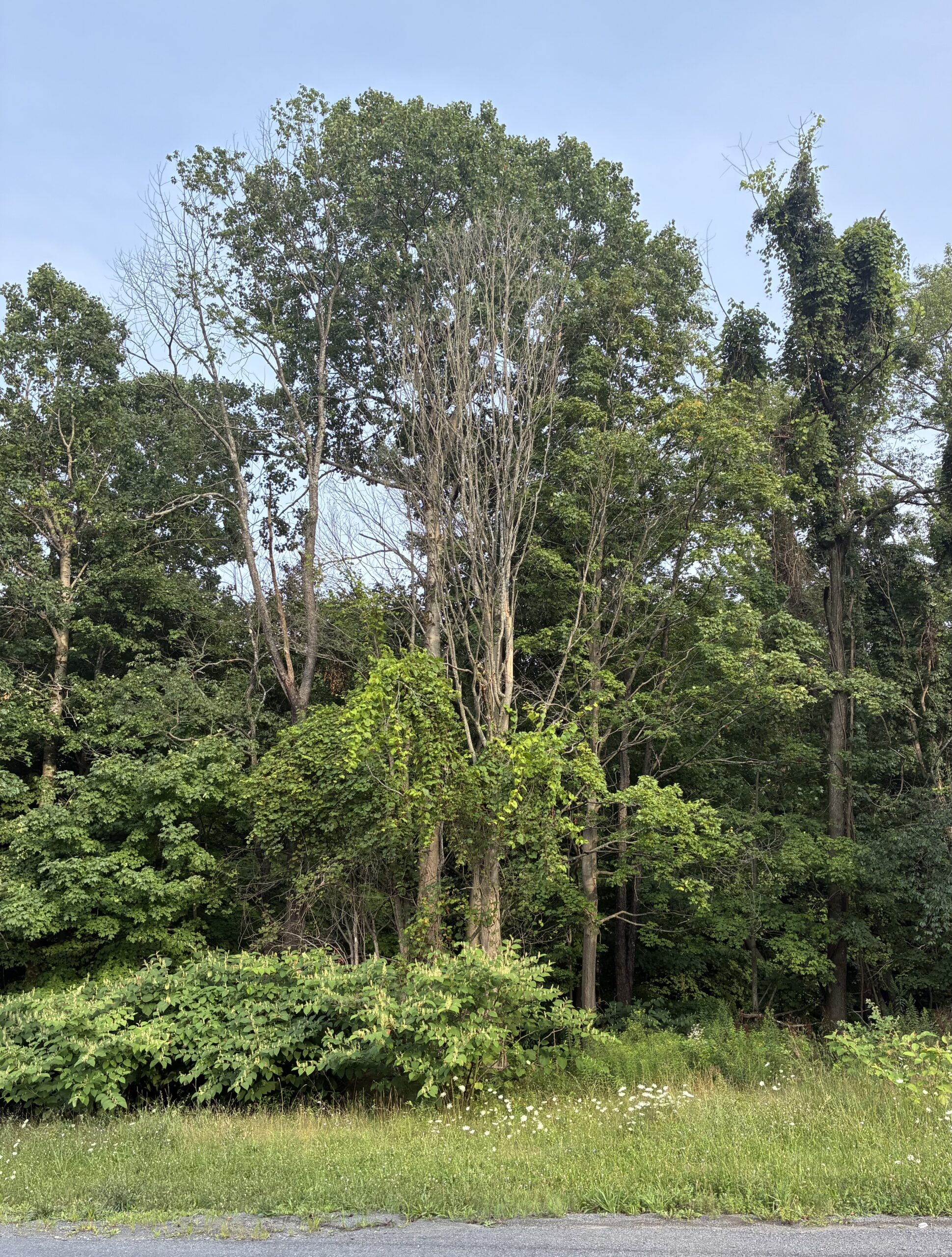

I was recently walking down my rural road. It was a quiet afternoon, mostly sunny and in the 80s. About a half mile from home, on the edge of a forest, the road turned sharply. When I reached the turn, it was suddenly windy. The tree leaves were shaking. The energy was the same as what precedes a rainstorm. But there were no clouds. And as soon as I walked 5 or 10 feet past this group of trees, the leaves were quiet.
I realized I had noticed the wind that inhabits this space many times before. And this was, as I said, especially true minutes or maybe hours before a rainstorm, when the leaves and trees in this curve in the road vibrated. It served as a semaphore or audiphore, a warning system, to turn back before the rains came. Why did the wind speak like this? Did it have to do with a change in air pressure caused by the road turning and butting against the forest? Or something else? It felt like the spot had a life of its own and could speak on its own. But somehow, before now, I hadn’t grasped anything of what was being said.
Life can give us so much, but we miss a great deal of it. In a way, our senses exist both to notice and ignore, to sense as well as filter what we perceive. The research psychologist and professor Dr. Robert Ornstein talks about the senses as “data-reduction systems.” He points out if we took in everything, if we became conscious of everything going on around us at any point in time, we’d be overwhelmed. It would be too much stimulation.
Ornstein quotes the 19th century philosopher and physician, often called the “father of American psychology,” William James as saying the mind acts like a sculptor. Out of the raw and swarming chaos around us we, through cumulative choices and with the help of our ancestors, our culture, and linguistic systems, we select this and reject that. We create the world we live in and feel. We’re also taught or conditioned to accept this and deny that. What we consciously perceive greatly depends on what we’re taught to see, what we expect and pay attention to, and what we value. Other minds create other worlds.
We also depend, of course, on what nature gives us. For example, our eyes can perceive only a tiny fraction of available light. The possibly visible light in the electromagnetic spectrum is so wide, ranging in wavelength from “less than one billionth of a meter to more than a thousand meters,” says Ornstein. But the human eye can detect only a tiny part of that, only 400-700 billionths of a meter.
For humans, ultraviolet light is barely perceptible. Ed Yong, in his wonderful book An Immense World: How Animal Senses Reveal the Hidden Realms Around Us, says ultraviolet is “an invisible hue just on the edge of our vision—a perceptual void that our imaginations are keen to fill.” But to bees, some fish as well as reindeer, dogs, cats, etc. UV signals are common.
So, thinking of our eyes as only windows to the world is a limited metaphor. We’re not merely windows; we’re not, as some would say, merely mechanical processes. And we’re not separate from the world we sculpt. How we think about reality strongly influences our ability to act in it. How we think about our ability to make choices influences how well and what we choose. This is so crucial to recognize. If we think we have no role, we create a world in which we’re powerless. Getting us to think we’re powerless in shaping what we see is a belief propagated by autocrats to enable them to control us….
*To read the whole article, please click on this link to The Good Men Project.

