
Caring for the One and Only World We Inhabit: A Community of Hope and Action

When we’re attacked, or the material supports of our lives are threatened, we might turn inward. We might do this not to bring light to our inner life but to shield our whole being. To hide from the attacker. To distance us from fear and pain.


We all need to turn inward sometimes for this, for self-reflection, to be present, to find peace. And to put aside memories, hurts, and traumas. But a fear and threat festers when left for too long inside us. When the time is right, taking action to break that impulse to hide, and instead to reach out to others, to learn more and fight back feels vivifying. It enriches. It might also save our lives. When we act to right a wrong, act to diminish pain and suffering, this can strengthen us, change us.


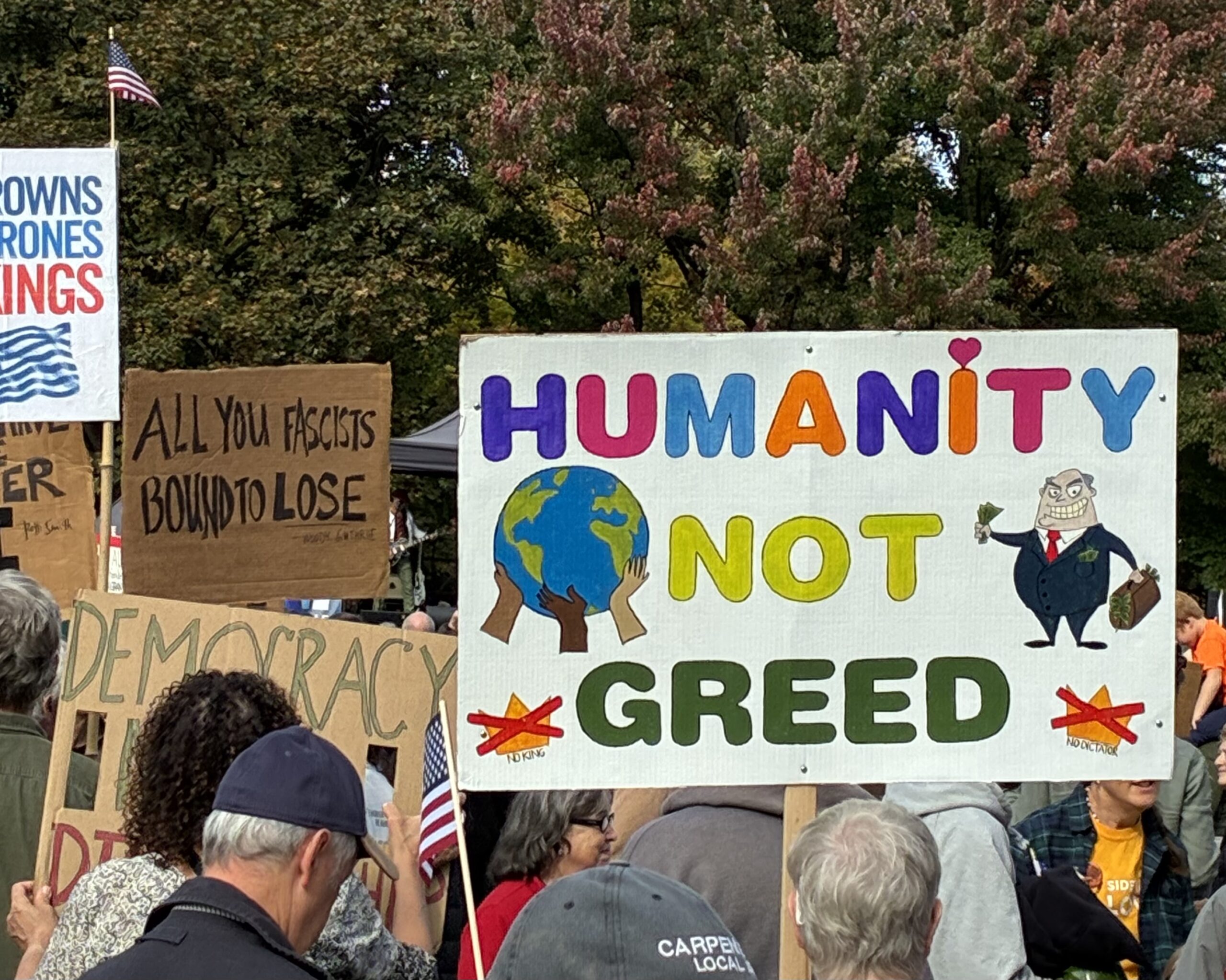
Saturday, 10/18/25, was such an action. The NO KINGS RALLY was a day to remember. One of the largest single days of protest in American history. Not just because almost 7 million of us in 2,600 locations, cities, towns spoke out against this administration’s outright corruption, suppression of the law, brazen infliction of cruelty and inhumanity. But because we the people acted on this day in a manner in stark contrast to DT and his Congressional sycophants. We acted peacefully. We acted lawfully. We acted joyfully. We acted patriotically, to protect the nation from a would-be King, Dictator. We spoke the truth.


They lied and said we hated America. But the rally showed something very different: exorbitant love. For the constitution. For the laws that DT blatantly ignores and undermines. For many brown and black Americans and so many others that DT and his ICE agents are abusing, detaining, jailing, deporting. For this earth that makes our life possible. For each other. As reported, with a bit of irony, in the internet news source The Feed, nothing says we hate America more than defending the constitution and exercising first Amendment rights. “No Kings” is literally the founding principle of this nation.


My wife and I were a few minutes late. As we walked to the rally site there were so many people on the sidewalk with us, with signs, and going in the same direction as we were. A few were turning toward a main road to share their signs with motorists. When we arrived, we listened to speakers talk about abuses of power, military and para-military agents turned against their own fellow citizens⎼ acts many in the military say they did not sign up for and deplore.  We heard talks about the impacts of firing of thousands of government workers. Heard the facts about how DT’s tariffs, and destroying the lives of working immigrants are raising the costs of living for all of us.  Heard how his super awful legislation is undermining our health. Heard how money approved by Congress for MEDICAID, for medical and scientific research is now going to the super-rich.


The people around us were neighbors and friends. Coworkers. Former students. Shopkeepers. A carpenter who worked on our house. A doctor who treated us. People smiled at us. We enjoyed the clever creativity of the signs people held. We felt empathy for the hurt that so many here and elsewhere have experienced at the hands of DT’s administration of cruelty. This is our home.


DT inflicts fear on the nation, hate and vengeance against anyone who speaks against him.  He attempts to make us feel isolated and powerless, that we have no future but the nightmare he’s creating….


*To read the whole article, please go to The Good Ken Project.
Science & Democracy: Anaximander and Opening the Mind Replacing a Myth of What Was with Expanding Our Understanding of What Could Be

A few years ago, I wrote an article asking Is Uncertainty A Blessing or a Curse, Or Both? It was based on a book by theoretical physicist Carlo Rovelli. As a result of the article, Dr. Rovelli’s publisher sent me a copy of his new book, Anaximander and the Birth of Science. This new book is as well written and intriguing as the first one I read years ago. It’s also as relevant as the older book was to this frightening moment in history that we are facing.


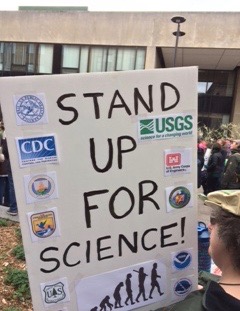
Rovelli defines science, in the introduction, as “the passionate search for ever newer ways to conceive the world.” Its strength is thus based not in what we’re certain of, but in a “radical awareness” of our ignorance, of recognizing that what we don’t know is vast. Thus, it’s fluid and constantly pushes us to learn more and more. And it constantly moves to overthrow the old ways that we ordered our world and move us into something new, something ever deeper and more comprehensive.


And one aspect of the threat we face today is the emphasis on certainty. To emphasize certainty in the face of a universe that’s continually changing and evolving is to deny and even hide reality. It’s to cling to the ideas, images, illusions we held of the past in order to pretend we can manufacture a future that fits those created illusions. It means to undermine learning itself in favor of indoctrination. It’s to fight for dominance for one person or group over the many; to fight for total centralized control of information, resources, and power instead of a de-centralized, interdependent, democratic sharing of perspectives, information, resources, and power. In other words, science and democracy are linked together.


Anaximander lived in a place and time where both political and mental realms were opening up, where gaps were emerging in the sources and institutions of both political power and intellectual ideas and belief. He was born in Miletus, a Greek city-state on the Ionian or Turkish coast, in 610 BCE. Athens was just beginning to grow in power. The Odyssey and The Iliad had been composed two centuries earlier.  Solon, the creator of the first constitution to incorporate democratic ideas, had just been born. And about 200 years later, we have Sophocles, Sappho, and Plato and the Golden Age of Greece.


Miletus was close to Mesopotamia, Egypt, the Black Sea, and traded with a good portion of the rest of the world. The city thrived from the introduction of ideas and products from all these different areas. Rovelli discusses how civilizations flourish when they mingle; they decline in isolation. So called cultural “purity’ closes off new ideas and understandings.


His was a time of secularization, where the religious or spiritual realms were not controlled by a church or religious institution. Where the ideas of the ancients, of the past, were not given divine and unquestioned status. The Homeric gods were neither fully credible nor majestic, but full of faults as well as powers. Miletus itself was an independent city-state in a league of cities where no one entity dominated the others. It was called the Ionian League, and it met in a Parliament, maybe the first in history.


Writing was no longer the exclusive domain of the religious elite and rulers, or to scribes, priests, and aristocrats. It was possibly the first time in history written accumulated knowledge and study were accessible to many, both to learn⎼ and to question, criticize, and debate. A large class of citizens could discuss not only intellectual issues but how to apportion power and make decisions critical to the lives of the community. And it was assumed that knowledge and truth best emerge from allowing criticism⎼ of established ideas as well as new understandings. And where open discussion replaced absolute belief. The same held true in social and political matters. Democracy in intellect and belief mirrored democracy in politics.


Of course, this didn’t last….


*To read the whole piece, please go to The Good Men Project.